
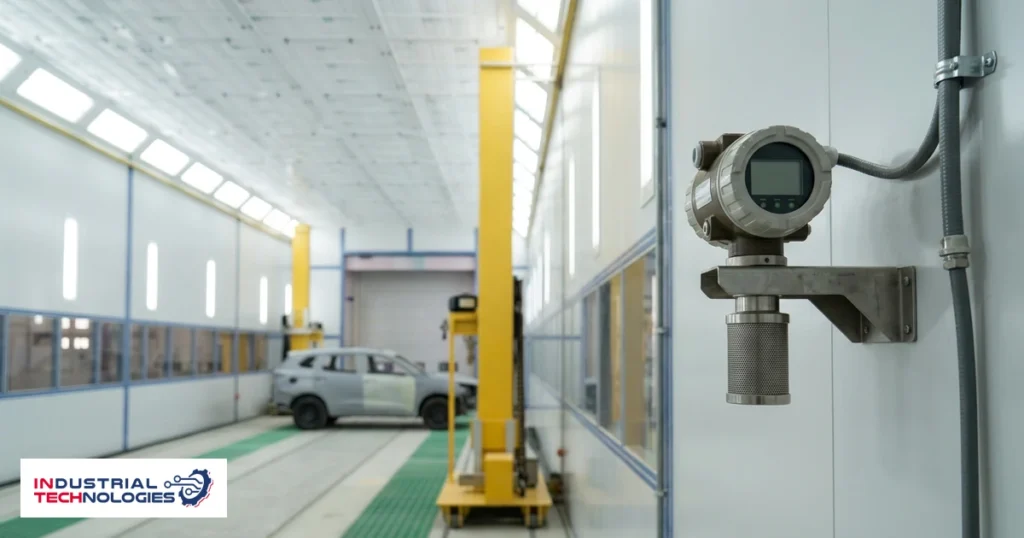
Two items appear in large-chamber specifications and not in an automotive booth specification: gas monitoring and static discharge. Reading that difference as simply a higher grade of equipment misses why they are there.
Spray booth gas monitoring appears past a certain volume because a large enclosure changes the concentration equation itself, not because the specification has become grander.
Why volume changes the equation
In an automotive cabin at 6900×4000×2650 mm, flow can renew air evenly across the whole volume. In a chamber reaching 24,000×20,000×6,000 mm, regions appear where the renewal rate differs from elsewhere by distance alone.
That is not solved by raising flow on its own — and the published range reaches 190,000 m³/h per set. It is solved by knowing what the concentration actually is in the regions that matter to you, which is what monitoring does.
Static discharge is a standalone item
Static charge accumulates on a large metal surface during spraying, and it accumulates on high-velocity air paths as well. In a volume carrying solvent vapour, that charge is a safety item in its own right rather than an annex to ventilation.
So static discharge is included as a separate specification line in large-structure builds, alongside filtration and the heating system.
| Item | Why it appears here specifically |
|---|---|
| Gas monitoring | Volume makes concentration uneven by distance alone |
| Static discharge | Large metal surfaces and air paths accumulate charge |
| Three-stage bag and high-efficiency filtration at ≥98% | Acceptance requirements in strictly accredited sectors |
| Powered door to 14,200×5,000 mm | An opening that size is not hand-operated |
Safety and acceptance meet here
In aerospace, marine and rail, acceptance depends on repeating a result and documenting it. Monitoring serves both ends: it protects the operator, and it produces a record that can be referred back to — which accrediting bodies typically ask for.
Discussing monitoring purely as a cost line therefore misses half its value. The same item feeds the acceptance file that will be requested later.
Local requirements
Ventilation and fire requirements for large spray chambers differ from those for a workshop booth, and they differ again by city and facility location within the Kingdom. Disposal of paint, solvent and stripping waste under the applicable environmental rules sits alongside them.
We meet the regulatory requirements applicable to each project, and the certificates and approvals required are supplied on request. SASO conformity for imported equipment applies in all cases.
Frequently asked questions
Is monitoring mandatory in every chamber?
No. It is included in large-structure builds and in sectors with strict acceptance requirements. A standard automotive cabin does not normally carry it, and its safety case is covered by ventilation, filtration and the applicable requirements.
How does monitoring relate to air capacity?
Monitoring measures the outcome; flow produces it. Raising flow without monitoring means assuming the result; monitoring without adequate flow means measuring a problem you are not solving. The two are read together.
Does static discharge need routine maintenance?
Yes, like any functional item in the chamber. It goes into the maintenance schedule alongside filtration and the burner, and it is checked during commissioning at handover.
When should I raise these two items with a supplier?
With the configuration rather than after it. Both affect services routing and electrical load and the commissioning sequence, and adding them after design costs more than including them in it.
Related reading
What to do next
Send the chamber size you need, your finishing material and your facility’s acceptance requirements, and we will return a safety configuration built on your project. talk to a specialist. Sector detail is on the aerospace, marine and rail industry page.