
A service workshop is measured by the cars that leave it, not the technicians in it
We equip the bay, end to end.
A workshop waiting for a free lift loses billable hours every single day, and a car that comes back twice for the same fault costs you more than the part: it costs you the customer. The bottleneck is rarely the technicians — it is how many service bays you have, how they are laid out, and what diagnostic gear sits in them.
Operational challenges
What stalls production in this sector
Five bottlenecks that recur in Saudi service workshops.
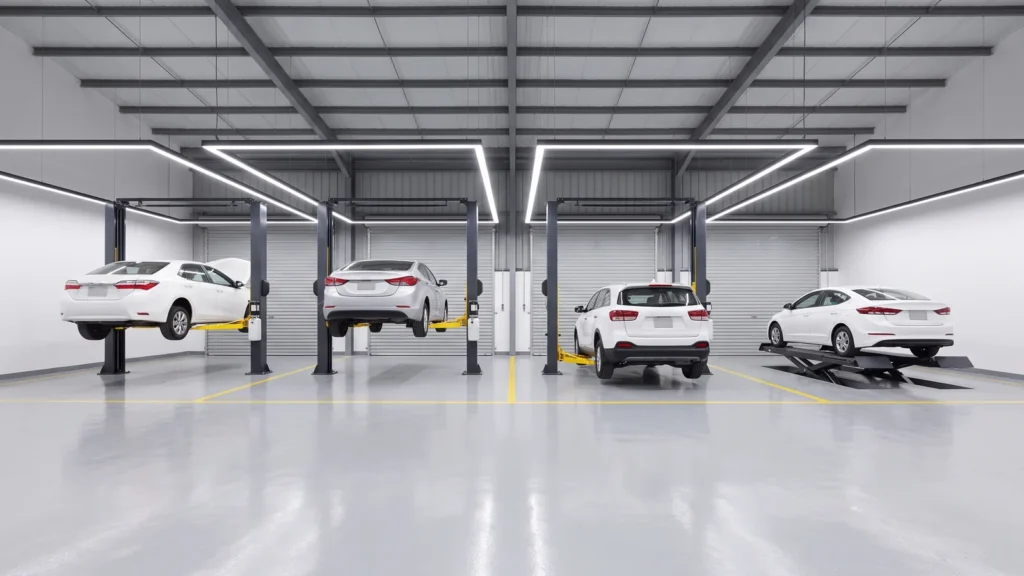
The service bay is your real throughput ceiling
How many cars you turn in a day is set by how many lifts you have and how long each one stays occupied — not by headcount. A shop with four lifts and six technicians turns the same work as one with four lifts and four technicians; the difference is spent waiting.
Ceiling height and floor slab decide which lift is even possible
Many leased workshops in Saudi cities have low ceilings or floor slabs that cannot take a two-post anchor. Choosing a lift is a site decision before it is a spec decision, and a low-rise scissor lift is sometimes the only thing that will physically work.
Heat and dust wear equipment faster than its rated cycle
Long summers and airborne dust shorten the life of filters, seals and hydraulics. Equipment bought to a European spec without climate adaptation runs for two years, then starts failing — and the cost shows up as downtime, not on the purchase invoice.
Modern vehicles can no longer be diagnosed by experience alone
Driver-assist systems, vehicle networks and EVs have changed what a fault looks like. A workshop without an up-to-date scan tool fixes what it can see and hands back the car with the fault it could not see — then pays for the comeback twice.
Licensing asks about ventilation and safety before it asks about equipment
Professional workshop requirements cover ventilation, cooling, lighting and waste handling, plus SASO conformity for imported equipment. A fit-out that ignores them gets rebuilt after installation, at the owner’s expense.
Our approach
How each challenge is addressed
At the level of approach and configuration — before any product is named.
We start from the number of service bays, not from an equipment list. We work out how many bays your current and two-year volume needs, then place lifts so that inbound and outbound vehicle paths do not cross inside the hall.
We measure the site before recommending a lift. Clear ceiling height, slab thickness, available voltage and air pressure — four numbers decide which lift family fits you: two-post, low-rise scissor, or platform. We tell you before the purchase, not after.
Climate adaptation is a line in the spec, not an optional extra. Filtration, replacement schedules and component protection are discussed with every quote, because the cost of dust and heat shows up as downtime, not on the first invoice.
Diagnostics and calibration are planned with the rest of the shop. Scan tools and an ADAS calibration platform need dedicated floor space, lighting and a level surface. Parking them in a leftover corner after fit-out turns calibration into a step that gets postponed, not a delivery step.
Recommended equipment
Configurations that serve this sector
Listed as we actually supply them — nothing appears here unless we serve this sector with it.
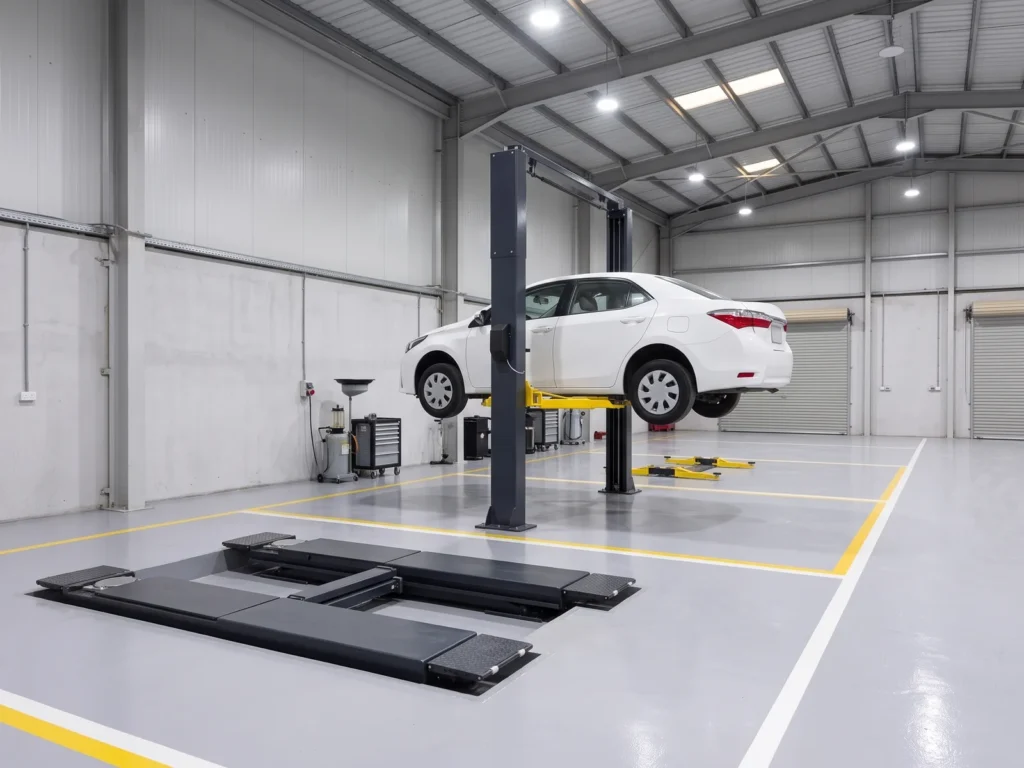
Vehicle Lifts & Lifting Equipment
The backbone of the bay: two-post for general service, low-rise scissor where ceiling or slab rules out anchoring.
1,200–4,500 kg capacity · 600–1,999 mm lift height · 2.2–3 kW Family details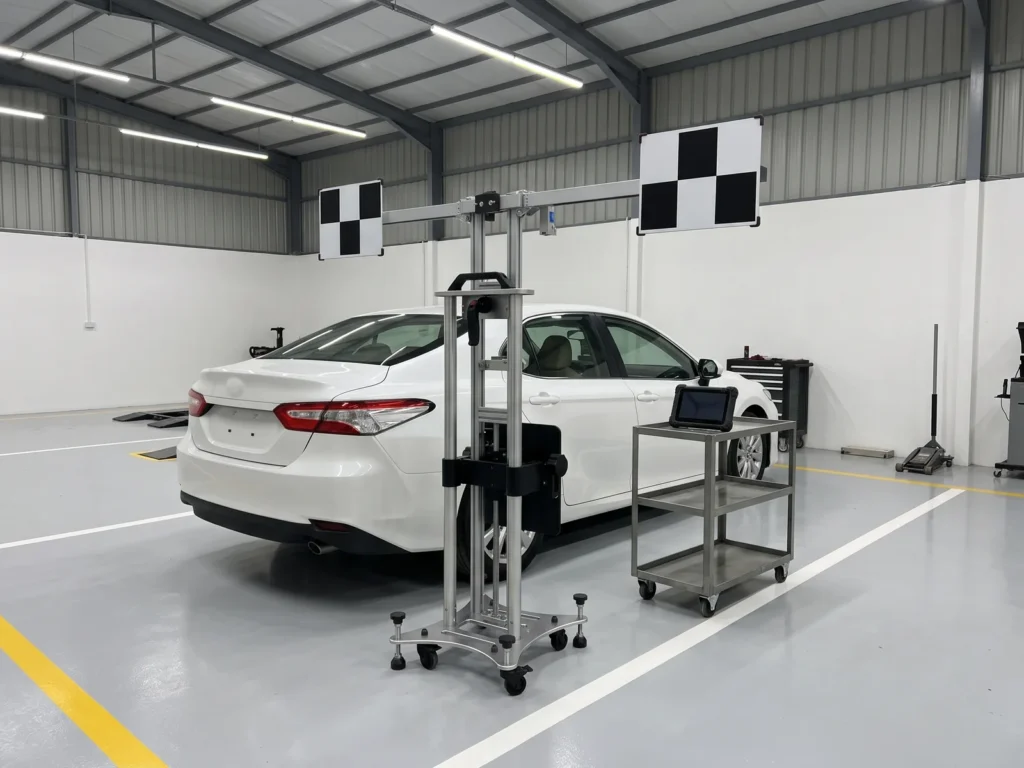
General Workshop Equipment & Tooling
Fault diagnosis tools, an ADAS calibration platform and general shop tooling — including ADAS PRO.
Scan and programming for 1996-onward vehicles (MS906 MAX) · ADAS PRO calibration Family details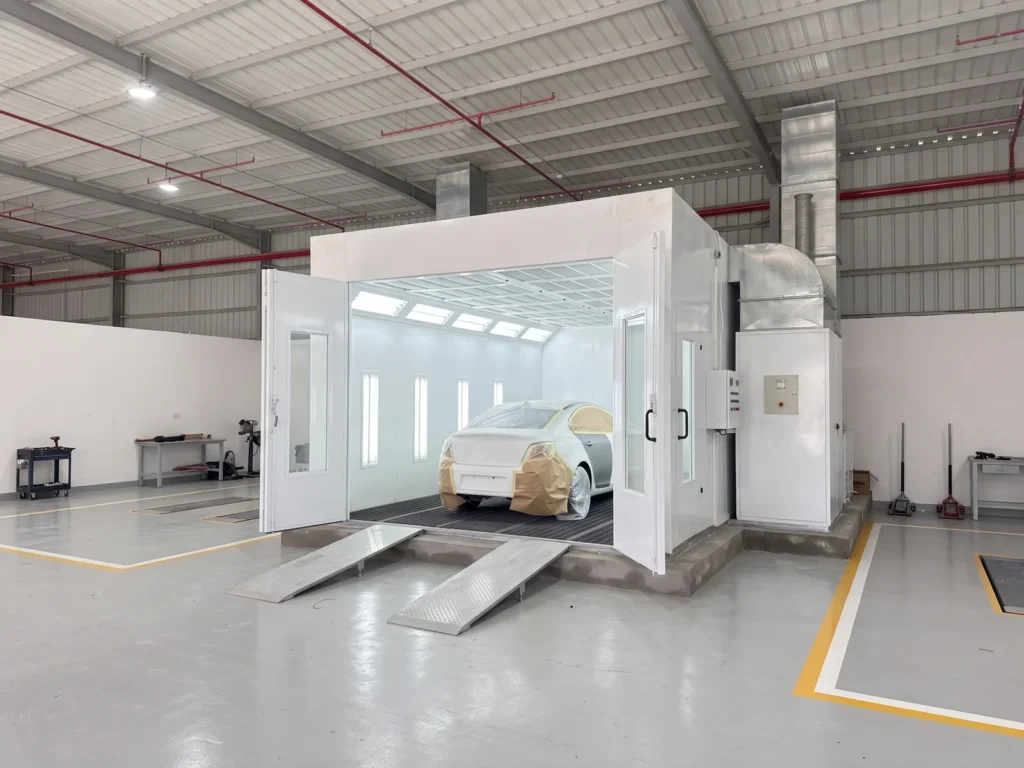
Paint Booths & Finishing Systems
For service shops that also do partial refinishing, sized to the largest vehicle that enters the hall.
INTECH chamber 6,900 × 4,000 × 2,650 mm — custom builds to 24,000 mm long Family details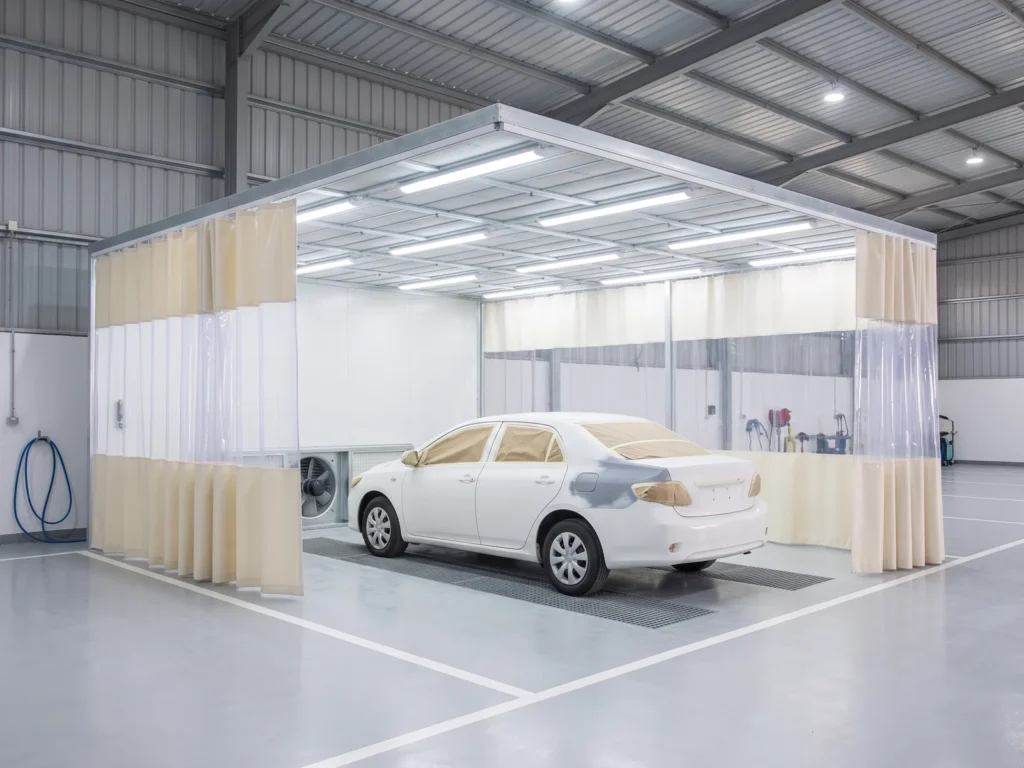
Prep Stations & Mixing Rooms
A clean surface before spraying — the difference between partial refinishing that passes and refinishing that gets redone.
15,000 m³/h air capacity at 800 Pa · PURE 200 and PURE 120 Family details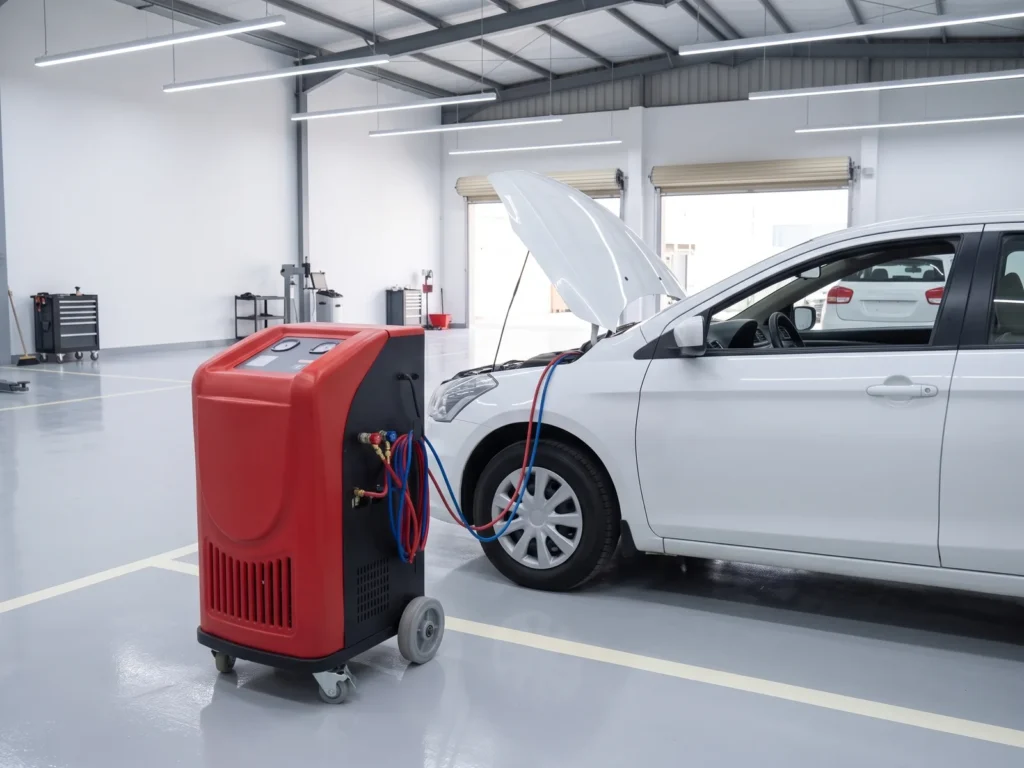
AC Service Stations
Vehicle A/C service: recovery, recharge and leak testing — a high-demand seasonal service in the Kingdom.
120 L/min vacuum pump · 2 kg/min recharge · R134a and R1234yf (ACMAS301) Family details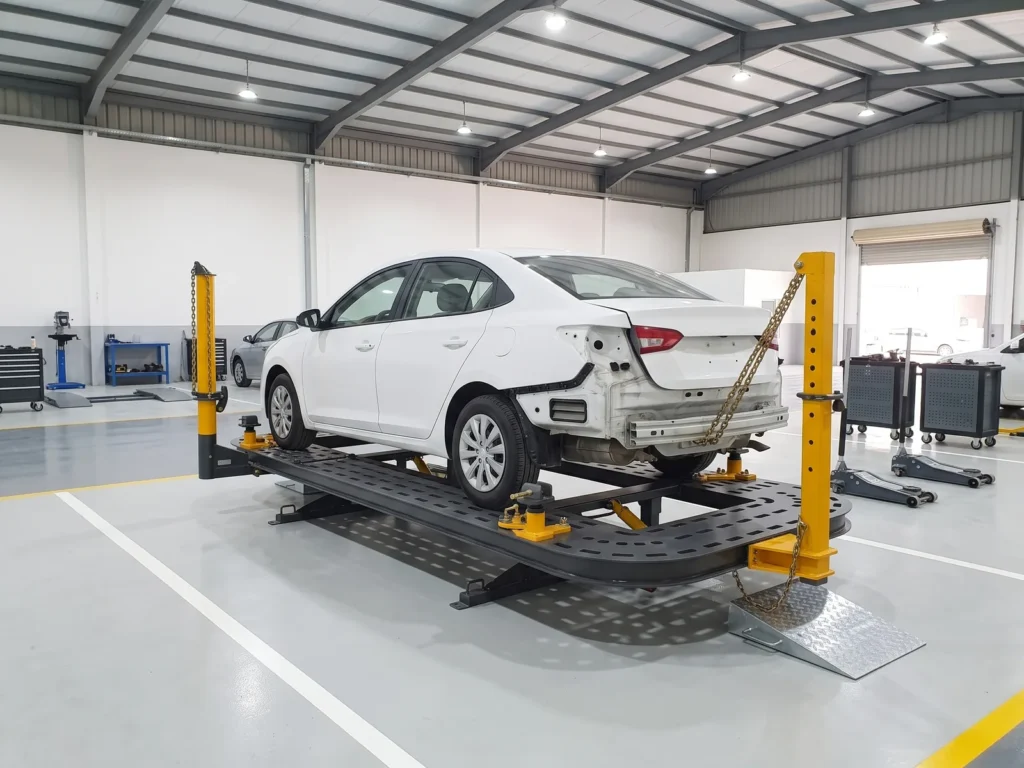
Chassis Pullers & Body Repair Equipment
For service shops that take in light damage instead of turning it away to a body shop.
Two to four pulling towers across the INTECH CR models Family detailsConfiguration notes
What actually changes for this sector
Configuration — not product identity — is the real difference between sectors.
| Item | Range / value | Why it changes for this sector |
|---|---|---|
| Number of service bays | Set per project | It is the daily throughput ceiling, derived from average job time rather than hall area. |
| Lift type and capacity | 1,200–4,500 kg depending on the published model | A general service shop mixes sedans, SUVs and light commercial vehicles, so it needs a capacity range rather than one rating. |
| Voltage and air pressure | 380 V/220 V for two-post · 220 V single-phase 60 Hz for scissor · air 0.4–0.6 MPa | Leased workshops often have single-phase supply only, which shortens the list of possible lifts before price is even discussed. |
| Filter replacement schedule | By running hours, and it differs between the primary, ceiling and floor filters — filters are typically replaced twice a year as part of preventive maintenance | Regional dust shortens the interval printed in the manufacturer’s manual, so the schedule is built on the actual environment, not the manual alone. |
Regulatory and site considerations
- Professional workshop requirements: ventilation, cooling, lighting and waste handling.
- SASO conformity for imported equipment.
- Fire and safety requirements inside the service hall and in oil and material storage areas.
- Pre-installation site requirements: available voltage, slab thickness, clear height and air pressure.
- Municipal licensing requirements for the workshop depend on its location, and we review them with you before execution.
Frequently asked questions about this sector
Are you a repair workshop? I need my car fixed
No. We supply equipment to workshops and plants; we do not take in vehicles and we do not offer repair or spraying services. If you own a workshop or are building one, we equip it. If you are looking to get your own car fixed, you need a workshop, not an equipment supplier.
What do I start with when equipping a new service workshop?
Start with the number of service bays, the ceiling height, the slab thickness and the available voltage. Those four decide which lift family fits you, and every later decision builds on them. Our fit-out order is: bays, then lifts, then diagnostics, then A/C service, then partial refinishing if you want it.
My workshop ceiling is low — can I still fit a lift?
Usually yes. Low-rise scissor lifts and platforms need far less clear height than a two-post, and the lowest starting height across our published models begins at 110 mm with a minimum surface-mount depth of 125 mm. Send us your ceiling height and floor type and we will tell you what is possible.
Does a lift need a three-phase supply?
Not necessarily. The scissor models and the battery-lifting platform in our catalogue run on 220 V single-phase at 60 Hz, while the published two-post lifts run on 380/220 V. If your site is single-phase only, say so with your enquiry and we will recommend what will actually run.
Do you supply diagnostic scanners and ADAS calibration?
Yes. Fault diagnosis and calibration tools sit within our general workshop equipment and tooling family, including the ADAS PRO calibration platform. Which unit suits you depends on the marques your shop serves and how many systems you need covered.
How much does a full workshop fit-out cost?
The price follows the configuration, not the other way round: bay count, lift types, diagnostic level and whether you add partial refinishing are what set the number. Send your hall dimensions, ceiling height and target bay count through the quote form and you will get a proposal built around your shop.
Want your workshop hall assessed?
Send us your hall dimensions, ceiling height and the number of service bays you want, and we will come back with a workable lift layout and workflow before we talk price.