
Paint Booths and Finishing Systems for Workshops and Plants
Finish quality is decided by airflow and the heat curve, not by the gun. INTECH models cover the automotive size used by repair workshops and collision centres, and anything beyond that size is designed and built to order around the size of the part, the nature of the industry, the site conditions, the ambient climate and the operating temperatures it will run in.
Models
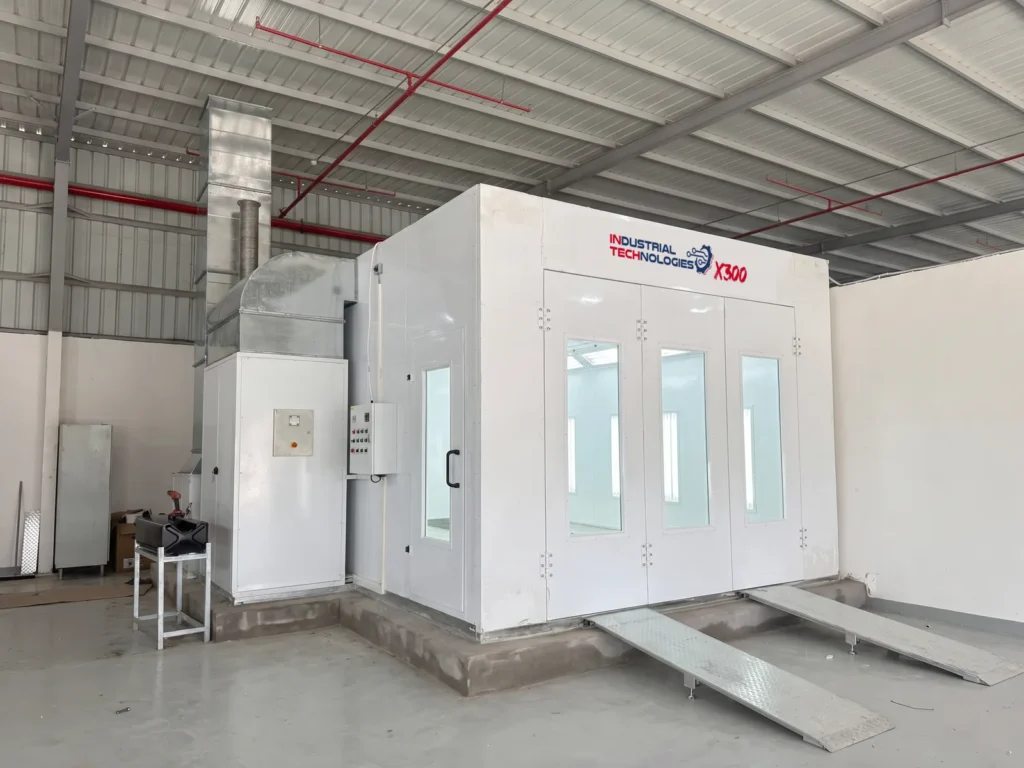
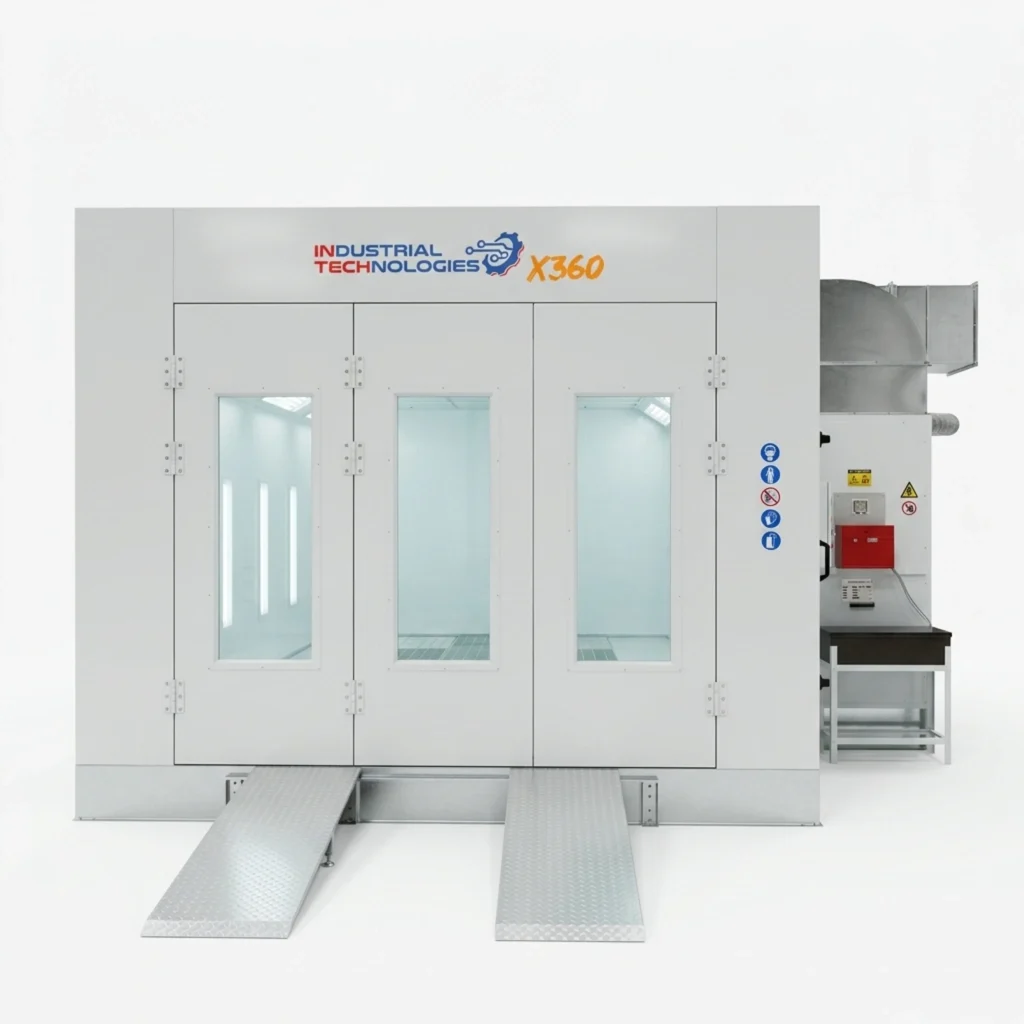
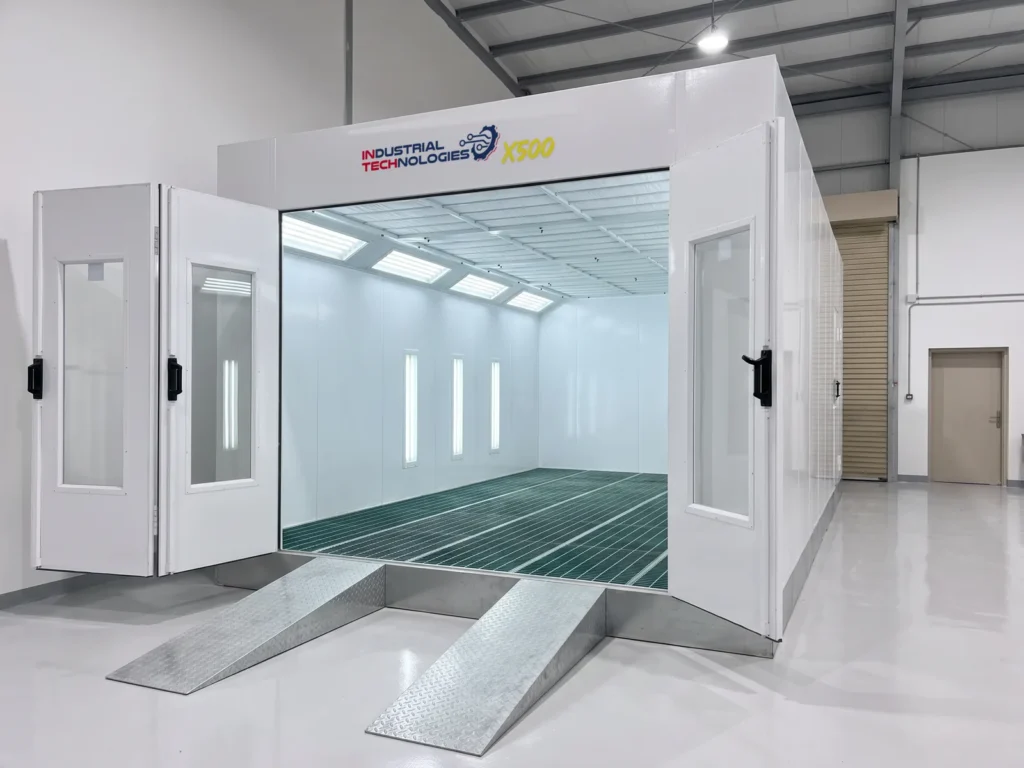
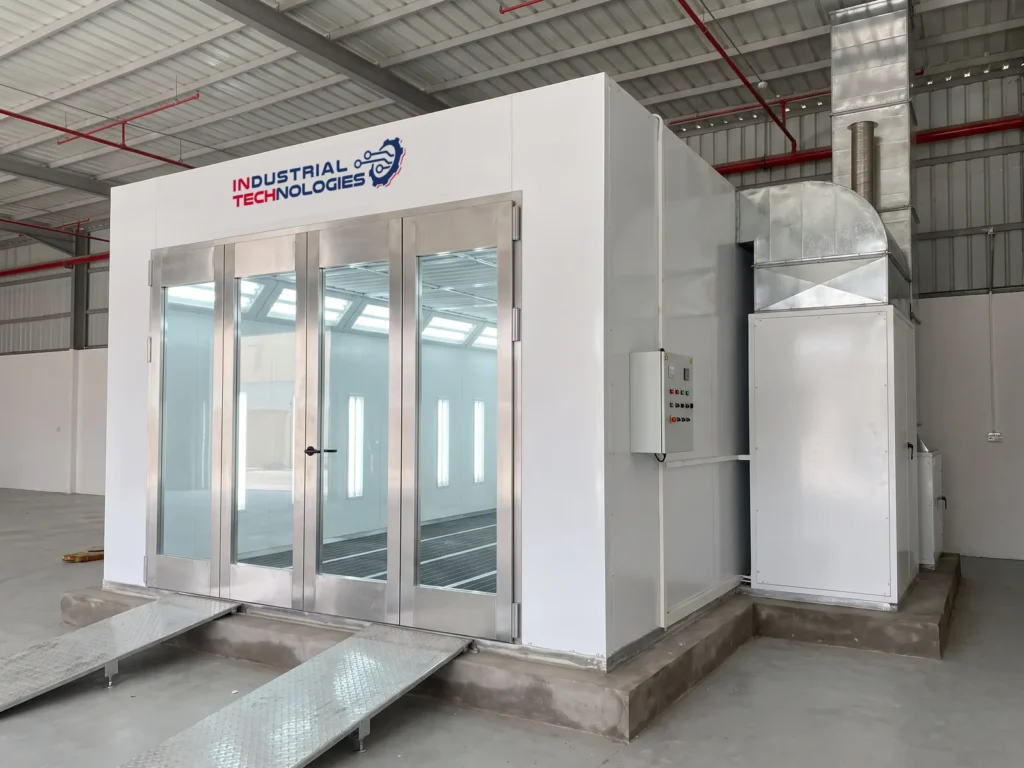
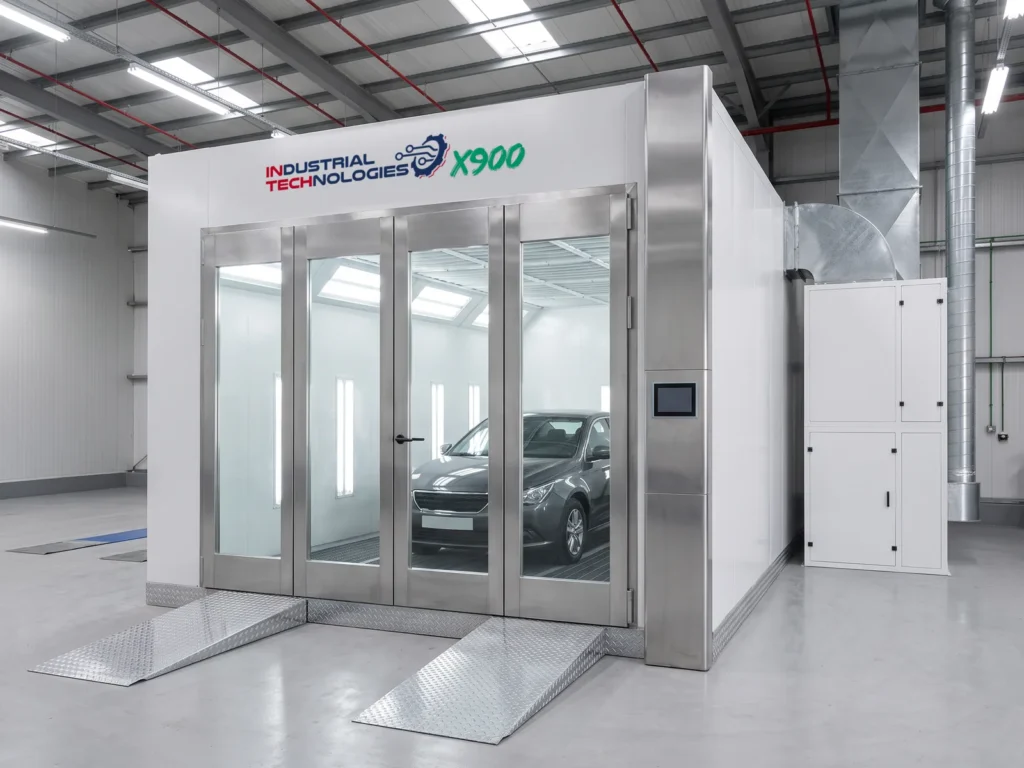
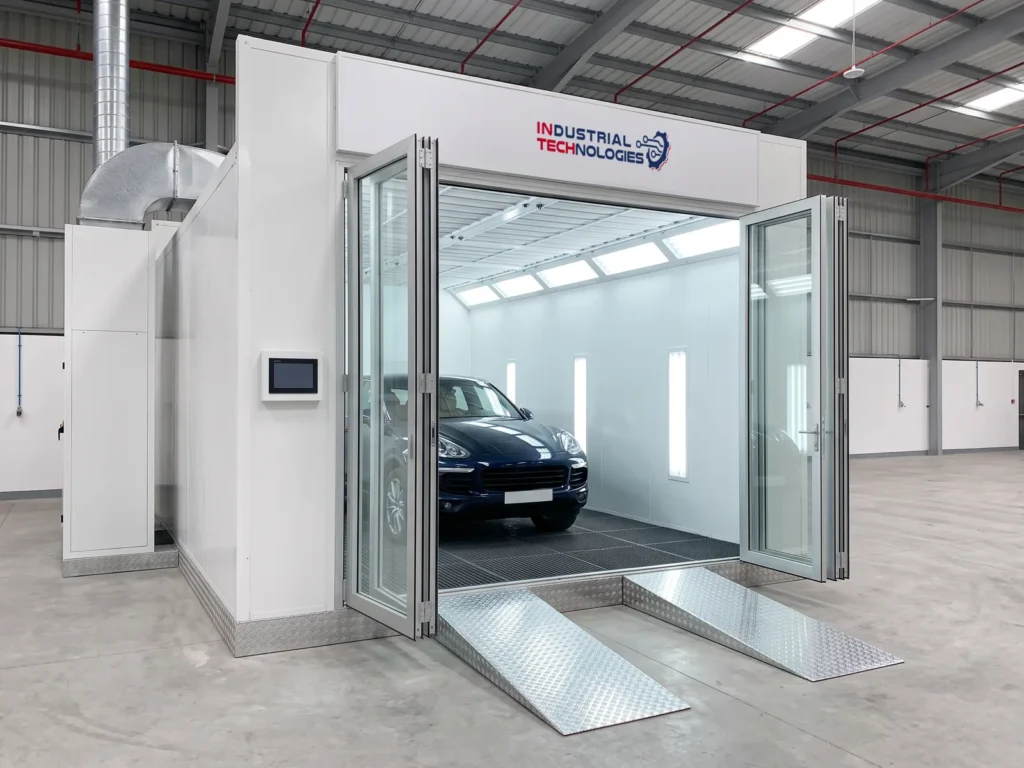
INTECH models come with an internal cabin sized for vehicle bays. Each model has its own page with full specifications and description — select a model to open it. Anything larger or smaller than that size is built to order, covered in the next section.
Custom-Built Booths — Designed and Made to Size
The INTECH models above are built on the standard automotive size, with a 6,900×4,000×2,650 mm internal cabin. Anything beyond that size — industrial parts, large structures, buses and furniture — is designed and built to order: internal size, cabin height, extraction direction, heating system and filtration stages are all set by the part being coated and the nature of the industry, not by an off-the-shelf model. Some are built as a controlled environment in which temperature and humidity are both regulated, where the coating or the part requires it.
| Item | Delivered range |
|---|---|
| Internal length (mm) | 3,000 – 24,000 |
| Internal width (mm) | 3,000 – 20,000 |
| Internal height (mm) | 2,650 – 6,000 |
| Air capacity (m³/h) | 18,000 – 190,000 per supply or extraction set |
| Heat output (kcal/h) | 200,000 – 600,000 |
| Electrical power (kW) | 11 – 50 |
| Voltage | 380 V three-phase · 50 or 60 Hz |
| Main door (mm) | 3,000×2,600 up to 14,200×5,000 powered |
| Temperature and humidity control | Delivered on custom booths whose coating requires a controlled environment — the range is set per project by the finishing material and the part’s requirements |
| Heating systems | Diesel · gas · electric · heat pump · short-wave infrared |
| Filtration | Stop, pre and ceiling filtration EU3, EU4 and EU5 — up to three-stage bag and high-efficiency filtration at ≥98% |
| Wall | 50 mm insulated panel (EPS · rockwool · glass wool) — or 1.5 mm galvanised sheet for large cabins |
Here is what gets built to order for each industry beyond the automotive size:
Industrial & Manufacturing
Size follows the manufactured part, not a vehicle. Delivered configurations start at a 3,000×3,000×3,000 mm cabin for powder coating curing and extend to 5,700×3,700×3,000 mm for industrial baking ovens and above. The heat curve is set to the industrial coating in use, with provision for hanging or moving parts inside the cabin.
Trucks, Buses & RV
From 8,000 mm for minibuses and vans, up to 16,000×6,500×4,500 mm for buses and long vehicles, with air capacity reaching 72,000+72,000 m³/h and a main door up to 4,000×4,200 mm.
Aerospace, Marine & Rail
Airframe cabins from 16,000 mm to 24,000×20,000×6,000 mm, with air capacity reaching 190,000+190,000 m³/h, three-stage bag and high-efficiency filtration at ≥98%, a powered door up to 14,200×5,000 mm, plus gas monitoring and static discharge.
Woodworking & Furniture
Size follows the largest piece of furniture rather than a vehicle, with a lower-temperature drying cycle suited to timber and extraction that handles dust and overspray together. Any required size is built to suit the part and the production line
Military & Defense
Heavy vehicle and large equipment sizes within the range above, special finishes, and site and security requirements defined per project.
Parts and structures beyond the above
Any part the automotive size cannot take is studied on its own: internal size is fixed from the dimensions of the part plus the technician’s working space around it, and the configuration is then built on that. Design, manufacture and delivery take up to 90 working days, and some projects take less.
Every custom booth starts with a site survey and a fixed internal size, then configuration sign-off before manufacture.
Industries Served
Each industry runs a different configuration. The table below states what actually changes in the booth from one industry to the next, whether the answer is a stock INTECH model or a custom-built booth.
| Industry | What changes in configuration |
|---|---|
| Education & Training | A single-vehicle chamber with observation windows and higher lighting, a control panel that shows cycle stages to trainees, and short repeated cycles instead of a long production cycle. |
| Auto Dealers | Internal length sized for passenger cars and SUVs, ceiling filtration at the highest class the model offers, and a faster drying cycle to shorten vehicle handover time. |
| Auto Fleet | Longer internal chamber for light commercial vehicles, higher extraction capacity for back-to-back cycles through the day, and an internal finish that takes heavy use. |
| Automotive Repair | The standard automotive footprint at mid-range extraction, prioritising serviceability and local filter availability over full automation. |
| Collision Repair | Higher air volume and a faster heat cycle, because throughput here is counted in vehicles per day, plus higher lighting for colour-matching work. |
| Car Rental | A short operating cycle for fast cosmetic repairs, the standard automotive footprint, and priority on time back into service. |
| Industrial & Manufacturing | Size and shape follow the manufactured part rather than a vehicle, the heat curve is set to the industrial coating in use, and the chamber is arranged to hang or convey parts. |
| Aerospace, Aviation, Marine & Rail | A chamber sized for large structures, downdraught or side extraction depending on the work, and filtration and safety requirements beyond the automotive footprint. |
| Military & Defense | Heavy-vehicle and large-equipment dimensions, special finishes, and site and security requirements defined per project. |
| Woodworking & Furniture | A lower-temperature drying cycle suited to timber, extraction that handles dust and overspray together, and a footprint set by the largest furniture piece rather than a vehicle. |
| Trucks & RV | Internal length and height for trucks, buses and recreational vehicles, larger doors, and air volume matched to the larger chamber. |
Configuration Range and Installation Requirements
Choosing the right booth starts from three questions: what part is being coated and what size is it? How much space is available on site? And what electrical supply is in place?
Start from the part, not the booth
What are the length, width and height of the largest vehicle, industrial part or furniture piece to be coated? Internal size is chosen from that, plus room for the technician to work around it.
Space available on site
A booth needs service space around it, not only its own footprint — to swing the doors open and to reach the air handling unit and filter box at change-out.
Electrical supply
380 V three-phase across all documented models, with power from 11 to 50 kW depending on size and configuration.
Heating system
Five systems delivered in this family: diesel burners, gas, electric heating, heat pump, and short-wave infrared. The choice follows the coating type and the cost of energy on site.
Filtration
Arrestor, pre- and ceiling filtration at classes that vary by size and by the type of work. Filter class is set with the configuration, not after installation.
Stack and floor base
Stack height and position follow the size and the site. Cabins with a full steel-grid pit require an excavation or an entry ramp.
Site requirements
A suitable concrete floor, an electrical supply matching the voltage, compressed-air runs feeding the booth, and duct runs for exhaust ventilation and the burner flue
Installation and commissioning take 7 days on average, with your site timeline confirmed after the survey
Frequently Asked Questions About This Family
What is the largest part or vehicle these booths accept?
INTECH models have a 6,900×4,000×2,650 mm internal cabin, which is the vehicle size. Anything beyond that is built to order within a measured range running from 3,000×3,000×3,000 mm for industrial parts up to 24,000×20,000×6,000 mm for aircraft structures.
Which heating systems are available?
Five: Italian Riello and Baltur diesel burners, gas, electric heating, heat pump, and short-wave infrared.
What electrical supply is required?
380 V three-phase at 50 or 60 Hz — the same value across all documented models.
Is there a model for water-based paint?
Yes — the water-based configuration is built to order with a short-wave infrared system and two overhead extraction fans. It has been delivered with ten infrared units at a combined 30 kW and a 15–20 minute heat-up time.
Do these booths serve anything other than vehicles?
Yes. Size and heat curve follow the part, not a vehicle — delivered work includes cabins for industrial parts, furniture and timber, and aircraft structures, plus powder curing ovens and industrial baking ovens, all designed and built to order.
How do I choose the right paint booth size?
Start from the largest part or vehicle you will paint and its dimensions, then from the nature of the activity and site conditions. If it is a passenger car or an SUV, the INTECH models cover it; anything beyond that is designed to order.
Are booths genuinely built to order?
Yes. A custom booth starts with a site survey and a fixed internal size taken from the dimensions of the part plus the technician’s working space around it. The configuration — extraction direction, heating system, filtration stages and doors — is then signed off before manufacture.
Equipping a paint shop or raising its throughput?
Send us the activity, the site area and the largest part or vehicle that will enter the booth, and we will recommend the model and the configuration.