
Buyer’s Guide
The paint booth is the engine of your production line. This guide walks you through the criteria that decide the choice, then rounds out the picture with the equipment that turns your workshop into a complete service center.
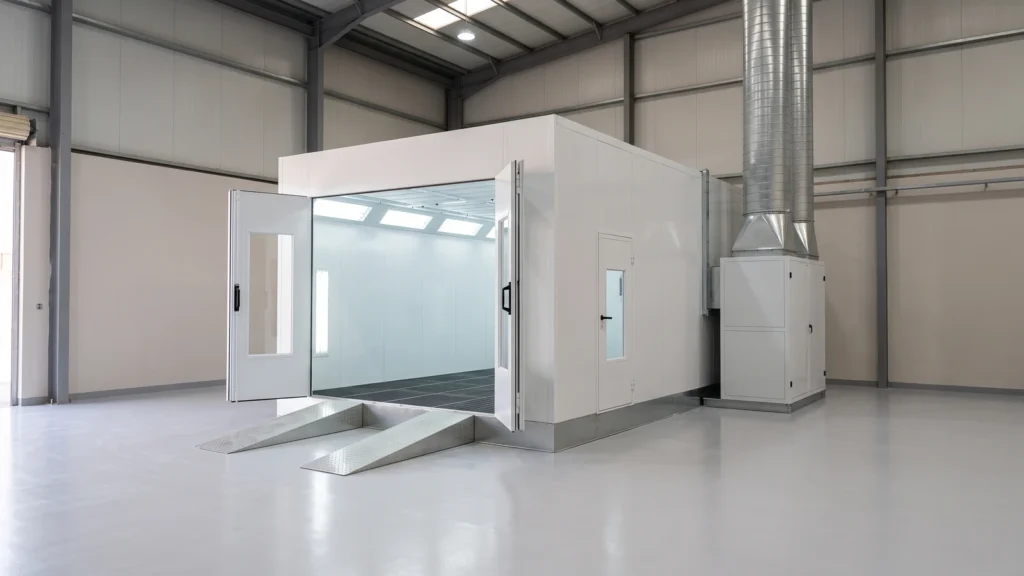
How to choose the right paint booth
1. Airflow system
Paint quality starts with airflow. In a professional booth, air travels a calculated path: from ceiling to floor (downdraft), or in a semi-downdraft design that pulls fumes and dust away from the body before they reach the freshly sprayed surface.
What to look for: a high air-change rate inside the cabin and a steady airflow at the floor intake. Any defect in these figures shows up immediately on the finish as blisters or grit — and that is costly.
Make sure the motors are built for continuous industrial duty rather than intermittent use, and that the air distribution covers the whole cabin with no dead zone and no unventilated corner.
2. Thermal insulation and curing temperature
Every riyal you spend on electricity or gas should stay inside the cabin — not leak through the walls. Poor insulation means higher energy use, longer heat-up, and unstable temperatures that hurt finish quality and lengthen the cycle.
What to look for: rock-wool insulated panels sandwiched between two galvanized steel skins, covering the whole body — walls, ceiling, and doors — with no thermal gaps.
3. Cabin lighting
Poor lighting inside the booth does not only tire the technician’s eyes — it means missing flaws you cannot see under weak light: a slight colour mismatch, a missed spot, an uneven surface. Small defects mean a full rework and lost production hours and paint.
What to look for: LED lighting spread at angles that give shadow-free visibility, mounted on the side walls and ceiling, with protection suited to the spray environment.
4. Filtration system
Dust is the number-one enemy of a painted surface. Any fine particle suspended in the cabin air will find its way onto the wet paint immediately.
What to look for: successive filtration stages — a pre-filter at the intake, a ceiling filter above the cabin, and a floor filter in the extraction run — with filters that are easy to reach for routine replacement without stopping work.
5. Dimensions and capacity — a cabin that fits your work
A booth that is too small limits the vehicles you can take in; one larger than you need burns energy for nothing. The right measure is the largest vehicle you expect to work on, plus working room for the technician on every side.
INTECH booths share one internal chamber sized for passenger vehicles, and anything beyond that — industrial parts, large structures, and buses — is built to order. See the paint-booth family page for the full range.
6. Electronic control — the booth’s brain
The control panel is the command center. An unclear interface or slow programming means human error in every cycle. A professional technician needs quick, simple control in the fewest steps.
What to look for: a digital touchscreen, an Arabic interface, the ability to save multiple programs, graphical temperature monitoring during the cycle, and a hold/resume function for power interruptions.
7. Energy efficiency
Energy cost is not a fixed number on the month-end bill — it is a daily variable that accumulates with every cycle. An inefficient booth costs you more over its lifetime than its original price.
What to look for: an economical burner with indirect heat exchange, pumps that adapt to the actual load instead of running at full power, and insulation that keeps heat loss to a minimum.
8. Safety and operating standards
The spray environment is flammable. Any shortfall in safety systems threatens not only the equipment but the lives of the people working around it.
What to look for: over-temperature sensors with automatic burner shut-off, emergency stop, doors that open from inside and outside in any condition, emergency ventilation that runs even during a main power failure, and full compliance with safety standards and regulatory operating requirements.
Beyond the booth: equipping a complete service center
The booth is the heart — but a heart does not work alone. A complete center needs a chain of equipment that fits together into a line that never stops.
Vehicle lifts
No workshop is imaginable without lifts. The right lift depends on the size and type of your work:
- Two-post lift: the most common for daily service, requiring a reinforced concrete floor.
- Four-post lift: ideal for inspection, alignment, and storage.
- Scissor lift: the fastest solution for quick service, with a low collapsed height that lets low vehicles pass.
The right lift completes the workflow with the booth: the vehicle enters on the lift for inspection, moves to the prep station, enters the booth for paint, then returns to the lift for final assembly.
Chassis pullers
In collision repair, the chassis puller is the second most important piece of equipment after the booth. A damaged body needs calculated pulling force to return it to factory specification, to the millimeter. See the chassis-puller family page for the available models.
Prep stations
The prep station is the station between mechanical work and painting — final sanding, preparation, and surface cleaning before the booth. Any dust left on the surface will show in the final finish.
Supporting equipment
- Air compressors: the air source for spray guns and pneumatic tools — it must deliver dry air free of oil and moisture.
- Exhaust extraction: essential to keep the workspace free of gases and fumes.
- Welding and cutting equipment: for repairing metal bodies before preparation and painting.
- Electronic diagnostics: modern vehicles need electronic inspection before and after any mechanical work.
Common questions before you buy
How much does a professional paint booth cost?
The cost depends on the specifications: dimensions, airflow type, burner type, and the level of control systems. We prepare custom quotations after studying your actual workshop needs — because every workshop has requirements completely different from the next.
How long does it take to install and commission a paint booth?
Installation time depends on the booth size and the number of units, and covers frame assembly, electrical and gas work, control-panel connection, and commissioning tests. Our technical team supervises installation on site and hands over the booth ready to work.
What is the difference between Semi-Downdraft and Full Downdraft?
In a semi-downdraft, air enters from the ceiling and is drawn out through a floor opening, creating a simple path suited to general paintwork. In a full downdraft, air enters through the entire ceiling area and is drawn out through a complete floor grid — a 100% vertical path that drives every particle of dust away from the vehicle. The difference in final surface quality is clear, especially in high-gloss and dark colours.
Does a workshop need special regulatory requirements to install a paint booth?
Yes. Installing a paint booth requires meeting a number of regulatory requirements covering safety and the environment. We help you prepare the required engineering and technical file, and ensure the equipment we supply meets the operating standards required in the market.
How much does it cost to equip a complete service center from scratch?
The cost depends on the number of workstations and the target production capacity. We recommend contacting us for a site visit so we can identify your actual needs and design a complete equipment plan — without equipment you do not need, and without shortcuts that hurt your production quality.
How to start
Everything you have read is a starting point. The right choice begins with understanding your actual needs: how many vehicles a day, what vehicle types, and what services you plan to offer.
Contact our engineering team today. We will visit your site, study your needs, and design a complete equipment plan with specifications and costs — with no obligation.