
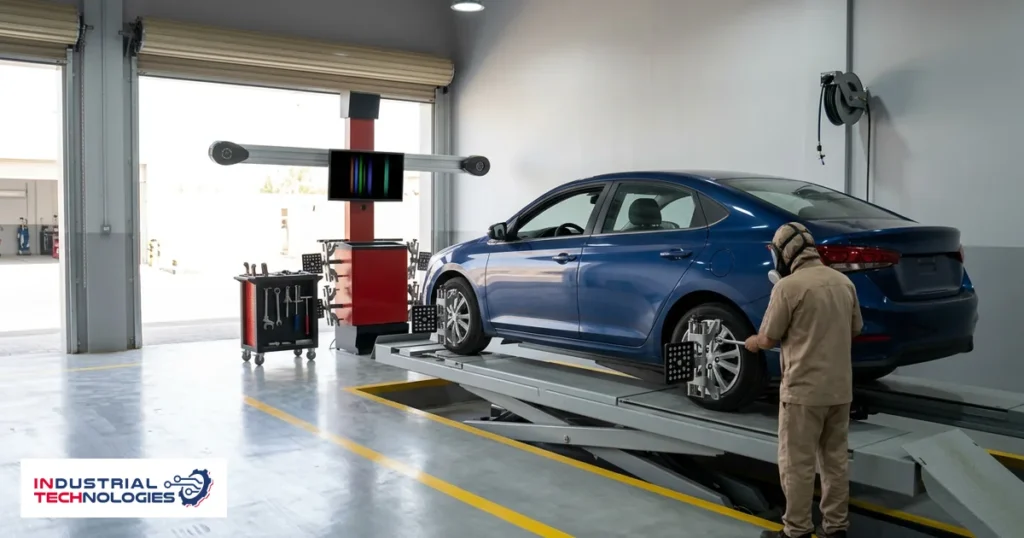
A customer describes it in one sentence: the car pulls to the right. The technician who adjusts toe alone treats the symptom, and the vehicle returns a fortnight later having worn a tire from one edge.
Which is why wheel alignment equipment is judged by what it reads rather than by how fast it reads it. The angle a machine does not measure is the angle that comes back.
Five angles, not one
The tire and oil service family publishes 3D aligners measuring camber, caster, toe, KPI/SAI and thrust angle.
Thrust angle is the one that explains a pull complaint when the front axle reads correctly: the rear axle is steering the vehicle along a line that does not match its centreline, the driver resists it at the wheel, and the tire records the argument.
KPI and SAI are diagnostic rather than adjustable. Readings outside range say there is bent suspension geometry, which adjustment will not correct — useful precisely because it stops work that would otherwise be attempted.
Passive targets change running cost
What sits on the wheel determines long-term cost more than the console does. The published specification is passive reflective targets — no batteries, no wires, no sensors to break.
That is an operational distinction rather than a marketing one. A passive target dropped on the floor is picked up and reused. An electronic sensor dropped on the floor is ordered, and the lane stops until it arrives.
They remain consumable items, and are published among the consumables supplied from local stock alongside balancing weights and tire-changer protectors.
Cycle time and vehicle database
Two values are published as varying by model and determined in the quotation: cycle time and vehicle database capacity.
The second matters more than it first appears. A machine without the manufacturer’s specification for a model that entered your bay leaves the technician working from an estimate — and an alignment done on an estimate is worse than no alignment, because it is recorded as completed work.
So send the makes that dominate your workload and let database coverage be compared against them, rather than against a total model count.
Preparation decides the reading
A wrong reading starts before the machine. Unequal tire pressures shift measured camber, play in suspension joints makes every value move, and load inside the vehicle changes ride height away from its reference.
Mechanical inspection therefore precedes measurement every time: correct pressures, no joint play, and a vehicle loaded as it is normally measured. A machine given an unprepared vehicle produces a report with precise numbers and a wrong conclusion.
Calibration of the machine itself is published as on-site using laser reference kits, alongside technician training on multi-link suspension and steering angle sensor calibration.
What the aligner measures
Five angles, and the lift the lane needs:
| Item | Published | Note |
|---|---|---|
| 3D aligner measurement | Camber, caster, toe, KPI/SAI and thrust angle | Thrust angle explains a pull when front-axle readings are correct |
| Targets | Passive reflective — no batteries, wiring or sensors | Changes running cost, not just specification |
| Cycle time and vehicle database | Vary by model, defined in the quotation | Compare the database against your dominant makes, not its absolute size |
| Lift for the lane | Scissor models installed on the floor surface, minimum 125 mm, no pit | Suits a lane in a leased building |
Common questions
What lift does an alignment lane need?
A level surface of known flatness. The lifts family publishes scissor models installed on the floor surface with a minimum of 125 mm and no pit, which suits a lane in a leased building.
How does this relate to driver assistance calibration?
Sequentially. Assistance systems reference the vehicle centreline, so work that changes that line requires calibration afterwards. Calibration equipment is published in the general workshop tooling family.
Is balancing a substitute for alignment?
No — they address different complaints that arrive sounding similar. Balancers are published with a laser indicator for weight placement behind the rim and an automatic arm measuring rim diameter and width.
What to send with your enquiry
The makes that dominate your workload, daily alignment volume, lane length and width, and the lifting arrangement available. Then request a quotation.