
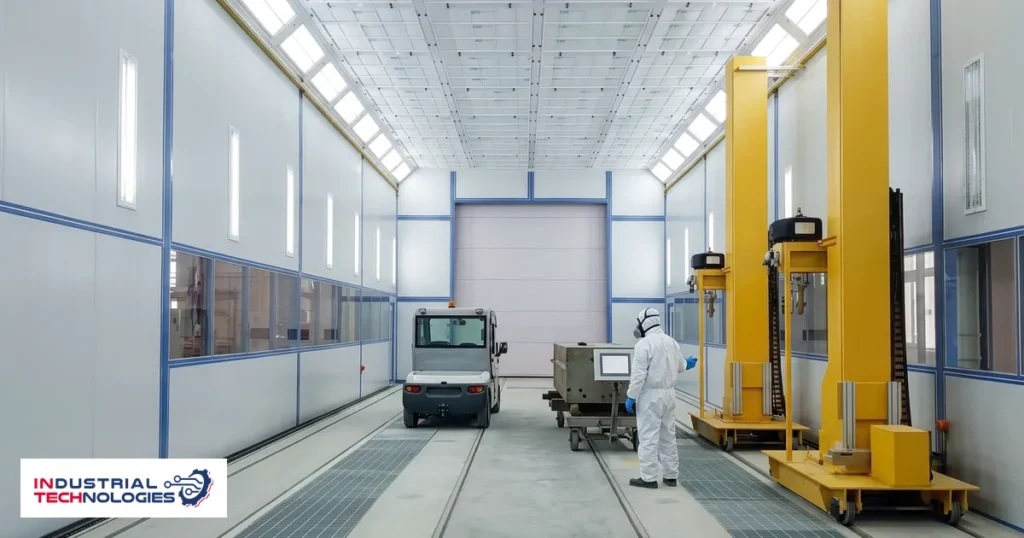
In nearly every negotiation over a large booth, the door is left until last. Size, flow, heating and filtration all get discussed, and then the door appears on the final page like an annex.
That ordering is expensive. A powered booth door is not an upgrade bolted onto a finished chamber — it constrains chamber size and position in the hall, so it belongs early.
The delivered door range
Main door size in this family runs from 3000×2600 mm to 14,200×5,000 mm powered. The gap between the two ends of that range is not incremental — it is a change in the nature of the item.
| Size | Operation | What it serves |
|---|---|---|
| 3000×2600 mm | Manual in practice | The standard automotive cabin |
| up to 4000×4200 mm | Manual feasible | Buses and long vehicles |
| up to 14,200×5,000 mm | Powered | Large structures, defence platforms, rail |
Why powered becomes mandatory
The reason is operational rather than luxurious: a door at 14,200×5,000 mm is not hand-operated on a repeated daily cycle. Weight alone makes manual operation slow and unsafe, and it turns into a bottleneck on every cycle.
So powered operation becomes part of the specification at that size, and it enters both the facility’s electrical load calculation and the routine maintenance schedule.
The door is measured on the largest section entering
The rule is simple and often broken: measure the door on the highest and widest point of the part or vehicle as it actually enters — not on its datasheet dimensions.
- The refrigeration unit on a reefer box front sits above the box roof
- Roof air conditioning on a bus raises actual height above body height
- Side mirrors add width if the vehicle enters with them fitted
- The trailer adds to overall length rather than counting separately
The door constrains position, not only size
A door fourteen metres wide needs manoeuvring space in front of it sufficient to bring the part in straight. A chamber placed in a corner of the hall can be correctly sized and unusable, because the turning radius in front of the door is not there.
Entry and exit path are therefore studied alongside door size in the same site survey, before chamber position is fixed.
Routine maintenance on a moving item
A powered door is a moving item in a facility that is mostly static, which means it needs a schedule like any other moving item. Anyone building a maintenance plan around filters and the burner alone leaves the door until it stops — and a stopped door stops the whole chamber.
Frequently asked questions
When do I need a powered door?
When size approaches 14,200×5,000 mm, or when daily cycle count is high enough that manual opening becomes accumulated wasted time. The threshold is not a single figure but the intersection of size and operating frequency.
Can a manual door be upgraded to powered later?
It depends on how the door frame was built initially and on available electrical capacity. Upgrading is far easier where it was allowed for in the first design, which is why we ask about expected rather than current operating frequency.
Does door size affect chamber sealing?
Yes, and it is a real consideration. A larger opening means a longer sealing perimeter, and that enters the flow and pressure calculation for the chamber. It is handled in design rather than after installation.
How much electrical power does it draw?
It is included in the chamber’s total, with a published family range of 11 to 50 kW depending on size and configuration. The final figure comes with the technical offer once configuration is fixed.
Related reading
- Bus Paint Booth
- Refrigerated Trailer Refinishing
- Food Truck Body Finishing
- Chamber Height RV Vehicles
- Powered Main Door Daily Duty
What to do next
Send the largest section entering the chamber as it actually enters — highest and widest point — and its path into the hall, and we will return a door size and chamber position built on your site. Request a quote. The published range is on the paint booth family page.