
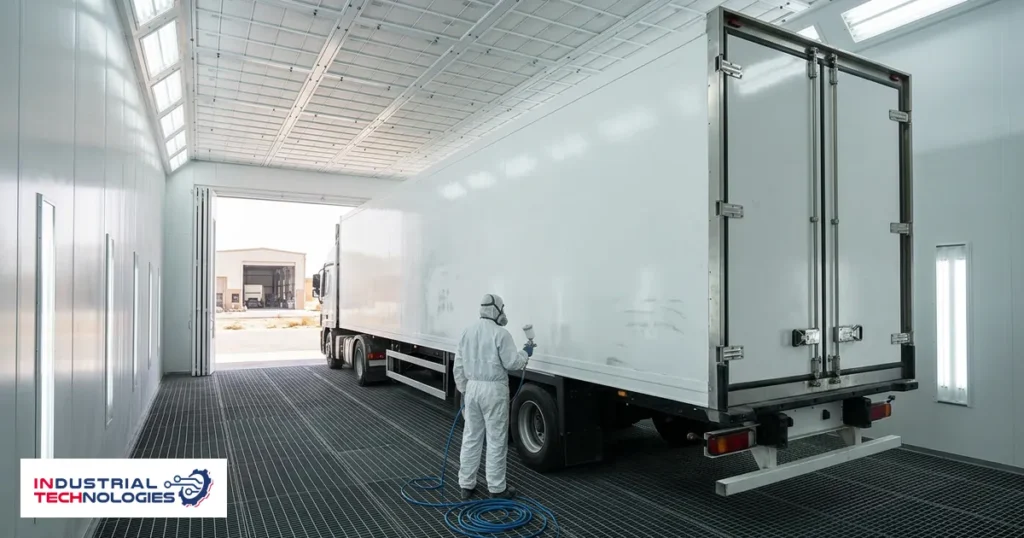
The figure most often sent to us in error on refrigerated transport projects is the tractor length. The operator measures the tractor, sends the number, and it emerges at design stage that the whole unit gets painted — a difference of eight metres, not centimetres.
Refrigerated trailer refinishing starts from the overall length of the unit as it actually enters the chamber, not from the length of any part of it.
Overall length is the input
If you paint the truck with its trailer attached, send the overall length including it, because that figure sets chamber length and door together. The delivered range in this family extends to 24,000 mm long and 6000 mm high.
If the trailer is detached and painted alone the required size is shorter — but that is an operating decision to settle before design rather than after, because reversing it means a new chamber.
| Dimension | How it is measured | What it sets |
|---|---|---|
| Overall length | Tractor + trailer if they enter together | Chamber length and door |
| Overall height | Highest point including the front-mounted refrigeration unit | Chamber and door height |
| Width | Widest point including mirrors if they stay fitted | Internal width and circulation |
| Turning radius | Entry and exit path inside the hall | Chamber position on site |
The refrigeration unit raises the required height
The refrigeration unit mounted on the front of a reefer box sits above the roof line. Measuring at the roof produces a door the unit will not pass. It is a small detail that stops a whole project at installation.
A large flat surface changes the flow calculation
A reefer box is a large, flat, continuous surface, and it is harder to match than the curved, panel-divided surface of a car. Any unevenness in flow across that surface shows as a visible line in the final finish.
So flow is calculated on the full chamber volume — the published range reaches 190,000 m³/h per supply or extraction set — rather than on an average carried over from an automotive booth.
Cycle time and fleet duty
A reefer fleet workshop runs back-to-back cycles through the day rather than a single cycle. That raises extraction requirements, and it makes an internal finish that takes heavy use a specification item rather than a cosmetic choice.
Frequently asked questions
Does the size include the trailer?
It must if you paint the truck with its trailer. Send the overall length with the trailer rather than the tractor length alone, because that figure determines chamber length and door size.
What makes the door powered?
Size. The main door on larger builds reaches 14,200×5,000 mm and is not hand-operated on a repeated daily cycle, so powered operation becomes part of the specification.
Does a reefer chamber differ from a general truck chamber?
The size envelope is the same in principle. The differences are height, because of the refrigeration unit, and flow uniformity across the large flat surface. The published range covers both cases.
Do you supply lifts for heavy trucks?
What we actually supply to this sector is paint booths. Heavy lifting is supplied from the vehicle lifts and lifting equipment family and configured by capacity and size to the vehicle and hall height.
Related reading
- Bus Paint Booth
- Food Truck Body Finishing
- Powered Booth Door
- Chamber Length With Trailer
- Tractor Unit Refinishing
- Refrigerated fleet workshop
- Fleet livery colour consistency
- Rail Axle Lifting Equipment
What to do next
Send the overall length, width and height of the largest unit entering your workshop — with the trailer if applicable — and we will return a chamber and door built on your dimensions. Request a quote. Sector detail is on the trucks and RV industry page.