
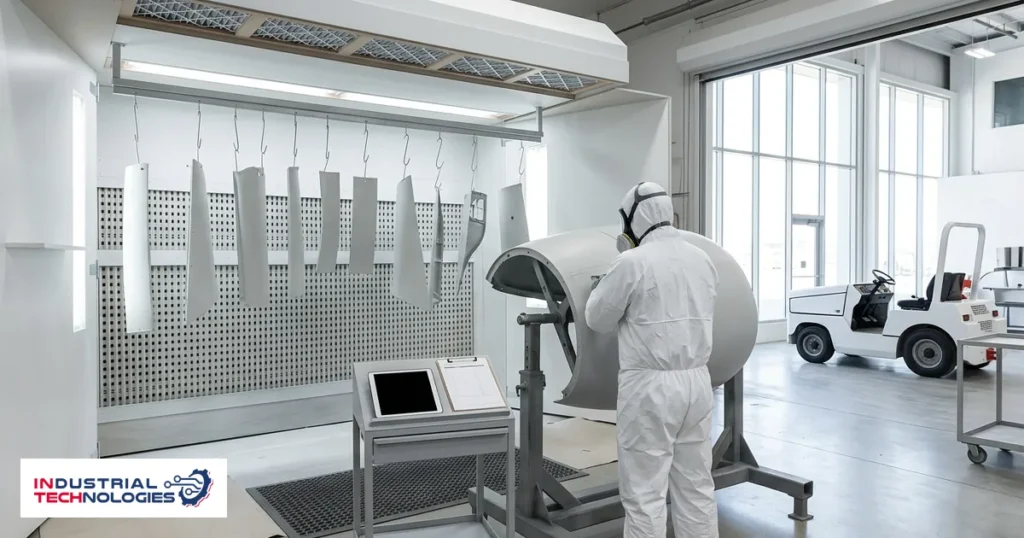
Aviation maintenance shops buy on a different logic from vehicle workshops. The first question is not what the peak specification is, but whether the same result comes out every time and whether that can be shown on paper.
An aviation MRO parts booth is judged on that standard, which turns items that look secondary in the automotive sector into blocking items here.
Acceptance precedes specification
These sectors run to strict accreditation and documentation standards. Equipment is judged on its ability to repeat the same result and to document it, rather than on its maximum specification.
The practical effect is that a control panel logging cycle stages becomes worth more than extra headroom in flow — the first produces a record that gets reviewed, the second a figure in a catalogue.
The component, not the airframe
MRO parts differ from a complete airframe: components, units and assemblies are removed, treated and refitted. Size here follows the largest component and how it is hung, not the size of the aircraft.
The published range runs from 3000 mm to 24,000 mm long, so it takes both the small component and the large structure — and the choice within it comes from your parts.
| Item | Published value | Why here specifically |
|---|---|---|
| Filtration | three-stage bag and high-efficiency filtration at ≥98% | Acceptance requirements precede technical specification |
| Gas monitoring | included in large builds | Volume makes concentration uneven by distance |
| Static discharge | standalone specification item | Metal surfaces and air paths accumulate charge |
| Prep and paint separation | two cells or disciplined separation | Each stage carries different extraction needs |
Preparation and painting are two operations
Stripping, preparation and inspection precede painting, and each carries different air and extraction requirements. Combining them into one volume makes one of them run short.
We fix the number of cells after reviewing your process. Some shops need two chambers; others manage with disciplined separation in one — the answer follows your line rather than a rule of thumb.
Frequently asked questions
What do you supply to the aviation sector?
Paint booths and chambers built to size, within a published range extending to 24,000 mm long, 20,000 mm wide and 6000 mm high. Other aviation workshop equipment is not listed because it is not among what we supply.
Is three-stage filtration mandatory?
Not by size alone. It is driven by your coating material and your facility’s acceptance requirements. Bag and high-efficiency filtration sits within the delivered range and is decided with the rest of the configuration.
Can you issue a specification fit for a tender?
Yes. We issue written technical specifications together with the required conformity data so they can be inserted directly into a competition or contract without redrafting.
What about our accreditation requirements?
Accreditation and documentation requirements differ between facilities and are set by your authority. We start by establishing what it requires before discussing specification, because the reverse order produces a procedurally unacceptable offer.
Related reading
- Aviation Component Prep Room
- Drone Airframe Finishing Booth
- Aircraft Paint Booth
- When to Leave the 6900 Size for a Custom Booth
- Business Jet Paint Booth
What to do next
Send the largest component dimensions, your process stages and your authority’s documentation requirements, and we will return a chamber concept built on them. talk to a specialist. Sector detail is on the aerospace, marine and rail industry page.