
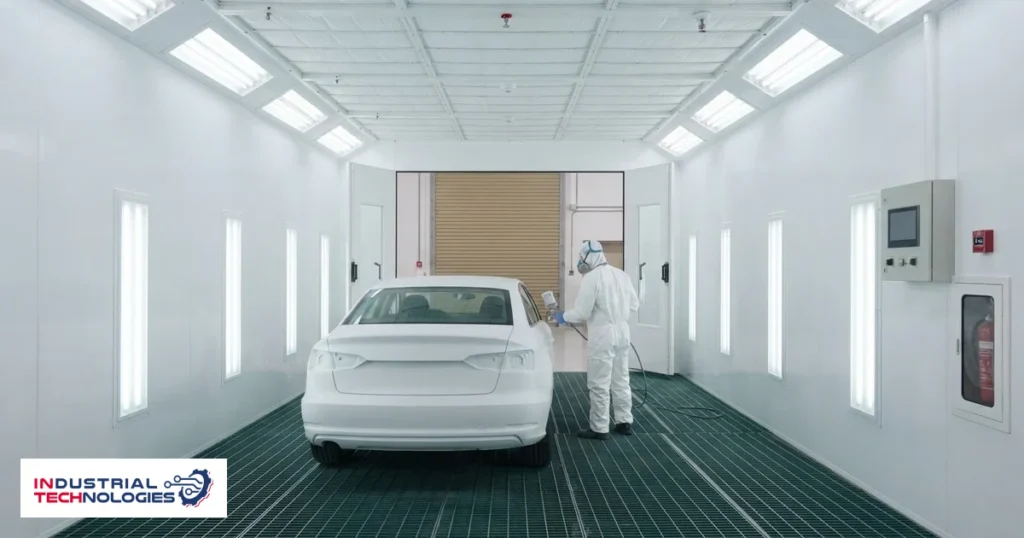
A question recurs before any fit-out contract is signed: what will we be asked for? The honest answer is that no single list applies to every site — requirements differ with chamber size, with the city and with where the facility sits.
Spray booth fire safety requirements do turn on three constant axes, though, and knowing them early prevents a surprise at approval.
The three axes
- Ventilation and fire — requirements specific to spray chambers, stricter for large chambers than for an automotive booth
- Waste — disposal of paint, solvent and stripping waste under the applicable environmental rules
- Conformity — SASO conformity for imported equipment
All three are studied with the configuration rather than after it, because each influences wall material, heating system and extraction routing.
Why requirements tighten with volume
A large chamber holds solvent vapour in greater volume, with regions where the air renewal rate differs by distance alone. That is why large builds carry what an automotive booth does not: gas monitoring, and static discharge as a standalone item.
| Item | Automotive cabin | Large chamber |
|---|---|---|
| Reference volume | 6900×4000×2650 mm | up to 24,000×20,000×6,000 mm |
| Gas monitoring | Not normally included | Included in large-structure builds |
| Static discharge | Within general configuration | Standalone specification item |
| Filtration | Ceiling at the highest class offered | Up to three-stage bag and high-efficiency filtration at ≥98% |
Wall material is a safety item
A spray booth is a compartment where flammable material and a heat source share a volume by design, and what the wall is made of participates in that.
The published options are 50 mm insulated panels cored in EPS, rockwool or glass wool, or 1.5 mm galvanised sheet for the largest chambers. The core cannot be changed after installation, so choosing it is a decision made once.
Variation by city
Requirements differ by city and by facility location within the Kingdom. We meet the regulatory requirements applicable to each project, and the certificates and approvals required are supplied on request.
Frequently asked questions
Who sets the requirements?
They are set by city, facility location and activity type, and they differ from one site to another. We start from the requirements applicable to your project specifically at the site survey stage.
Are conformity certificates provided?
We meet the regulatory requirements applicable to each project, and the certificates and approvals required are supplied on request. SASO conformity for imported equipment applies in all cases.
When is gas monitoring included?
In large-structure builds and in sectors with strict acceptance requirements. A standard automotive cabin does not normally carry it, and its safety case is covered by ventilation, filtration and the applicable requirements.
Can wall material be changed later?
Not in practice. The chamber wall is among the items not changed after installation, which is why the panel core is chosen with the first configuration and after the requirements applicable to your site are known.
Related reading
- Spray Booth Gas Monitoring
- High-Efficiency Filtration Paint Booth
- Custom Booth Site Survey
- Spray Booth Pressure Safety
- Booth Filter Replacement Schedule
- Explosive atmosphere zones explained
What to do next
Send your facility location, required chamber size and coating material, and we start from the requirements applicable to your project before the specification. talk to a specialist. The published range is on the paint booth family page.