
Most booth specifications describe how much air moves. Very few describe what happens when the two air streams stop agreeing with each other — and that is the condition that damages structures and injures people.
Spray booth pressure safety is a small group of components that do nothing at all on a good day and matter entirely on a bad one.
Why a chamber runs at a pressure at all
Supply and extraction are separate figures on the published models, given as pairs such as 25,000+25,000 m³/h. The relationship between them is what sets internal pressure.
Slightly positive is normally what a finishing chamber wants, because it means air leaks outward through gaps rather than inward. Unfiltered air entering through a door seal defeats the entire filtration chain that sits upstream of it.
That balance is not static. Filters load. Ducts accumulate. The pressure the booth ran at in week one is not the pressure it runs at in month six, which is why it is instrumented rather than assumed.
The gauge is a maintenance instrument
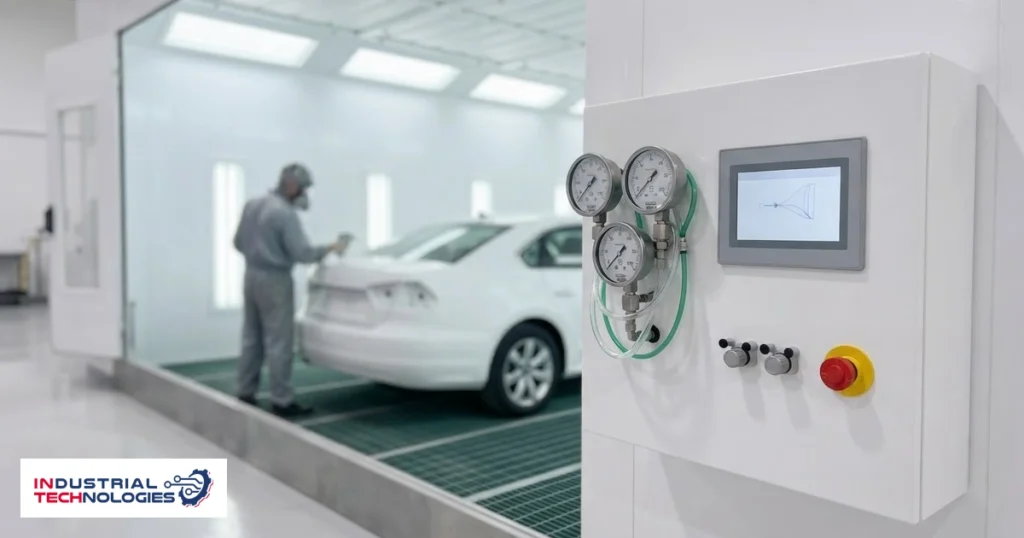
A pressure gauge is listed in the published standard supply of the highest-extraction model, and it earns its place twice over.
Its obvious job is telling the operator the chamber is in its normal band. Its more valuable job is trend: a reading that has drifted steadily over weeks is filtration reaching the end of its life, visible before any defect reaches a panel.
This only works if somebody wrote down the reading when the booth was new and the filters were clean. That single number at handover turns the gauge from a dial into a diagnostic.
The safety door is the last line
The same published supply list includes a safety door that opens automatically when pressure exceeds 10 Pa.
Its function is purely protective. If the balance between inside and outside is disturbed — by a blocked filter or an obstructed duct — the door relieves the difference rather than the structure absorbing it.
It is built into the chamber rather than added afterwards, which is the distinction worth applying when comparing offers. Safety features that arrive as accessories tend to be the first items removed under budget pressure.
What sits upstream and downstream
Pressure behaviour is downstream of filtration and upstream of the stack. Both are published: dry fibreglass filtration that captures overspray before the exhaust path, protecting the fan and the stack, and a 5 m chimney in the standard supply.
Every additional elbow added on site between fan and outlet reduces actual extraction below the published figure. The pressure reading is where that shows up first, which makes duct routing a pressure question as much as a layout one.
Pressure components in the published supply
What ships as standard, and what each part is for:
| Component | Published | Role |
|---|---|---|
| Paired air figures | e.g. 25,000+25,000 m³/h | Supply and extraction are separate figures |
| Pressure gauge | In the standard supply | A maintenance instrument, not a display |
| Safety door | Opens automatically above 10 Pa | The last line — a designed outlet for excess pressure |
| Dry fibreglass filtration | Captures overspray before the exhaust path | Protects the fan and the stack |
| Chimney | 5 m in the standard supply | The exhaust path itself |
Common questions
What should the operator do when the door opens?
Stop the cycle and check filtration and the exhaust path before restarting. A door that has opened has reported a real imbalance, and restarting without finding it means the next event happens under load.
How often should filters be changed?
Filtration is a consumable replaced on schedule rather than on failure — typically twice a year within preventive maintenance, according to running hours, and differing between pre-filter, ceiling filter and floor filter. The detail is on the spare parts and filters page.
Are these components on the custom builds too?
Filtration stages, heating system, extraction direction and chamber dimensions are all specified per build for anything outside the automotive chamber size, so the safety arrangement is set in design rather than inherited from a catalogue model.
What to send with your enquiry
Your building height and roof type, the proposed booth position, the available route to the stack outlet, and the regulatory requirements applied at your location. Then request a quotation.