
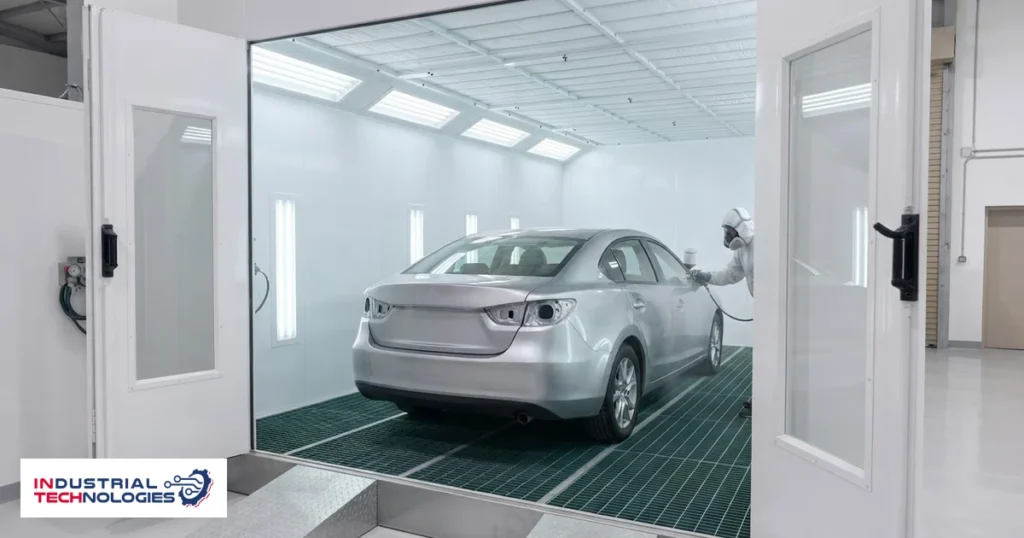
A finish defect is almost never a paint problem. It is a particle problem, and particles move with air. Which means the question that decides finish quality is not what you spray but where the air goes while you spray it.
That is why downdraft booth airflow is the first specification to settle and the hardest to change afterwards — it is built into the structure, the floor and the site works.
Three arrangements, three site consequences
The buyer’s guidance published on this site describes air moving through a calculated path: from ceiling to floor in a full downdraft, or in a semi-downdraft arrangement that pulls fumes and dust away from the vehicle body before they touch freshly sprayed paint.
A third arrangement is documented on the published models: side intake and rear exhaust. The highest-extraction model in the range specifies exactly that, described as an engineered path that keeps overspray moving in one direction away from the workpiece.
The practical separation between them is civil works. Full downdraft needs somewhere for air to go beneath the vehicle — a pit or a raised platform. Side-intake arrangements do not, which is why they appear on installations where the floor cannot be opened.
Volume is only half the specification
Published capacities across the range are given as paired figures, not single ones: 20,000+18,000 and 25,000+25,000 m³/h.
Reading those as a total is the most common mistake in comparing two offers. They are supply and extraction, and the relationship between them determines whether the chamber sits at positive pressure — which keeps unfiltered air out — or negative, which pulls it in through every gap.
What the guidance asks you to look for is consistent: a high air change rate inside the cabin and a stable air velocity at the floor inlet. A booth that satisfies the volume figure and not the velocity figure will still show defects.
The dead corner problem
Air distribution is not uniform by default. The published guidance is direct about it: verify that the distribution system covers the entire cabin with no dead zone or unventilated corner.
Dead zones matter because they are where suspended particles settle out of the moving stream and wait. They come back down onto the next panel, and the defect appears in a spot that has no relationship to where the operator was standing.
The same guidance adds a motor requirement worth carrying into a quotation comparison: confirm that motors are rated for continuous industrial duty rather than intermittent use.
Airflow changes between spray and bake
The two phases of a cycle want different things. Spray needs full extraction to carry overspray out. Bake does not, because discharging all of the heated air means paying to heat it again.
The published standard supply on the highest-extraction model includes a pneumatic damper that switches between painting and drying modes, which is the mechanism that makes the two phases behave differently in the same chamber.
Published air capacities
Capacities are given as paired figures, not single ones — and the gap is the specification:
| Tier | Supply + extraction | What the figures mean |
|---|---|---|
| Published models | 20,000+18,000 · 25,000+25,000 m³/h | Supply above extraction on the INTECH X300 and X360 holds positive pressure; the higher pair is balanced |
| Custom range | to 190,000 m³/h per supply or extraction set | Heat output 200,000–600,000 kcal/h |
Common questions
Can I retrofit an arrangement change later?
Rarely without civil works, because the path is structural. It belongs in the design conversation, and for anything outside the automotive chamber size it is set as part of a custom build.
What air capacity is available on custom builds?
The published executed range extends to 190,000 m³/h per supply or extraction set, with heat output from 200,000 to 600,000 kcal/h. The final figure follows chamber volume, as set out on the family page.
How do I verify airflow after installation?
Measure velocity at defined points and record the pressure gauge reading when filters are new. Both are baselines. A drifting reading later tells you the filtration has loaded before any defect appears on a panel.
What to send with your enquiry
Whether your floor can be opened, your clear building height, the largest workpiece you handle, and your daily cycle count. Then request a quotation against that site.