
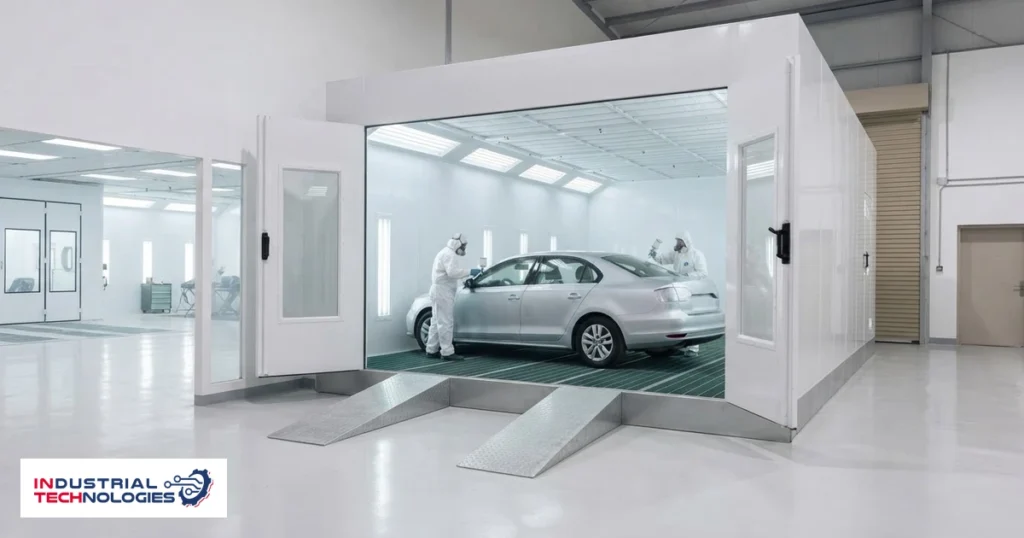
Most refinishing work in the Kingdom runs on temperature control alone, and that is sufficient. But one class of work will not pass inspection if temperature is held and humidity is left to the weather — and it is exactly the class industrial and aerospace coating engineers ask about.
A temperature and humidity controlled paint booth is delivered here on custom builds whose coating requires a controlled environment, with the range set per project by the finishing material and the part’s requirements.
Why temperature alone is not enough
Temperature governs reaction rate and time to cure. Humidity governs something else entirely: the rate at which solvent leaves the applied film, and how the surface behaves before it sets.
So the symptom appears after spraying rather than during it — a finish that lost its gloss, or a film dry to the touch and soft underneath. An operator reading temperature alone sees two correct numbers and a wrong result.
| Variable | What it controls | What shows when it drifts |
|---|---|---|
| Temperature | Reaction rate and time to cure | Slow cycles or under-cure |
| Humidity | Solvent evaporation rate and film behaviour | Surface defects appearing after apparent drying |
| Airflow | Spray environment renewal and overspray removal | Variation across areas of the same part |
When it becomes a requirement
Three situations make humidity control a specification item rather than a luxury:
- The coating demands it — some industrial and aerospace coatings are applied inside a humidity window the material supplier defines
- Acceptance demands it — sectors running to strict accreditation judge equipment on repeating a result and documenting it
- The site demands it — a coastal facility works in conditions an inland one does not, and the gap shows in one season rather than year-round
Outside those three, temperature control with the right filtration and even airflow covers most repair workshops and collision centres, and adding humidity control there is cost without a return on the finish.
How the window is set
We do not publish a single humidity window that fits every project, because it is not a property of the booth — it is a condition of your material. The range is set per project from the finishing material and the part’s requirements, and it is written into the technical specification.
So the conversation starts from the datasheet of the material you use rather than from a booth catalogue. The window is read from that sheet, and the configuration is built on it.
Where this sits in a custom build
Temperature and humidity control is one of the configuration items set by the part and the nature of the industry — like internal size, extraction direction, heating system and filtration stages.
The published family range extends to 24,000 mm long, 20,000 mm wide and 6000 mm high, with heat output from 200,000 to 600,000 kcal/h, and the controlled environment is built inside that range rather than outside it.
Frequently asked questions
Do the stock INTECH models control humidity?
The stock models are built on the standard automotive size and their temperature is controlled. An environment holding both temperature and humidity is delivered on custom booths whose coating requires it.
What humidity window do you hold?
It is set per project from the finishing material and the part’s requirements. We do not publish one figure because it changes with the material — send your material datasheet so the window is derived from it and written into the specification.
Does humidity control raise running cost?
It adds load to the system, yes. That is why we recommend it only where the material, the acceptance requirements or the site conditions call for it — elsewhere it is spend with no effect on the finish.
Can it be added to an existing booth?
It depends on the booth’s construction and the available supply capacity. Adding it is far easier where it was allowed for in the first design, which is why we ask about the coating you expect to run rather than the one you run today.
Related reading
- Controlled Spray Environment
- Humidity Effect on Paint Drying
- Custom Booth Site Survey
- Radar Component Finishing Booth
What to do next
Send your finishing material datasheet, the largest part size and your acceptance requirements, and we will return a controlled-environment configuration built on your material. talk to a specialist. The published range is on the paint booth family page.