
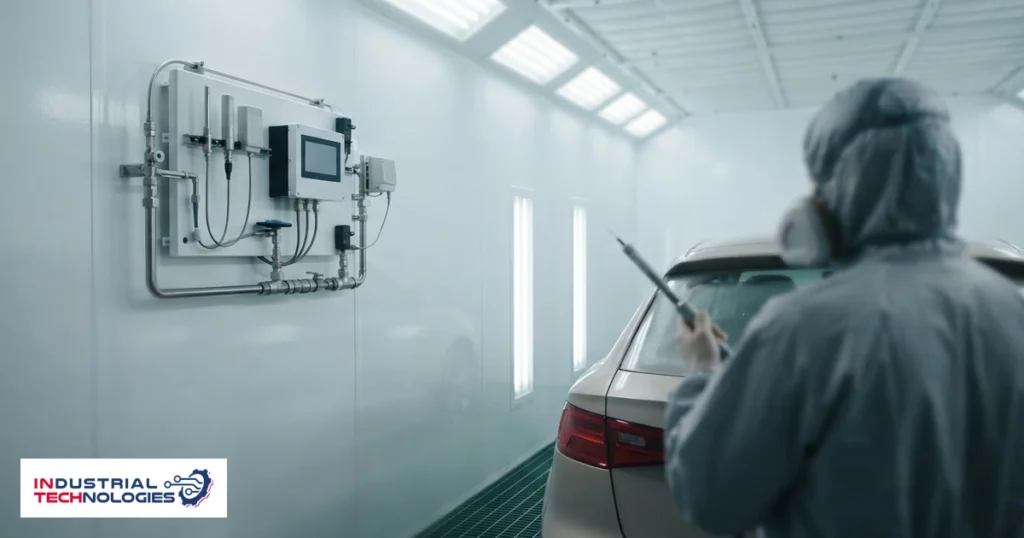
A complaint that recurs in summer and near the coast: the booth runs at its correct temperature, the cycle ends on time, and the finish comes out with less gloss than usual or as a film that looks dry and scratches easily.
The humidity effect on paint drying is the commonest explanation for that, and it is an effect no thermometer reports.
What humidity actually governs
Temperature governs reaction rate and time to cure. Humidity governs something else: the rate at which solvent leaves the applied film, and how the surface behaves before it sets.
So the symptom misleads. The cycle finished on time and at temperature; the film did not finish what belonged to it. The operator reads two correct numbers on the panel and a wrong result on the part.
| What the panel shows | What happens at the surface |
|---|---|
| Temperature reached target | Reaction proceeding at its correct rate |
| Time elapsed | Solvent not leaving at the assumed rate |
| Cycle complete | Film dry to the touch and soft beneath |
Why it worsens in particular seasons
A coastal facility works in conditions an inland one does not, and the gap does not show year-round but in one season. That explains why output quality shifts in a workshop that changed nothing in its procedures.
The correct reading is that conditions changed rather than that the equipment tired — a distinction that saves an unnecessary service call.
When both are held together
Holding humidity alongside temperature is delivered on custom booths whose coating requires a controlled environment, with the range set per project from the finishing material and the part’s requirements rather than by a general figure.
Short of that, three measures reduce the effect without changing equipment: scheduling sensitive work outside humid peak hours, staying inside the material’s window as its supplier defines it, and logging time-to-cure-temperature weekly as an early indicator.
Filtration enters the calculation
A loaded filter resists airflow, flow drops, and the spray environment renews more slowly. The result gets read as a humidity effect when its source is filtration.
So the two causes are separated by measurement rather than guesswork: differential pressure across the filter reports its actual condition, and time-to-temperature moves with it.
Frequently asked questions
How do I know the problem is humidity rather than heat?
The distinguishing symptom is that temperature and time are correct and the finish is not, and that the condition is seasonal or tied to an hour of the day. A heat problem shows as slowness reaching temperature rather than as a surface defect.
Can longer cycles compensate?
Sometimes partly, but it is an expensive remedy: extending the cycle multiplies across daily part count. It is sounder to establish your material’s window first, then decide whether a controlled environment is actually needed.
Do you control humidity in every booth?
No. It is delivered on custom builds whose coating requires a controlled environment. Stock models at the automotive size hold temperature, which covers most repair and collision work.
What should I send first?
The datasheet of the finishing material you use. The operating window you need is read from it, and the configuration is built on that if it is required at all.
Related reading
- Temperature and Humidity Controlled Paint Booth
- High-Efficiency Filtration Paint Booth
- Controlled Spray Environment
- Colour Matching After Modification
What to do next
Send your material datasheet and a description of what you see and when, and we will come back with a diagnosis and a configuration if one is warranted. talk to a specialist. The published range is on the paint booth family page.