
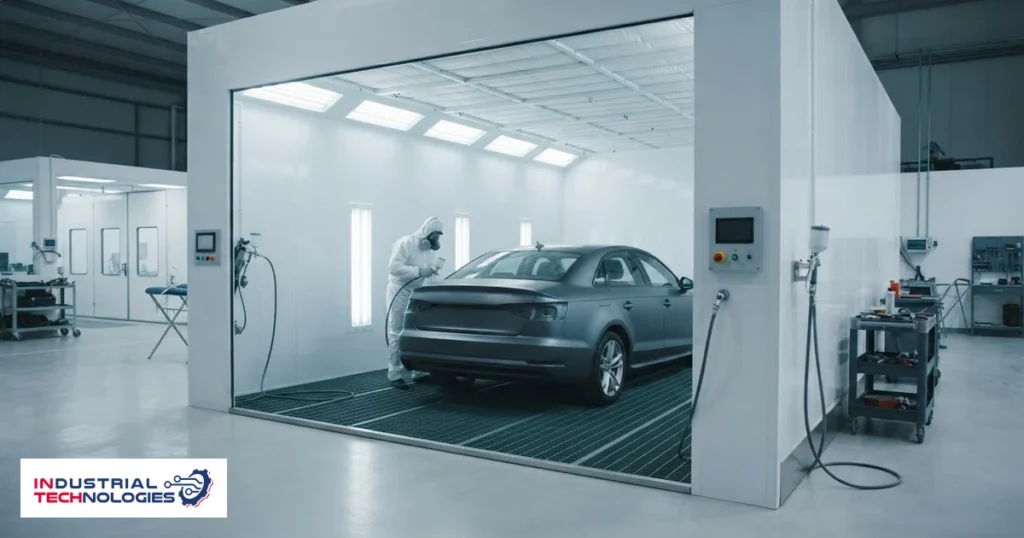
A question recurs in specification meetings: do we need high-efficiency filtration? The honest answer is that it is not a yes-or-no question. Filtration is layered, and each layer is added for a different reason and carries a different running cost.
A high-efficiency filtration paint booth is specified from your coating material and your facility’s acceptance requirements, not from chamber size alone as is commonly assumed.
What is published in this family
Filtration in our builds starts with stop, pre and ceiling filtration at EU3, EU4 and EU5 classes, and extends to three-stage bag and high-efficiency filtration at ≥98% efficiency where the build requires it.
| Stage | What it catches | What consumes it |
|---|---|---|
| Stop filter | Overspray leaving the chamber | Volume of material sprayed |
| Pre-filter | Ambient dust entering | Cleanliness of site air |
| Ceiling filter EU3–EU5 | What reaches the sprayed surface | Running hours and dust load |
| Bag and high-efficiency filtration ≥98% | Remaining fine particulate | The two stages ahead of it |
Note the last column. Each stage protects the one behind it, and the last stage is the most expensive. Neglecting the pre-filter consumes the high-efficiency filter several times faster than the budget assumed — the commonest cause of running costs rising with no visible reason.
When three stages are genuinely required
Three contexts make three-stage filtration a requirement rather than an option:
- Acceptance and documentation — sectors like aerospace and rail run to strict accreditation, and equipment is judged on repeatability
- Large chambers — builds toward 24,000 mm in length carry three-stage bag and high-efficiency filtration
- Coating material — some materials impose a higher filter class by their nature rather than by chamber size
Outside those contexts, ceiling filtration at the highest class the model offers covers most repair workshops and collision centres.
Saudi ambient conditions change the consumption maths
The pre-filter is by a wide margin the shortest-lived stage here, because it receives ambient dust directly. Two workshops on identical schedules can differ completely in pre-filter consumption simply because one sits near an unpaved road.
So managing filtration by differential pressure is more accurate than managing it by a date on the wall. A loaded filter resists airflow and the pressure drop across it rises, which reports its actual condition rather than its age on paper.
Filtration and airflow are read together
Every added filtration stage adds resistance for the fan. A chamber designed with three stages needs more pressure headroom than one designed with two at the same flow — and the published flow range runs from 18,000 to 190,000 m³/h per set.
Frequently asked questions
Is high-efficiency filtration mandatory in every large chamber?
Not by size alone. It is included in large builds and in sectors with strict acceptance requirements, and it is decided with the rest of the configuration once your material and facility requirements are known.
What is the difference between EU3, EU4 and EU5?
Ascending efficiency grades in ceiling filtration. The higher class catches finer particulate and produces a cleaner surface, and resists airflow more — so the choice is read against fan pressure headroom rather than on its own.
How often are filters changed?
Each stage has a different life: the pre-filter is shortest and watched weekly, the ceiling filter follows running hours, and the stop filter follows the volume of material sprayed rather than elapsed time. Differential pressure is the truest indicator.
Can filters be blown clean with compressed air instead of replaced?
We advise against it. Back-blowing opens channels through the filter medium and air then passes without being filtered, so the filter looks clean and has lost its function. The result shows on the finish rather than on the filter.
Related reading
- Powered Booth Door
- Custom Booth Site Survey
- Spray Booth Gas Monitoring
- Activated Carbon Filtration
- Downdraft Booth Airflow
- Three Stage Bag High-Efficiency Filtration
What to do next
Send your finishing material, your facility’s acceptance requirements and the chamber size you need, and we will return a filtration configuration built on your case. talk to a specialist. The published range is on the paint booth family page.