
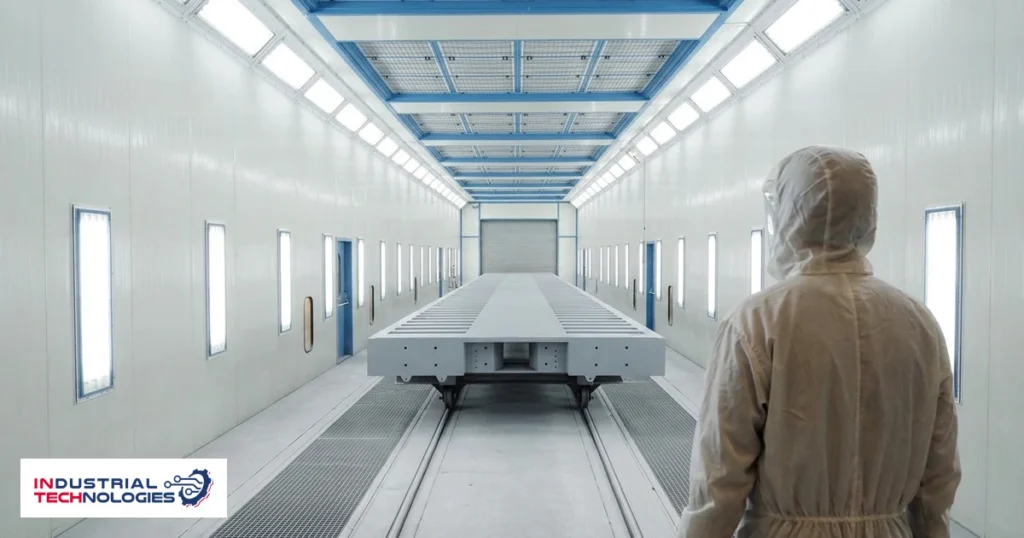
One scene repeats across rail projects. The site is approved, the floor area is reserved, and then somebody works out that the vehicle is two metres longer than the chamber. Those two metres do not cost a modification — they cost a redesign.
A rail car paint booth begins with one figure fixed ahead of the others: the overall length of the vehicle as it will actually enter, not its length on a datasheet.
Length first, the rest follows
The published delivery range in this family starts at 16,000 mm for large structures and extends to 24,000 mm. Metro and mainline vehicles both sit inside that range, but where they sit is set by your vehicle.
After length comes free height above the vehicle roof, which is why the required figure is higher than the vehicle itself — spraying and ventilation both need volume above it, not parity with it.
| Item | Where the number comes from | Published range |
|---|---|---|
| Internal length | Vehicle overall length + technician working space | up to 24,000 mm |
| Internal width | Vehicle width + circulation around it | up to 20,000 mm |
| Internal height | Vehicle height + free volume above | 2650 – 6000 mm |
| Main door | The largest section entering | up to 14,200×5,000 mm powered |
| Air capacity | Final chamber volume | up to 190,000 m³/h |
The door is a specification item, not an accessory
A door reaching 14,200×5,000 mm is not hand-operated on a repeated daily cycle. Powered operation becomes part of the specification itself, and it enters both the electrical load calculation and the maintenance schedule.
Buyers commonly leave the door to the end of the negotiation. That is the wrong order: door size constrains chamber size and chamber position in the hall, so it is an early decision.
Flow is calculated on the chamber, not the vehicle
A simple rule settles the confusion: air capacity follows the volume you need to keep clean, not the type of object inside it. A 24 metre chamber needs flow reaching 190,000 m³/h per set, and that is what separates this build from an automotive booth.
Heat output follows the same logic, with a published range extending to 600,000 kcal/h and a final figure set once volume is fixed.
Separating preparation from painting
Stripping old coating and inspection carry different extraction requirements from spraying. On a full-vehicle rail project the case for separation is stronger than in an automotive workshop, because each stage runs longer and overlap costs more.
Frequently asked questions
Is there a stock booth at rail vehicle size?
No. Anything beyond the automotive size is built to order rather than sold as a stock model. The published range extends to 24,000 mm long, and the final size is built on your vehicle.
How does a metro car differ from a mainline car in design terms?
In the numbers rather than the principle. Length, height and width differ between them, and both sit inside the same published range. We take your vehicle dimensions rather than choosing between two categories.
Can two vehicles share one chamber?
Possible where internal length takes both plus working space between and around them. Flow and heat output are then calculated on the larger volume, so a double chamber is not twice the cost of a single one — it is more, specifically in the air package.
What site requirements apply at this size?
Ventilation and fire requirements for large chambers, disposal of paint and solvent waste under the applicable environmental rules, and SASO conformity for imported equipment. Details vary by city and by where the facility sits.
Related reading
- Aircraft Paint Booth
- Yacht Paint Booth
- Spray Booth Gas Monitoring
- Timber Drying Cycle Booth
- Chamber Length for Rail Vehicles
- Metro Car Finishing Enclosure
- The industrial coating heat curve
- Rail Axle Lifting Equipment
What to do next
Send the overall length, width and height of the vehicle and how it enters the hall, and we will come back with a chamber and door built on your dimensions. Request a quote. The full range is on the aerospace, marine and rail industry page.