
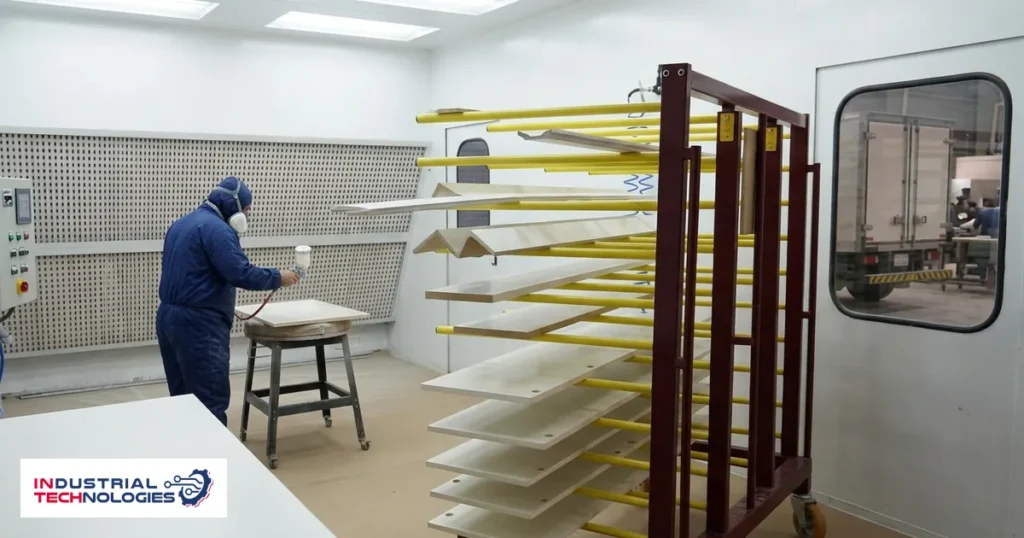
A furniture manufacturer bought a used booth from a car workshop and ran it on the same schedule. The result was cracked surfaces and warped panels, and two lost batches before anything changed.
The booth was not the fault. A timber drying cycle booth is not a vehicle cycle at slightly lower heat — it follows a different logic, starting from the fact that timber is a living material reacting to heat and moisture together.
Why the heat is lower
Booths in this sector are built with a lower-temperature drying cycle suited to timber. Wood holds internal moisture, and rapid heating drives it out faster than the surface can accommodate — so cracking or warping shows up days later rather than immediately.
The practical consequence: cycle time in wood finishing is longer and its temperature lower than in vehicle refinishing. Anyone measuring throughput in parts per hour has to build the calculation on that rather than on an automotive average.
| Item | Vehicle refinishing | Timber finishing |
|---|---|---|
| Heat curve | Higher and faster | Lower, with a drying cycle suited to timber |
| What sets the size | Vehicle length | Largest furniture piece and how it enters |
| Dust source | Ambient air outside the workshop | Sanding and cutting inside the plant |
| Extraction | Handles overspray | Handles dust and overspray together |
Extraction handles two things, not one
This difference is widely missed. In a car workshop dust arrives from outside and is dealt with by the pre-filter. In a furniture plant dust is generated inside continuously by sanding and cutting, and it keeps forming while work proceeds.
Extraction here is designed to handle dust and overspray together, and separating preparation from spraying becomes a surface quality condition rather than an environmental improvement. The separation is physical rather than procedural, because procedure alone does not stop dust.
Size follows the largest piece
A door, a panel, a table and a kitchen front pass down the same line at completely different sizes. The chamber is built on the largest piece and on how it is hung or placed, within a published range extending to 24,000 mm long and 20,000 mm wide.
Air capacity follows the material too
Timber finishing materials differ from vehicle refinish in volatility and drying requirements. Air capacity and filter class are set on that basis rather than carried over from another sector, with a published range from 18,000 to 190,000 m³/h depending on size.
Frequently asked questions
Will an automotive paint booth do wood finishing?
The principle is the same — a controlled air and heat environment — but size, heat curve and part entry differ. That is why a wood booth is built to order around the part and the production line.
How much lower is the timber cycle?
The specific temperature follows your finishing material and timber type. The published principle is that the cycle runs cooler than a vehicle cycle, and the figure is set to your material at configuration stage.
Do I need a preparation room separate from the booth?
In woodworking yes, and more clearly than in the automotive sector, because dust is generated continuously inside the plant by sanding. Physical separation with dedicated extraction is what stops dust returning to the surface after spraying.
What safety requirements are specific to timber?
Management of accumulated wood dust and the fire requirements attached to it, plus ventilation and disposal of finishing material and solvent waste. Details vary with the municipality and the plant location.
Related reading
- Signage Finishing Oven
- EU3 EU4 EU5 Filter Classes
- Continuous shift booth operation
- Furniture booth sizing
What to do next
Send the largest piece on your line, how it enters, and the finishing material you use, and we will return a chamber design built on your line. talk to a specialist. Sector detail is on the woodworking and furniture page.