
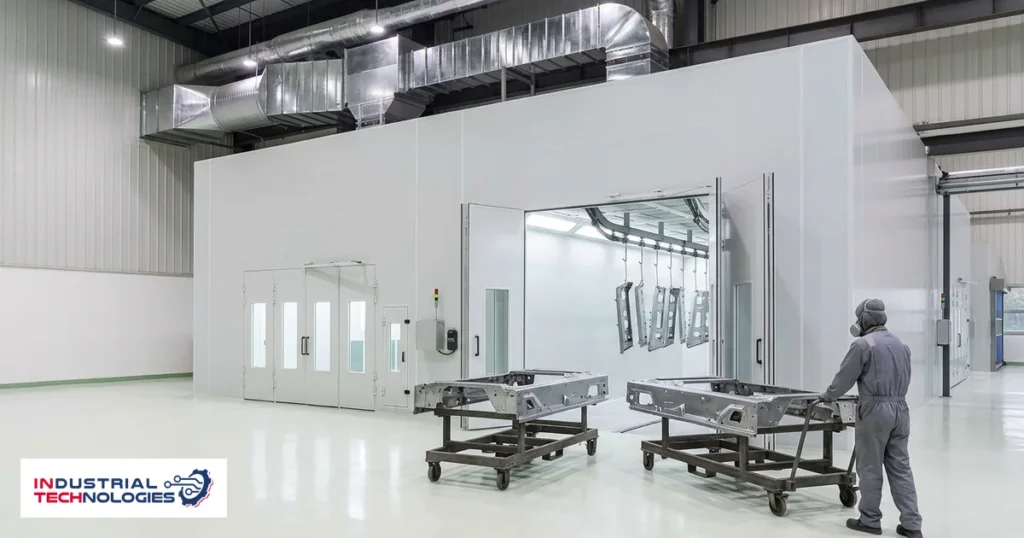
A workshop that runs its oven for a few hours a day is buying a specification. A plant that runs it across continuous shifts is buying something else entirely.
Continuous shift booth operation shifts the selection criteria from peak specification to endurance, serviceability and spare-part availability — a difference written into this sector’s configuration rather than inferred from it.
Why the criteria invert
A peak figure is read in a catalogue and measured under ideal conditions. What gets measured in a plant that never stops is the running time between two services, and how quickly the equipment is back in service after a fault. A finishing chamber going down in a plant stops a whole line, not a station — and the difference between one hour of downtime and eight is part availability, not fan power.
Three items discussed alongside the specification itself
| Item | Why it comes before the peak figure |
|---|---|
| Filtration | Change intervals govern planned downtime, and filter class changes airflow resistance |
| Maintenance schedules | Planned service is scheduled around production shifts rather than after them |
| Critical spares | A part that is not held locally turns a short fault into a long stoppage |
What gets sent so it can be built on
Shift count and daily operating hours are what this side of the specification is built on. They describe how the plant actually runs, and they cannot be inferred from chamber size or coating type, so they are stated explicitly alongside the other inputs.
Frequently asked questions
Are the chambers suitable for continuous shifts?
Continuous operation shifts the selection criteria from peak specification to endurance, serviceability and spare-part availability. Send the shift count and operating hours so the specification is built on how the plant actually runs.
How often are filters changed under continuous running?
Change intervals follow actual running hours, the coating material and overspray density, so they are built on the plant’s operating pattern rather than a general schedule. They are discussed alongside the specification because they govern planned downtime.
Does filtration selection differ from a workshop?
Filtration delivered in this family is stop, pre- and ceiling filtration in classes EU3, EU4 and EU5, reaching three-stage bag and high-efficiency filtration at ≥98%. The choice among them follows the finish level required and the operating pattern together.
Why are spares discussed before purchase?
Because critical spares are discussed alongside the specification itself in this sector. A part ordered after the fault is measured by its lead time rather than its price, and that lead time shows up directly in production.
Related reading
- Four inputs for industrial booth design
- Steel structure finishing chamber
- Part weight in chamber design
Next step
Send the dimensions and weight of the largest part or platform to be coated, together with your site area, and the internal size and configuration come back against them. Talk to a specialist. The published range sits on the paint booths family page, and the sector configuration on the Industrial & Manufacturing sector page.