
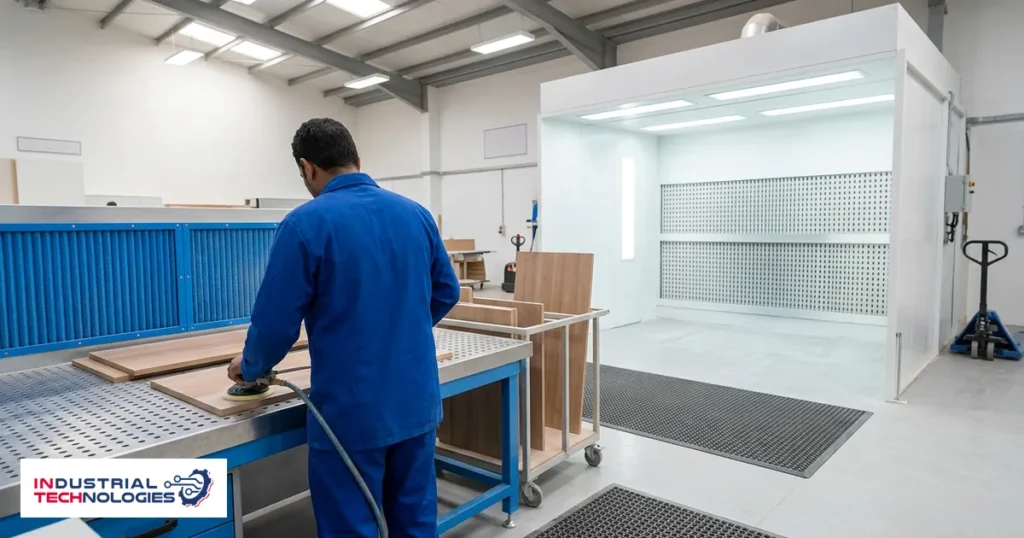
In a car workshop dust arrives from outside, so it is handled by sealing and filtering at the intake. In a furniture plant the dust is produced inside the plant itself, by sanding and cutting, so it circulates and settles back onto the surface right after spraying.
That is why the family page describes the woodworking configuration as extraction that handles dust and overspray together. Dust and overspray extraction is not a marketing phrase but two loads sharing one air path, and each of them behaves differently.
Two loads, not one
Overspray leaves the gun at the moment of spraying and travels with the air stream to the filter while it is still wet and tacky. Sanding dust comes before spraying, stays suspended after it, and is dry and light enough to settle on the first horizontal surface it finds. A path designed for overspray alone lets the dust through; a path designed for dust alone loads up with overspray.
What changes in the configuration
| Item | What changes in woodworking |
|---|---|
| Extraction direction | Set by the part and how it is loaded, not by an envelope carried over from vehicles |
| Filtration stages | Set by the finishing material in use rather than by vehicle paint |
| Air capacity | Calculated from chamber volume and finishing material together, within the delivered range 18,000–190,000 m³/h |
| Prep location | Physically separated in a prep and mixing room with its own extraction |
Why the answer is not carried over from another sector
The family page notes that the woodworking cycle is a lower-temperature drying cycle suited to timber. A cooler cycle means a longer window in which the surface stays open to dust. So a solution carried over from a car workshop handles overspray well and leaves the surface exposed during exactly the period when dust matters most.
Frequently asked questions
Is general extraction from the workshop roof enough?
General extraction lowers the concentration in the room without protecting the sprayed surface, because the dust that matters is what settles on the part in its first few minutes. That protection comes from an air path inside the chamber and from separating prep away from it.
What extraction capacity does the prep area need?
It is fixed during the site survey rather than by a general rule, because it follows the prep area, the number of sanding points working at once and the timber in use. Those are measured in the plant itself before the configuration is signed off.
Can one filter stage handle both loads?
Filtration stages are set by the finishing material in use, and dry dust and wet overspray load a filter in two different ways. The number of stages is therefore fixed with the configuration before manufacture, not after it.
How do I know the current extraction falls short?
The operational signal is re-sanding and repainting rather than an instrument reading. If the surface needs a second pass after spraying, dust is reaching it somewhere between prep and curing.
Related reading
- Physical separation of sanding and spraying
- Air capacity for wood coating
- Fire requirements for wood dust
Next step
Send the largest part on your line, how it is loaded and the finishing material you use, and a chamber design comes back built around your line. Talk to a specialist. The published range sits on the paint booths family page, and the sector configuration on the Woodworking & Furniture sector page.