
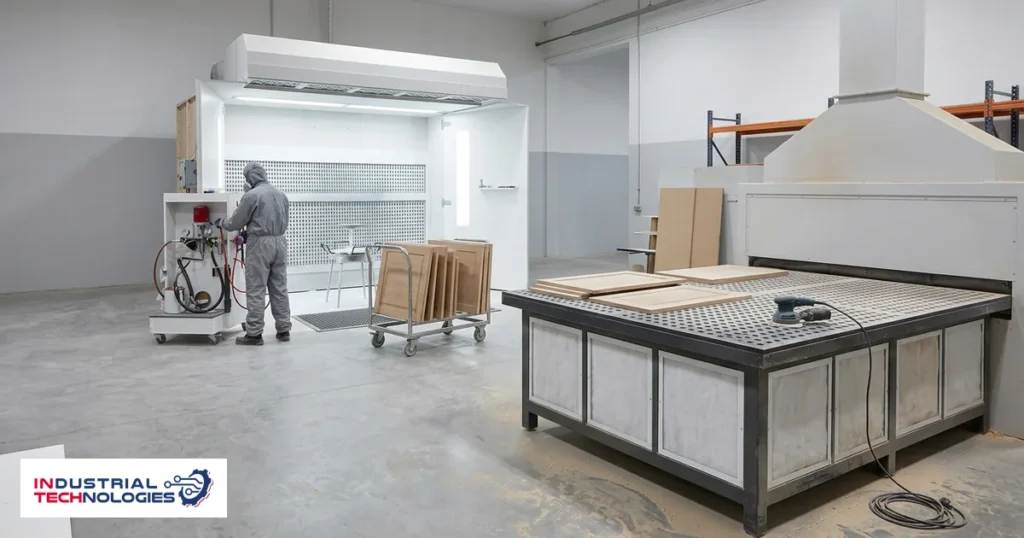
Many plants answer the dust problem with a timetable: sand in the morning, spray in the afternoon. Then dust settles on the sprayed surface, the part is re-sanded, and it is repainted.
The reason is that dust does not follow a timetable. What the job needs is physical separation of sanding and spraying — and the sector page says it plainly: the separation here is physical, not procedural, because procedure alone does not stop dust.
The difference between the two separations
| Kind of separation | What it guarantees |
|---|---|
| Procedural (by time) | Reduces overlap between the two tasks; does not stop suspended dust settling on the prepared surface |
| Physical (by place and extraction) | Traps dust where it is generated, so it never reaches the prepared surface |
| Operational effect | The difference is paid in re-sanding and repainting, not in finishing materials |
Why woodworking is a special case
Unlike a car workshop, a furniture plant generates its own dust from sanding and cutting, and it does so continuously. The source is internal and constant rather than external and occasional, which is what makes extraction and separating prep from spray areas a surface-quality requirement rather than an environmental nicety.
What makes the separation physical
The prep and mixing room has its own extraction, independent of the spray chamber. That independent extraction is what makes the separation physical: dust is pulled out where it is generated, before it reaches shared air. The distance and openings between the two areas are fixed during the site survey along with the rest of the configuration.
Frequently asked questions
Is a curtain or partition between the areas enough?
A partition cuts the direct path without addressing shared air, and light dust travels with the air stream rather than in a straight line. What settles the question is dedicated extraction for the prep area.
How far should the prep room sit from the spray chamber?
The distance follows the plant area and the route the part takes between the two stations, and it is fixed during the site survey rather than by a general rule. The aim is the shortest route and the least open air for a prepared part.
Do I need a prep room separate from the booth?
In woodworking yes, and more clearly than in the automotive sector, because dust is generated inside the plant continuously by sanding. Physical separation with dedicated extraction is what stops dust returning to the surface after spraying.
Is the prep room used for mixing as well?
Yes — it is called a prep and mixing room because it carries both functions. Mixing itself needs a controlled environment because finishing materials are volatile, which is what makes the dedicated extraction necessary twice over.
Related reading
Next step
Send the largest part on your line, how it is loaded and the finishing material you use, and a chamber design comes back built around your line. Talk to a specialist. The published range sits on the paint booths family page, and the sector configuration on the Woodworking & Furniture sector page.