
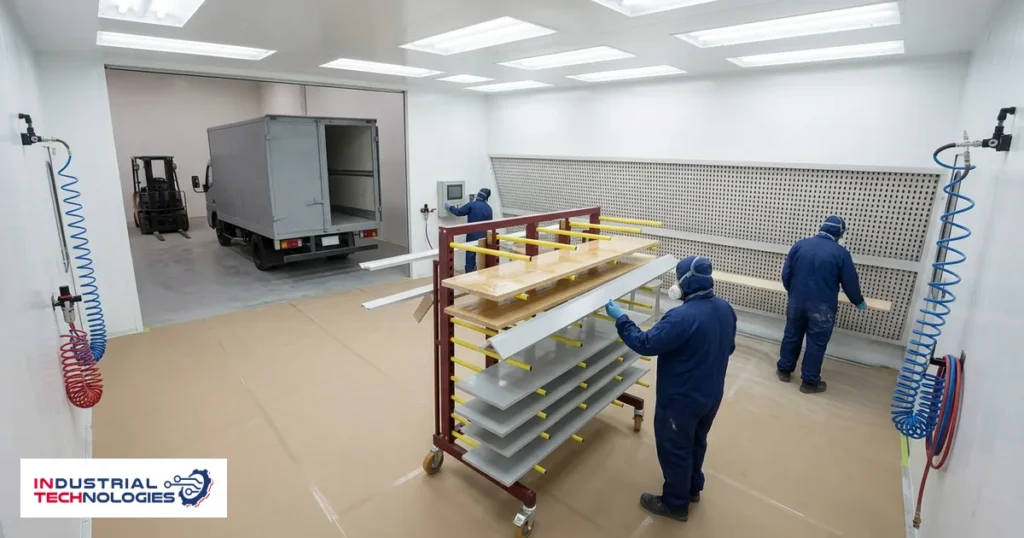
The question “how much air capacity do we need?” usually arrives before the question “which finishing material do you use?” — and the order is reversed. Air capacity is an output, not an input.
The air capacity for wood coating is one item with the material, not two: the sector page states that ventilation and filtration are designed around the finishing material, so air capacity and filtration class are set from it rather than carried over from another sector.
Why the figure is not taken from vehicle paint
Wood finishing materials differ from vehicle paint in volatility and in curing requirements. The two differences pull in opposite directions: volatility raises the need for air changes, while the lower-temperature drying cycle suited to timber lengthens the period over which those changes happen. A figure carried over from a car workshop gets a volume right and a duration wrong.
What goes into the calculation
| Input | Effect |
|---|---|
| Internal chamber volume | The arithmetic base, itself derived from the largest part and how it is loaded |
| Finishing material | Sets filtration class, air-change requirements and the drying curve |
| Sanding dust | A second load on the same path, counted with the overspray rather than after it |
| Delivered range | 18,000–190,000 m³/h per supply or extraction set |
The drying cycle follows the material too
The family page describes the woodworking configuration as a lower-temperature drying cycle suited to timber. The lower temperature is not a relaxation but a requirement of the timber itself, and the heat curve is signed off with the rest of the configuration before manufacture.
Frequently asked questions
What do I send about the finishing material?
Its name, its class and its data sheet if you have one, because volatility and curing requirements are written there. Those are the figures filtration class is built on, rather than a general estimate.
Does the capacity change if I switch material later?
Filtration class and heat curve may both change, because both are derived from the material. State more than one material if the line runs more than one class, so the configuration is built on the widest rather than the most common.
Can I adopt the air capacity from a similar plant?
A similar plant may share your volume and differ in material, which changes the figure. Volume alone is not enough, because the calculation rests on volume and material together.
Is air capacity measured after installation?
Acceptance and commissioning are where the delivered build is checked against what was signed off. The values measured there are the values fixed in the configuration before manufacture.
Related reading
Next step
Send the largest part on your line, how it is loaded and the finishing material you use, and a chamber design comes back built around your line. Talk to a specialist. The published range sits on the paint booths family page, and the sector configuration on the Woodworking & Furniture sector page.