
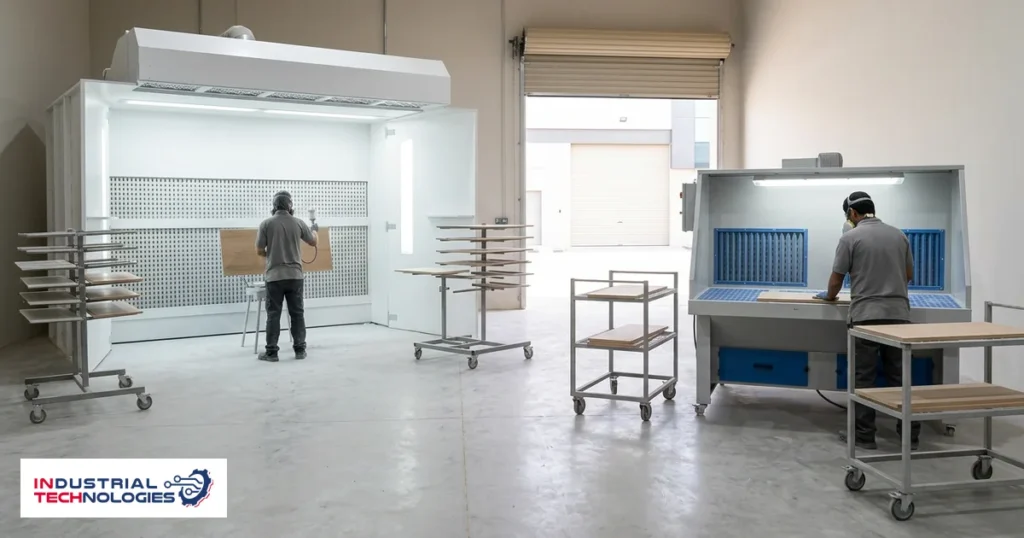
In most sectors ventilation and filtration are operating items weighed against cost. In woodworking the item leaves the weighing altogether.
The reason is that fire requirements for wood dust meet flammable finishing materials in the same room — and the sector page states it directly: accumulated wood dust and flammable finishing materials make ventilation, filtration and waste handling regulatory items rather than operational choices.
Three items the requirement pulls together
| Item | Why it enters the requirement |
|---|---|
| Ventilation | Suspended dust and volatile materials share the same air |
| Filtration | Dust accumulated in the filter is part of the load rather than outside it |
| Waste handling | Finishing-material and solvent waste is disposed of rather than stored in the work path |
| Imported equipment | SASO conformity for equipment brought in from outside |
Why “accumulated” is the word that matters
Dust circulating in the air leaves with the extraction. Dust that settles on high surfaces and inside ducting stays and builds up, which is what the published text calls accumulated wood dust. The requirement is therefore read against the whole system — extraction, filtration and cleaning — not against the chamber alone.
What the site fixes
Municipal requirements and environmental permits vary with location, plant activity and size, so they are reviewed with the competent authority for your site before the configuration is signed off. What enters the chamber design out of all this is ventilation, filtration and waste handling, and those are signed off before manufacture.
Frequently asked questions
Are an extinguisher and a smoke detector enough?
Those are response equipment, and the requirement starts earlier: ventilation that prevents build-up, filtration managed on a cycle, and waste that is not left in the work path. Response is built on top of prevention rather than instead of it.
How often is the extraction ducting cleaned?
The interval follows sanding intensity, timber type and running hours, and is fixed for your plant during the site survey along with the other operating items. The measure is preventing build-up rather than removing it afterwards.
Does conformity cover an imported booth?
SASO conformity for imported equipment is named explicitly among this sector’s considerations, and it is reviewed with the technical specification before purchase rather than after arrival.
Do the requirements differ inside an industrial city?
Location changes the authority issuing the requirement and its detail, so your own site’s requirements are the ones to review. The items that enter the chamber configuration stay the same: ventilation, filtration and waste handling.
Related reading
Next step
Send the largest part on your line, how it is loaded and the finishing material you use, and a chamber design comes back built around your line. Talk to a specialist. The published range sits on the paint booths family page, and the sector configuration on the Woodworking & Furniture sector page.