
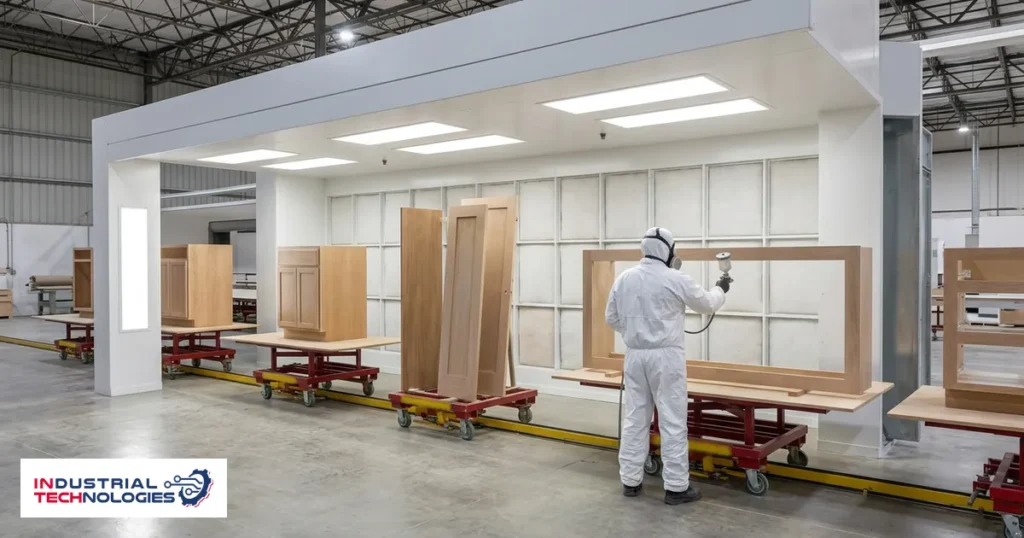
A joinery workshop differs from a large furniture plant in that its line is not fixed: a door today, a kitchen front tomorrow, a wall panel after that, at sizes no single figure covers.
A joinery product finishing booth is built on the largest piece passing down the line and on how it enters, not on the average of what gets produced.
Size from the largest piece
A door, a panel, a table and a kitchen front pass down the same line at completely different sizes, and the chamber is built on the largest piece and on how it is hung or laid.
The published range extends to 24,000 mm long, 20,000 mm wide and 6000 mm high, taking these applications with margin — and usable volume is set by row arrangement rather than by dimensions alone.
| Question | Effect |
|---|---|
| What is the largest piece on your line? | Minimum internal length and width |
| How many pieces per cycle? | Usable volume and row arrangement |
| Hung or laid flat? | Internal height and rack design |
| Which finishing material? | Heat curve and filter class |
Lower heat, longer cycle
Booths in this sector run a lower-temperature drying cycle suited to timber. Wood holds internal moisture, and rapid heating drives it out faster than the surface can take, so cracking shows days later.
The practical consequence is a longer cycle at a lower temperature than vehicle refinishing — and basing a throughput calculation on an automotive average misjudges it.
Extraction handles two things
A joinery shop generates its own dust from sanding and cutting, and it keeps forming while work proceeds. Extraction is therefore designed to handle dust and overspray together, and separating preparation from spraying becomes a surface quality condition.
The separation is physical rather than procedural, because procedure alone does not stop dust returning to the prepared surface.
Frequently asked questions
What is the largest piece you can finish?
The published range extends to 24,000 mm long and 20,000 mm wide. Final size is set by the largest piece on your line and by how it enters.
Will an automotive booth do joinery products?
The principle is the same — a controlled air and heat environment — but size, heat curve and part entry differ. That is why a timber booth is built to order around the part and the production line.
Do I need a separate preparation room?
In woodworking yes, and more clearly than in the automotive sector, because dust is generated continuously by sanding. Physical separation with dedicated extraction is what stops it returning to the surface after spraying.
What safety requirements are specific to timber?
Management of accumulated wood dust and the fire requirements attached to it, plus ventilation and disposal of finishing material and solvent waste. Details vary with the municipality and workshop location.
Related reading
What to do next
Send the largest piece on your line, pieces per cycle and the finishing material, and we will return a chamber design built on your line. talk to a specialist. Sector detail is on the woodworking and furniture page.