
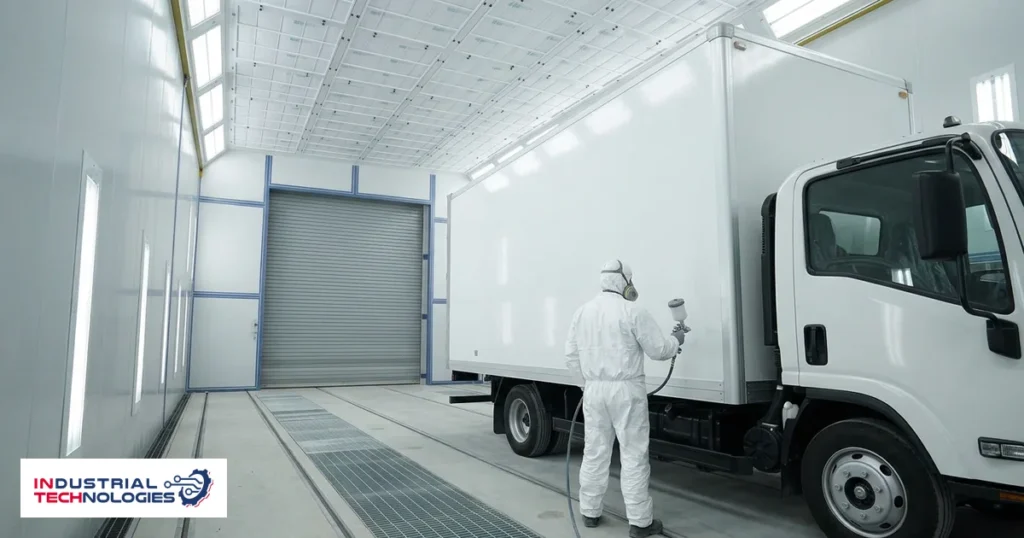
Landscaping, irrigation and municipal fleets grow with every new project, and workshops grow with them. The commonest error in fitting out those workshops is measuring the vehicle by its chassis.
A utility fleet vehicle booth is measured by the vehicle as it works: tank, boom, pump and sprayers fitted.
Fitted equipment is part of the size
A raised tank above the chassis, a folded boom and side brackets all lift real height and width above the base vehicle’s figures.
The delivered range extends to 24,000 mm long, 20,000 mm wide and 6000 mm high, which takes these vehicles — but the final figure comes from measuring yours fully fitted.
| Dimension | How it is actually measured |
|---|---|
| Overall height | Highest point including tank and folded boom |
| Overall width | Widest point including brackets and sprayers |
| Overall length | With the trailer if it enters attached |
| Turning radius | Entry and exit path inside the hall |
Irregular surfaces need reach from several directions
These vehicles are not flat boxes: a cylindrical tank, booms, pipework and shadowed areas beneath fitted equipment. Extraction running one way leaves regions the flow does not reach as it reaches others.
Extraction direction — downdraft or side — is therefore set by the nature of the work and the vehicle rather than by automotive convention.
Fleets run back-to-back cycles
A fleet workshop does not paint one vehicle a day; it runs back-to-back cycles through the day. That raises extraction requirements and makes an internal finish that takes heavy use a specification item rather than a cosmetic choice.
Add to it a longer internal chamber for light commercial vehicles, which is what distinguishes fleet configuration from a general repair workshop.
Frequently asked questions
Do I measure the vehicle bare or fitted?
Fitted, as it actually enters the chamber. The base vehicle is a misleading figure here because what you coat is the vehicle with its equipment.
Is the equipment removed before painting?
That is your operating decision, but it must be settled before design rather than after. The difference between fitted and stripped can reach a metre in height, and that changes chamber and door together.
What air capacity is required?
Calculated on final chamber volume rather than vehicle type, within the published range of 18,000 to 190,000 m³/h per set. Back-to-back cycles raise what is actually needed.
Do you serve government fleets?
Government and commercial fleets are both among the industries this family serves. Configuration follows your vehicles and operating pattern, and the specification is built on those.
Related reading
- Food Fleet Vehicle Refinishing
- Bus Paint Booth
- Refrigerated Trailer Refinishing
- Vehicle Lift Cycle Time
- Last mile fleet workshop
- Government fleet workshop fit out
What to do next
Send the overall length, width and height of the largest fully fitted vehicle in your fleet, and we will return a chamber and door built on your dimensions. Request a quote. Sector detail is on the auto fleet industry page.