
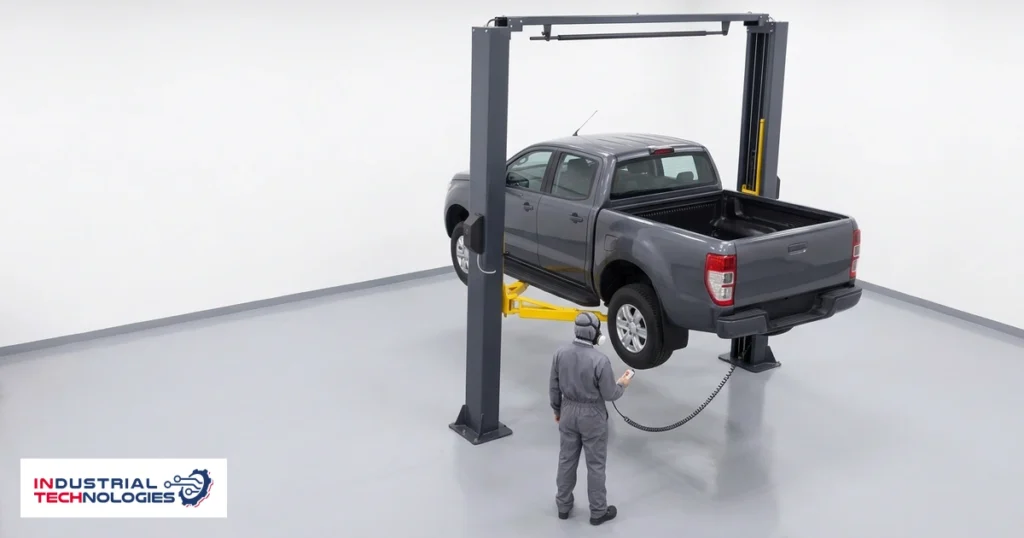
Nobody buys a lift because it rises four seconds faster. But nobody counts how many times it rises in a year either, and that is where the number stops being trivial.
Vehicle lift cycle time is one of the few specifications that converts directly into bay capacity, and it is published on the models rather than left to demonstration.
The published figure and what it covers
Across the two-post models in the family the specification is 50 seconds up and 30 seconds down, listed in the standard supply rather than as a marketing claim.
Two separate values, not one average, and the asymmetry is normal: raising works against the load, lowering works with it. Comparing one offer’s up-time against another’s average is how comparisons go wrong.
That published pair is a full cycle of 80 seconds of machine time per vehicle, before anyone touches a tool.
Where it compounds
In a general repair bay where the vehicle stays up for two hours, cycle time is noise. In a bay built for short, repetitive work, it stops being noise.
An inspection lane running fifteen vehicles a day spends twenty minutes of machine time on lifting alone. Over a working month that is several hours of bay availability decided by a specification most buyers skim past.
This is why the figure belongs to certain operations more than others: fleet inspection lanes, rental turnaround bays, and tire and brake stations all run high cycle counts against short work times.
The number is also a condition monitor
A published cycle time is useful when buying and more useful afterwards, because it is a baseline you can measure against.
A lift that rose in its rated time when installed and now takes noticeably longer is reporting something about oil, a valve or a leak — before any visible fault appears. Record the time at handover and re-measure it quarterly, and you have a maintenance indicator that costs nothing.
Preventive maintenance after final handover is the operator’s responsibility under our published terms, and this is one of the cheapest checks in that programme.
Choosing lift type by work pattern
Cycle time is not the only route to throughput. Lifting less far is the other one.
The ultra-thin scissor model publishes 600 mm lift height at 4000 kg, documented as intended for wheel, brake and suspension work that does not require raising the vehicle to standing height. A shorter travel is a shorter cycle by definition.
Matching lift height to the work is the throughput decision that sits above cycle time, and the family page sets out the published range from 600 mm to 1999 mm.
Published cycle figures
Machine time per vehicle, before anyone touches a tool:
| Item | Published | Throughput consequence |
|---|---|---|
| Two-post cycle | 50 s up · 30 s down | A full cycle of 80 s of machine time per vehicle |
| Ultra-thin scissor | 600 mm lift at 4000 kg | Wheel, brake and suspension work without raising to standing height |
| Family lift range | 600 mm to 1999 mm | Matching lift height to the work sits above cycle time |
Common questions
Does a faster lift wear out sooner?
Not as a rule — speed is a design characteristic, and the published two-post models pair their cycle times with a direct or chain drive, polymer sliders and ratchet arm locks intended for repeated duty. What wears components is cycle count and maintenance, not the rated speed.
How do I use this in a fleet bay?
Multiply cycle time by expected daily lifts and treat the result as fixed machine time. It belongs in the same calculation as bay count, which is discussed for that sector on the fleet page.
Is cycle time published for every model?
It is published where the manufacturer specifies it. Where a value is not confirmed in the catalogue it is marked as such on the product page rather than estimated, and it can be requested for a specific model at quotation stage.
What to send with your enquiry
Expected daily lifts per bay, the typical work duration once the vehicle is up, the lift height your work actually needs, and your bay count. Then request a quotation.