
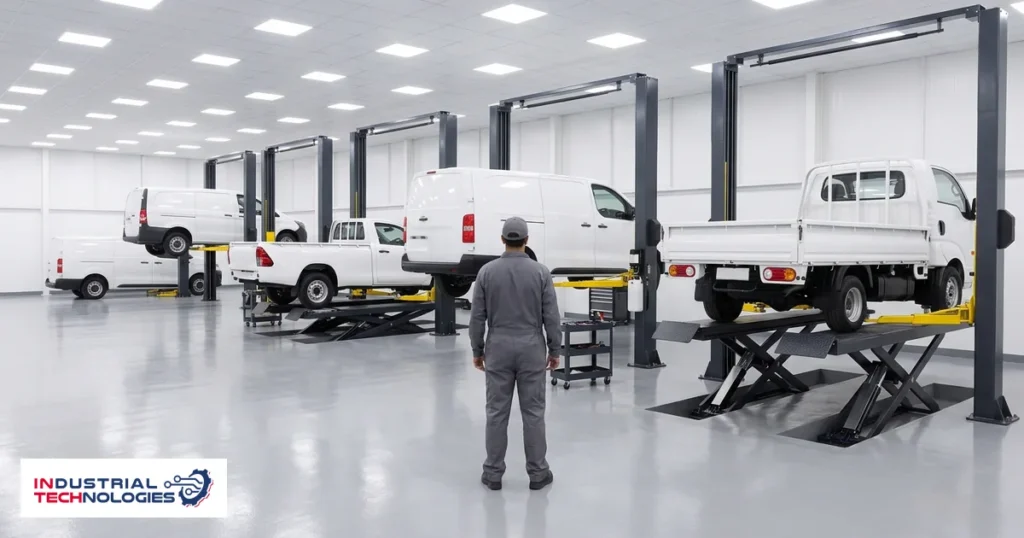
In last mile operations a stationary vehicle does not hold up a repair — it holds up a whole route and a set of deliveries. Workshop success is therefore measured by time back into service, not by jobs completed.
That metric inverts the order of decisions: a last mile fleet workshop is built around the available off-road window, and equipment is then chosen to work inside it.
What a short window means in practice
A short window does not necessarily mean faster equipment. It means the vehicle should not queue. A vehicle finished in an hour after waiting four has been out of service five — and five is the number that counts.
- A bay free on arrival — which forces the separation of planned work from breakdowns
- A comfortable lift height — underbody work repeats daily, and the published range is 600–1,999 mm
- Capacity matched to the heaviest unit — within the 1,200–4,500 kg range by model
Where refinishing sits in that equation
Paint work does not fit a short off-road window at all: the heat curve and the drying cycle take the time they take and do not compress under pressure. A vehicle going into the booth is therefore handled differently — pulled from service by plan rather than by emergency.
Where the parc is small vans, the cabin starts at 8,000 mm of internal length as a built-to-order job, or stays inside the INTECH cabin of 6,900 × 4,000 × 2,650 mm if the vehicles fall within the automotive envelope.
| Job | Fits the short window | What governs it |
|---|---|---|
| Inspection and preventive service | Yes | Availability of a dedicated bay |
| Underbody work | Yes | Lift height and capacity |
| Breakdown repair | Depends on the failure | The failure, not the schedule |
| Refinishing | No — planned withdrawal | Heat curve and drying cycle |
Common questions
How do we actually shorten time back into service?
By cutting the wait before work starts rather than by speeding up the work itself. In delivery fleets the largest source of waiting is breakdowns and planned work competing for the same bays.
Does a delivery fleet need a booth?
It depends on how often operational damage recurs and whether the vehicles carry a livery. The booth here serves planning rather than emergencies, because its cycle does not fit a short window.
Are movable lifts better suited to this kind of fleet?
Movable models serve more than one bay, which helps when bay loads shift through the day. Choosing between movable and fixed is built on how work is distributed, not on a general preference.
What do you need to size the requirement?
Vehicle count, the off-road window available per vehicle, and floor area. Those three produce the bay layout.
Related reading
- Fleet maintenance scheduling around the booth
- Refrigerated fleet workshop
- Back to back booth cycles
- Workshop battery tester
Next step
Send your vehicle count and the off-road window available per vehicle, and we will come back with a bay layout and equipment list built on that window. Talk to a specialist. The sector challenges sit on the fleet sector page.