
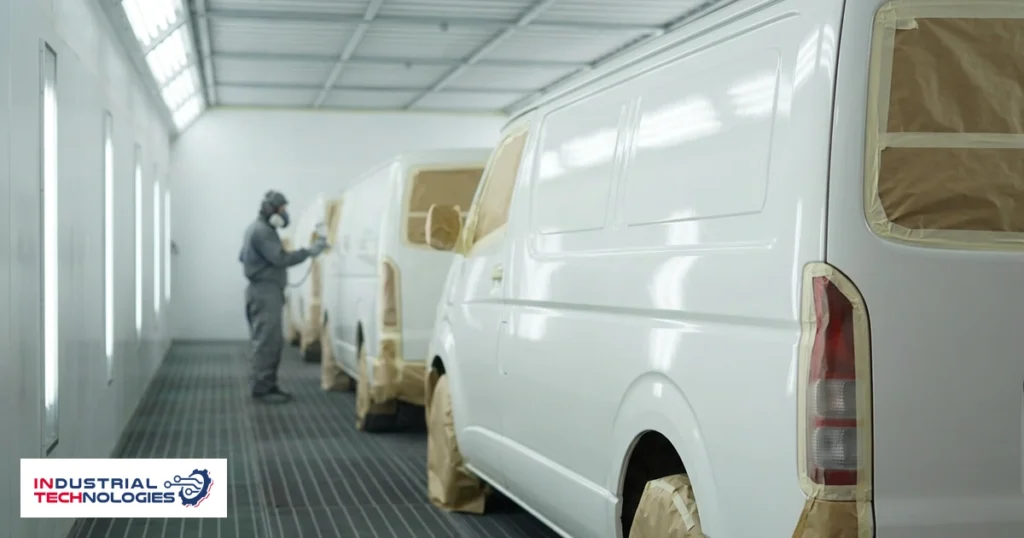
A food distribution company runs hundreds of vehicles in one colour with one livery. Its refinishing problem is not the quality of any single vehicle — it is that vehicle two hundred leaves in the same colour as vehicle one.
Food fleet vehicle refinishing is judged on consistency across the count and on how fast a vehicle returns to service. Both are settled in chamber configuration rather than in operator skill alone.
Colour holding across the count
Colour matching needs higher lighting inside the chamber, and that is a published configuration item for exactly this purpose. A poorly lit chamber produces variation nobody sees at handover and everybody sees when two vehicles park side by side.
Consistency also needs a repeatable environment: even flow and filtration that holds its performance between cycles, rather than conditions that drift with the hour of the day.
| Item | Published configuration |
|---|---|
| Internal length | Longer, to take light commercial vehicles |
| Extraction capacity | Higher, for back-to-back cycles through the day |
| Internal finish | Takes heavy use |
| Lighting | Higher, for colour matching work |
Back-to-back, not one at a time
A fleet workshop runs back-to-back cycles through the day, which raises required extraction capacity and makes a hard-wearing internal finish a specification item.
The published flow range runs from 18,000 to 190,000 m³/h per set, and the choice within it follows chamber volume and daily cycle count together.
Return-to-service time
A vehicle in the workshop is a vehicle out of distribution. Cycle time becomes a commercial figure rather than a technical one in this sector, and it is read alongside extraction capacity and the heat curve.
That is what makes filtration a daily operating item: a loaded filter slows the climb to cure temperature, and the delay multiplies across the vehicle count rather than across one vehicle.
The refrigerated box where fitted
Some food fleets run refrigerated vehicles, and the unit mounted on the front of the box sits above its roof line. Measuring at the roof produces a door the vehicle will not pass.
Frequently asked questions
How do we hold colour across the fleet?
With higher lighting inside the chamber for matching work, and with a repeatable environment: even flow and filtration holding its performance. The first is configuration; the second is a maintenance schedule run on an indicator rather than a date.
What size suits distribution vehicles?
A longer internal chamber that takes light commercial vehicles. Send the longest vehicle in your fleet so size is built on it, within the published range extending to 24,000 mm.
How many vehicles a day can be refinished?
Set by cycle time and extraction capacity together rather than by size. Send your daily target so capacity is built on it.
Do you serve both commercial and government fleets?
Both are among the industries this family serves, and configuration follows your vehicles and operating pattern rather than the type of organisation.
Related reading
- Utility Fleet Vehicle Booth
- Refrigerated Trailer Refinishing
- Bus Paint Booth
- AC Service Station Functions
- Refrigerant Tank Capacity
- Part weight in chamber design
- Physical separation of sanding and spraying
What to do next
Send the longest vehicle in your fleet and your daily vehicle target, and we will return a specification built on your fleet. Request a quote. Sector detail is on the auto fleet industry page.