
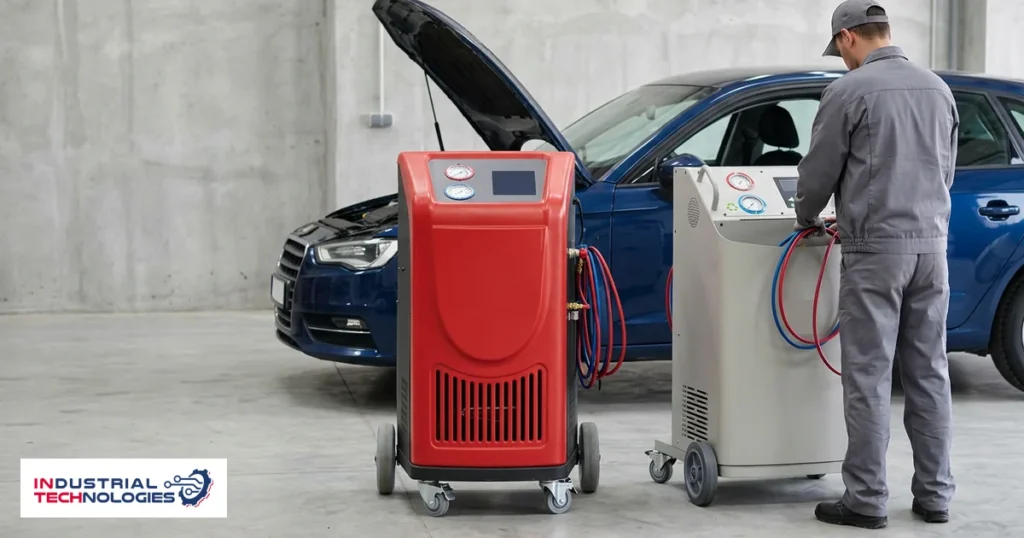
Two air conditioning stations can both be described as fully automatic and still do different amounts of work. The word covers a range, and the range is where the price difference lives.
Reading AC service station functions as a list rather than a label is the fastest way to see what you are actually comparing.
Eight functions on one circuit
The higher model in the family is published as performing 8 functions on a single circuit: recovering gas, recycling it, evacuating the circuit, recharging by controlled weight, flushing the circuit, and leak testing with UV dye.
Two of those are worth isolating. Circuit flush is a repair operation, not a service one — it is what you do after a compressor failure has put debris into the system. Leak testing with UV dye answers the question that recharging alone never does: why the charge was low.
A workshop that recharges without leak testing will see the same vehicle again, and the customer will remember who touched it last.
The economy model draws a deliberate line
The ACMAS302 is published as aimed at the workshop that wants automation without the higher functions: recovery, evacuation, oil injection and recharge.
Its distinguishing feature is hand-valve-free operation, and the published reasoning is operational rather than technical: a manual valve opened at the wrong moment loses an entire charge, and removing it from the design means the cycle runs by screen prompt rather than by the technician’s sequence.
The same description names who benefits: a workshop where crews change, or a training institute where new trainees rotate through. That is a clearer selection criterion than any feature count.
Recovery rate is a cumulative number
The published recovery figures are 99% and 97%, and the site’s own commentary on the difference is worth repeating: it does not show on one vehicle, it shows cumulatively across a fleet entering the workshop every day.
Recovered gas passes through a drying filter before returning to the tank, so it is reused rather than buying a new cylinder for every vehicle. The published drying filter capacity on the higher model is 0.122 L.
It is also, as the product page notes, what separates an environmentally compliant workshop from one that vents.
What supports the cycle
Published supporting features differ between the two and tell you about intended duty. The economy model lists an integrated condenser and cooling fan that keep the cycle stable, a cylinder heating belt, pressurisation discharge, a service reminder every 600 operations, and a 4.3 inch colour TFT screen.
The service reminder is the underrated one. Equipment that tells you when it is due removes a scheduling task from a workshop that has plenty of them already.
What the stations publish
Function count is the headline; the supporting figures are what you compare:
| Item | Higher model | Economy model |
|---|---|---|
| Functions | 8 on a single circuit — recover, recycle, evacuate, recharge by controlled weight, flush, UV leak test | Recovery, evacuation, oil injection and recharge |
| Recovery rate | 99% | 97% |
| Drying filter capacity | 0.122 L | — |
| Listed extras | — | Integrated condenser and cooling fan · cylinder heating belt · pressurisation discharge · service reminder every 600 operations · 4.3 inch colour TFT screen |
Common questions
Which model suits a high-volume workshop?
Vacuum pump rate separates them in throughput terms — 120 L/min against 60 L/min — and evacuation is the longest phase of the cycle. The family page sets both out.
Do these stations handle both common refrigerants?
Refrigerant compatibility is a per-model specification and should be confirmed against the models you actually service, at quotation stage, rather than assumed from the function list.
Is a database update included?
The economy model publishes free updating of the vehicle circuit database and a multi-language interface. What is included commercially is set in your quotation.
What to send with your enquiry
Daily service volume, the refrigerants in your vehicle mix, whether you perform circuit repair as well as service, and how often your crews change. Then request a quotation.