
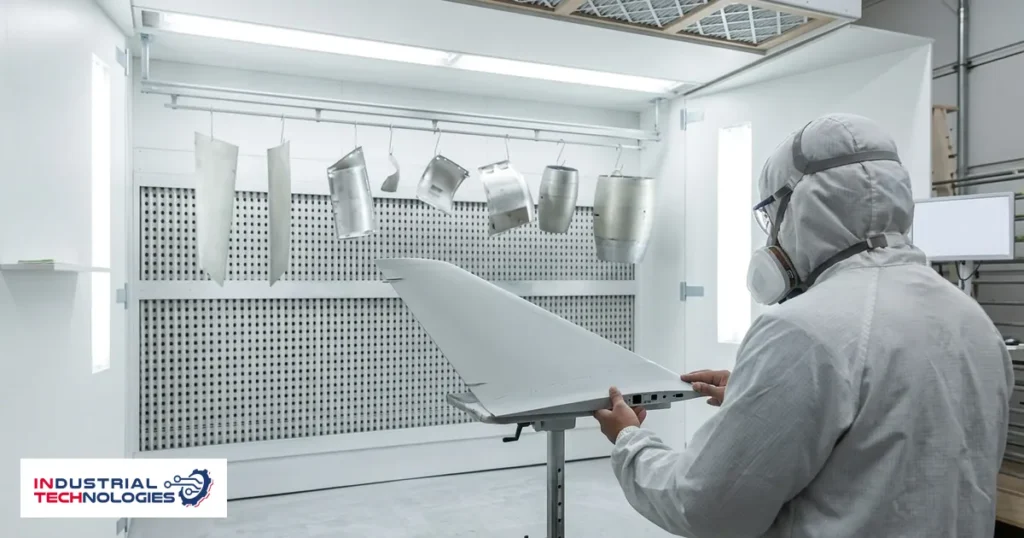
When budget tightens on an aviation fit-out, the first thing proposed for removal is the second chamber: prep and spray in the same space. It reads as a saving in the offer, and the cost appears at the first batch that fails inspection.
An aviation component prep room is not organisational luxury — it is physical separation between two stages whose air requirements conflict.
Why they do not share a volume
Stripping, preparation and inspection precede painting, and each stage carries different air and extraction requirements. Combining them makes one run short — usually preparation, because the chamber gets tuned for spraying.
The separation is physical rather than procedural: scheduling alone does not stop particulate from a preparation stage settling on a surface ready to spray.
| Item | Preparation stage | Spray stage |
|---|---|---|
| Contaminant source | Sanding and stripping inside the volume | Overspray from the material |
| Extraction direction | Local capture at the dust source | Even flow across the surface |
| What is protected | The working environment and the operator | The prepared surface itself |
| Effect of combining | Preparation under-extracted | Surface receives the previous stage’s dust |
How many cells the project needs
It depends on stage separation in your process. We fix the number after reviewing your line: some facilities need two independent chambers, others manage with disciplined separation in one volume where cycles are far apart.
The practical question we open with: do you strip old coating? If the answer is yes, separation moves closer to necessity than to preference.
Size follows the component
Aviation components range from a small part to a full structure. The prep room is built on the largest thing entering it and on how it is hung, within the published range extending to 24,000 mm long and 20,000 mm wide.
Documentation extends to preparation
Acceptance in this sector depends on repeating a result and documenting it, and documentation does not begin at the spray stage. Surface condition before coating is part of the record an accrediting body reviews.
Frequently asked questions
Do I really need a separate prep room?
If you strip old coating or sand before spraying, then largely yes. Those stages carry extraction requirements different from spraying, and combining them in one volume shortchanges one of them.
How does it differ from the spray chamber?
In extraction and direction. A spray chamber is designed for even flow protecting the sprayed surface; a prep room is designed for capture at the dust source. Size may be similar while configuration differs.
Can it be added later?
Possible, but its position and extraction route are studied with the first chamber rather than after it. Adding a prep room to a site with no extraction path left costs more than including it in the first survey.
What filter class does it carry?
Set with the configuration according to your material and your authority’s requirements, within the published EU3, EU4 and EU5 classes in pre and ceiling filtration, and up to three-stage bag and high-efficiency filtration where the work requires it.
Related reading
- Aviation MRO Parts Booth
- Aircraft Paint Booth
- Spray Booth Gas Monitoring
- Steel structure finishing chamber
What to do next
Send your process stages, the largest component size and your site area, and we will return a one- or two-cell concept built on your line. talk to a specialist. Sector detail is on the aerospace, marine and rail industry page.