
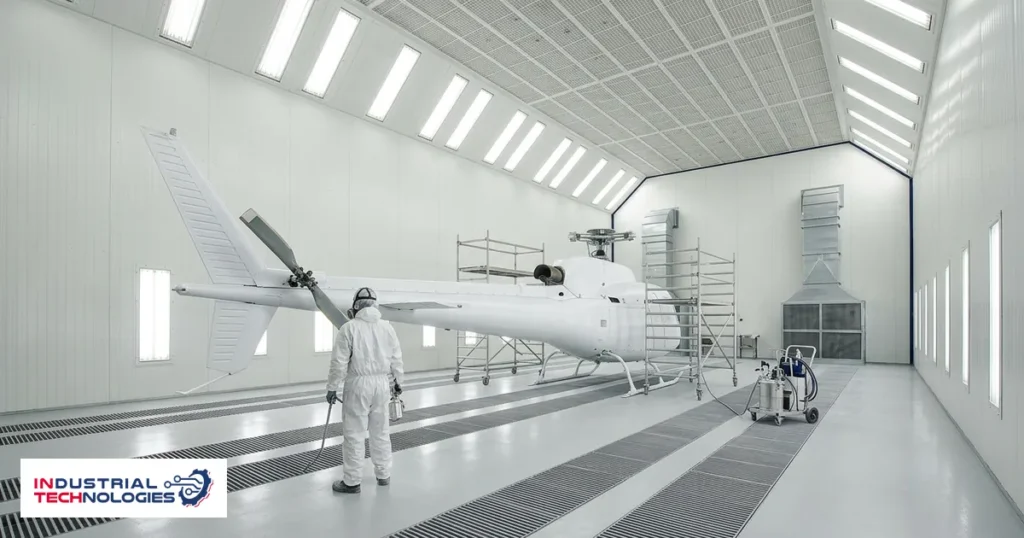
Planning a chamber for a rotorcraft with fixed-wing habits gets the governing number wrong. An aeroplane drives length first; a helicopter drives width and height, because the rotor reaches out horizontally and the fuselage sits tall.
A helicopter paint booth is designed around that difference, and the final size comes from your structure rather than from a category.
Width before length
The delivered range in this family extends to 24,000 mm long, 20,000 mm wide and 6000 mm high — a range that takes structures at this scale. But where you sit inside it is set by required width first in this case.
The first practical question is whether the airframe enters with the rotor fitted or removed. The answer changes required width fundamentally, and it is an operating decision settled before design rather than after.
| Input | Effect |
|---|---|
| Does the rotor enter fitted? | Internal width and door — the governing figure here |
| Overall airframe height | Internal height plus free volume above it |
| Overall length | Internal length plus technician working space |
| Entry method | Door size and chamber position in the hall |
| Your process stages | One chamber or two |
The door follows the widest section
The main door on large builds reaches 14,200×5,000 mm under powered operation, because an opening that size is not hand-operated on a repeated cycle.
It is measured on the widest section that actually enters, not on the airframe’s datasheet dimensions. That item specifically is discovered late on most projects that end up needing a redesign.
Airflow and safety at volume
Air capacity follows the volume rather than the aircraft type, with a published range reaching 190,000 m³/h per supply or extraction set. Large-structure builds also carry three-stage bag and high-efficiency filtration at ≥98%, plus gas monitoring and static discharge.
Preparation and painting are two stages
Stripping, preparation and inspection precede painting, and each carries different extraction requirements. Combining them in one volume makes one run short, and we fix the number of chambers after reviewing your process.
Frequently asked questions
Have you delivered a chamber for a rotorcraft specifically?
Our published delivery range covers chambers to 24,000 mm long, 20,000 mm wide and 6000 mm high — airframe dimensions rather than vehicle dimensions. Reference projects that can be named publicly are requested from the sales team directly.
How does it differ from a fixed-wing chamber?
In how the dimensions distribute, not in principle. An aeroplane drives length and a rotorcraft drives width and height, and both sit inside the same published range. We take your airframe dimensions and build on them.
Can humidity be held in this chamber?
Yes where the coating or the acceptance requirements call for it. Temperature and humidity control together is delivered on custom builds, with the range set per project from the finishing material and the part’s requirements.
How many chambers does the project need?
It depends on stage separation. Stripping, preparation and inspection need different extraction from spraying, and combining them shortchanges one. We fix the number after reviewing your line.
Related reading
- Aircraft Paint Booth
- Aviation MRO Parts Booth
- Drone Airframe Finishing Booth
- Mid Size Vessel Paint Booth
What to do next
Send the airframe dimensions, whether the rotor enters fitted, and your process stages, and we will return a chamber concept built on your structure. talk to a specialist. Sector detail is on the aerospace, marine and rail industry page.