
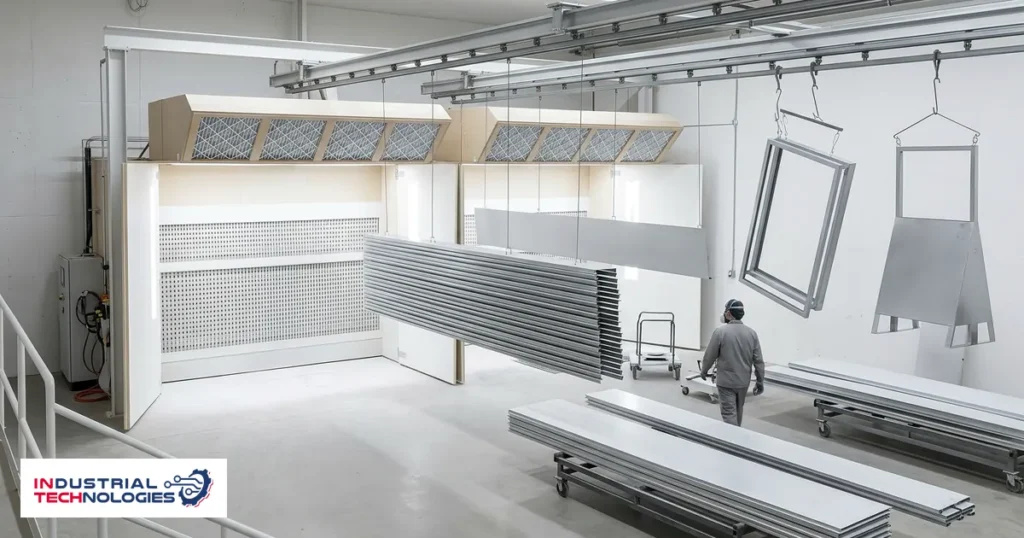
Sign manufacturers fall into a simple arithmetic trap. The largest panel measures three metres, so a three-metre chamber gets specified. Then it turns out the plant produces twenty panels a day and the chamber takes one.
A signage finishing oven is built on parts per batch before it is built on the single-part dimension, because a panel is thin and the wasted volume in a badly sized chamber is enormous.
A thin part changes the sizing arithmetic
A sign panel is a large surface at small thickness. That means a chamber two metres deep takes rows of panels hung vertically, where the same chamber takes exactly one vehicle.
So design starts from the number of parts to be processed per cycle, and the internal size is derived from it within a published range extending to 24,000 mm long and 20,000 mm wide.
| Question | Effect on the design |
|---|---|
| How many panels per cycle? | Internal size and usable volume |
| What are the largest panel dimensions? | Minimum internal length and height |
| How is a panel hung? | Hanging arrangement and row spacing |
| What is the finishing material? | Heat curve and filter class |
| How many cycles per day? | Extraction capacity and durability criterion |
Hanging determines usable capacity
Provision for hanging or moving parts inside the cabin goes into the design from the start. In signage work that arrangement is what converts floor area into throughput, because row spacing decides how many panels actually fit.
Spacing is not arbitrary: it has to allow air to reach between two panels, or the inner panel leaves the chamber with a different result from the outer one in the same batch.
Heat curve on the material, not on convention
Signage finishing materials range across powder coatings, liquid paints and heat-cured inks, and each carries a different curve. The heat curve is set to the industrial coating you use, with published heat output from 200,000 to 600,000 kcal/h.
A plant processing more than one material needs thermal headroom rather than a single operating point. That decision is made when choosing among the five delivered heating systems.
Dust before spraying
Metal or timber panels are sanded and prepared before finishing, and the resulting dust returns to the surface unless the two volumes are physically separated. A preparation room with its own extraction precedes the finishing chamber, and the separation is physical rather than procedural.
Frequently asked questions
What is the largest panel you can process?
The published range extends to 24,000 mm long, 20,000 mm wide and 6000 mm high. A long panel sits inside that comfortably, and the real constraint is usually parts per batch rather than part size.
Do I need an oven or a spray booth?
It depends on your material. Powder needs thermal curing; liquid paint needs a spray and dry chamber. Some lines need both in sequence, and the answer comes from the finishing material first.
How do I calculate the chamber’s output?
Parts per batch divided by cycle time. Those two figures together are what must match your line rhythm, and we build the specification on them rather than on size alone.
Can the chamber be extended later?
Internal size and chamber wall are effectively fixed after installation. Hanging arrangement and row count can be reorganised, which is why size is built on the production horizon rather than today’s output.
Related reading
- Powder Coating Curing Oven
- Industrial Baking Oven
- Industrial Tank Coating Booth
- Paint Booth Heat Output Range in kcal per Hour
What to do next
Send parts per cycle, largest panel dimensions and finishing material, and we will return a specification built on your throughput. Request a quote. The published range is on the paint booth family page.