
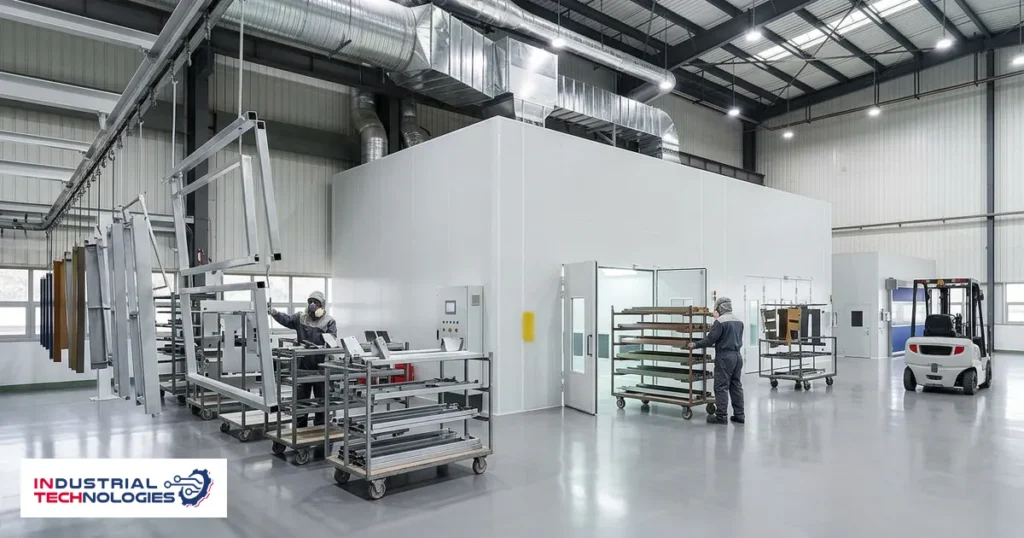
Manufacturers usually approach us asking for a paint booth, and it becomes clear in the first technical meeting that a spray chamber is not what they need. Thermal curing is a different operation from wet spraying, and the enclosure that serves it differs in shape before it differs in numbers.
A powder coating curing oven is built closer to a cube than to the automotive rectangle, and the reason lies in how the part enters rather than in the coating itself.
Sizing starts from a cube, not a vehicle
Delivered configurations in this family start at a 3000×3000×3000 mm cabin for powder curing. The three dimensions are near-equal because an industrial part is hung and turned rather than driven in on wheels in a straight line.
From there the range widens with the largest part on your line, within a published range extending to 24,000 mm long and 20,000 mm wide.
| Item | Automotive cabin | Industrial curing oven |
|---|---|---|
| Reference size | 6900×4000×2650 mm | from 3000×3000×3000 mm |
| What sets the shape | Vehicle length and width | Part dimensions and how it is hung |
| Heat curve | Follows vehicle refinish materials | Set to the industrial coating in use |
| Part entry | Drives in on its wheels | Provision for hanging or moving parts inside |
The heat curve follows the coating, not the oven
Powder needs a defined curve: a ramp to temperature and then a dwell at cure. That curve is set by the material you buy, and the oven is configured to it rather than the other way round.
So the first question we ask is which finishing material is in use, before any question about size. A plant that changes powder supplier after installation needs a recalibration rather than a repurchase — provided the thermal range was specified with headroom.
Hanging and conveying belong in the design
Provision for hanging or moving parts inside the cabin goes into the design from the start. An oven specified without it becomes a slow manual station, and it turns into the constraint on the line rather than a step within it.
- Part weight — determines the hanging system and load points
- Parts per batch — sets internal size more than the single-part dimension does
- Line takt — cycle time must match the line rhythm or beat it
Heating systems for industrial duty
Five systems are delivered across this family: diesel and gas burners, electric heating, heat pump, and short-wave infrared. In an industrial application the choice follows the coating and the cost of energy at your site, with a published electrical range of 11 to 50 kW.
Frequently asked questions
Do you build chambers for non-automotive parts?
Yes, and it is the norm in industrial and manufacturing work. Anything beyond the automotive size is built to order within a published range extending to 24,000 mm long, 20,000 mm wide and 6000 mm high.
What information do you need to design the oven?
Four inputs: the size and weight of the largest part, how it is hung or moved, the finishing material in use, and target line throughput. The chamber, air capacity and heat curve are derived from those four.
Will it take continuous shift operation?
Continuous running shifts the selection criterion from peak specification to durability, ease of maintenance and spare parts availability. Send shift count and daily running hours so the specification is built on your actual pattern.
Can one oven handle both powder and wet coatings?
It depends on the curve each material needs and on the cleaning sequence between them. Dual use is engineering-feasible in some cases and needs a study of your two materials specifically before it is promised.
Related reading
- Industrial Baking Oven
- Industrial Tank Coating Booth
- Signage Finishing Oven
- Paint Booth Heat Output
- continuous powder coating line
What to do next
Send the largest part size and weight, how it moves, the finishing material and target throughput, and we will return a chamber specification built on your line. Request a quote. Sector detail is on the industrial and manufacturing page.