
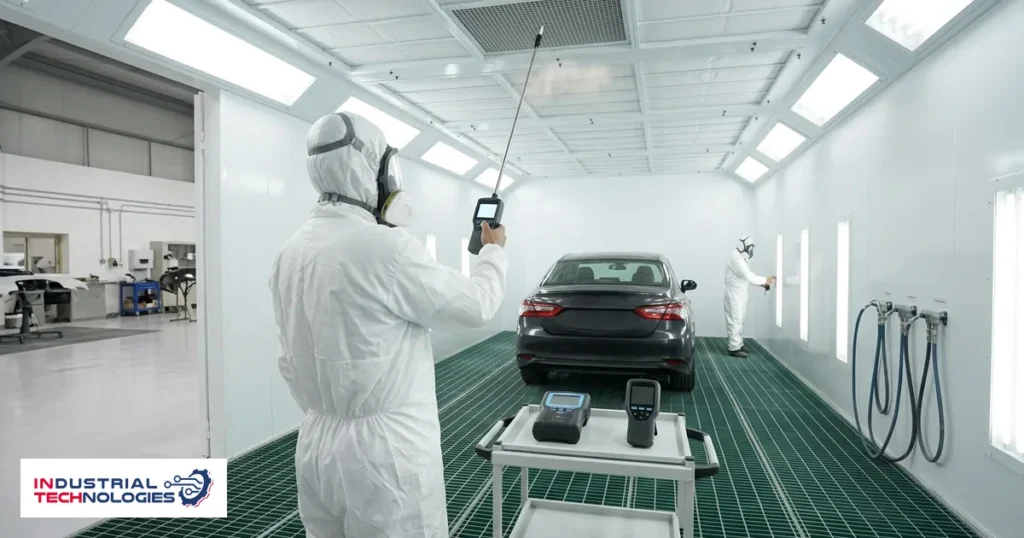
A burner appears in every quotation as a brand and a number. Neither of those tells you whether the chamber will reach cure temperature on a hot afternoon with a full-size vehicle inside.
Paint booth heat output is a figure that only means something once it is read against chamber volume, air capacity and the fuel actually available at your site.
The published figure across the standard range
The entry model publishes 200,000 kcal/h from a Riello G20 diesel burner, with air capacity of 20,000+18,000 m³/h and an internal chamber of 6900×4000×2650 mm.
The same heat output figure and the same burner appear on the automated model, paired there with 25,000+25,000 m³/h.
That pairing is the useful observation. Heat output stays constant while air capacity rises, because more air moving through the same chamber changes how quickly the chamber reaches and holds temperature. Neither figure describes the booth alone.
What reaches the chamber, not what leaves the burner
Output is an input measurement. What arrives at the workpiece depends on the exchanger between the flame and the air.
The published specification across the models is a SUS304 stainless heat exchanger, 1.5 mm thick, transferring more than 90% of burner output to chamber air — with the thickness documented as tolerating the repeated heating and cooling cycles that damage thinner sections.
An offer quoting only burner output has described the input and said nothing about the fraction that arrives. The two numbers belong together in any comparison.
Fuel is a site constraint before it is a preference
The standard models publish a diesel burner. The custom range publishes a wider set of heating systems: diesel, gas, electric heating, heat pump, and short-wave infrared.
Which of those is available to you is a question about your site, not your specification. Gas needs a connection or a storage arrangement; electric heating needs capacity in your supply; diesel needs storage and delivery access.
The published custom electrical range is 11 to 50 kW at 380 V three-phase, at 50 or 60 Hz — a range wide enough that the answer changes the electrical design of the installation.
Scaling for larger chambers
Heat output does not follow chamber length in a straight line, but it does rise with volume, and the published executed range shows how far: 200,000 to 600,000 kcal/h.
Air capacity in the same range extends to 190,000 m³/h per supply or extraction set. As the trucks and RV page puts it, the larger the chamber the more flow and heat it requires — and the final figure is determined from your dimensions.
Heat figures on the published models
Input is measured, not what arrives — and the exchanger is what decides the difference:
| Item | Entry model | Automated model |
|---|---|---|
| Heat output | 200,000 kcal/h from a Riello G20 diesel burner | Same output and same burner |
| Air capacity | 20,000+18,000 m³/h | 25,000+25,000 m³/h |
| Internal chamber | 6900×4000×2650 mm | Same |
| Heat exchanger | SUS304 stainless, 1.5 mm, transferring more than 90% of burner output | Thickness documented as tolerating repeated heating and cooling cycles |
| Custom electrical range | 11–50 kW at 380 V three-phase, 50 or 60 Hz | Wide enough to change the electrical design |
Common questions
Is a higher output always better?
No. Output matched to chamber volume reaches temperature predictably; output far above it cycles the burner more often without shortening the useful part of the cycle. Match it to the chamber, then look at exchanger efficiency.
Does ambient temperature change the requirement?
It changes how much work the system does to reach and hold a set point, which is why custom builds are designed against site conditions and the ambient temperatures the booth will operate in, as stated on the family page.
What limits how well heat is retained?
Wall construction. Published options are insulated panels at 50 mm in EPS, rockwool or glass wool, or 1.5 mm galvanised sheet for the largest chambers. Heat that escapes through the wall is paid for twice.
What to send with your enquiry
Your intended chamber dimensions, the fuel available on site, your electrical supply and main breaker rating, and expected daily cycle count. Then request a quotation.