
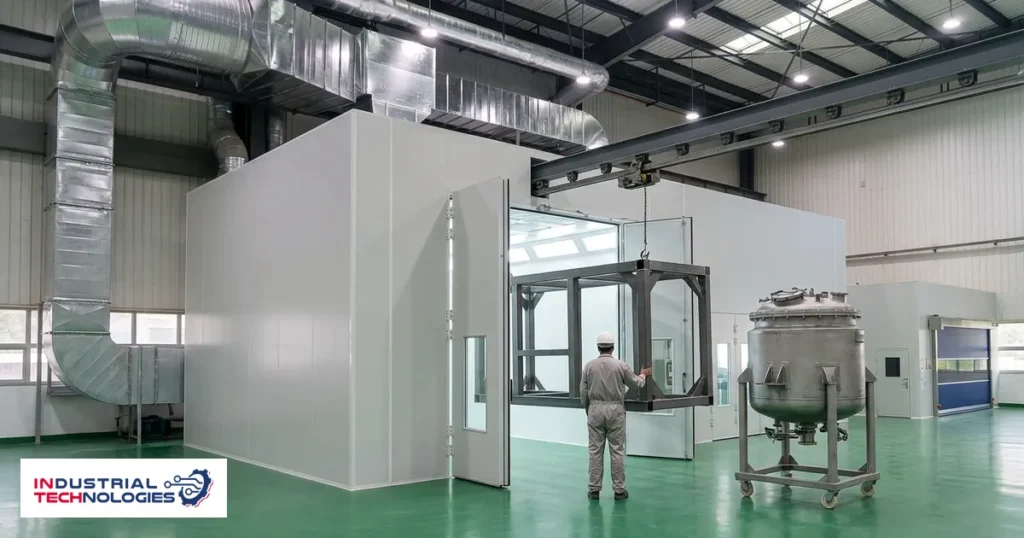
A plant bought an oven with an excellent specification and then ran it at half capacity. The specification was not the problem. Cycle time exceeded line takt by a few minutes, so the oven became the bottleneck that cancels the benefit of every improvement upstream of it.
That is the most common error in acquiring an industrial baking oven: it gets chosen on peak specification instead of on the rhythm of the line it will serve.
The delivered size in this class
Our industrial builds extend to 5700×3700×3000 mm for baking ovens and above, and start at 3000×3000×3000 mm in powder curing applications.
The phrase “and above” is not a hedge. The published family range extends to 24,000 mm long, and the part decides where inside that range you sit.
| Input | Direct effect |
|---|---|
| Largest part dimensions | Internal size plus circulation space |
| Part weight | Hanging or conveying arrangement inside the cabin |
| Finishing material | Heat curve and filter class |
| Target line throughput | The cycle time you are allowed |
| Shifts per day | Durability criterion and maintenance schedule |
Cycle time before specification
The rule we start from: finishing cycle time must equal line takt or fall below it. An oven slower than the line stops it; an oven far faster is idle capital the plant pays for monthly in depreciation.
So we ask for target throughput before we ask about specification. The reverse order produces an excellent oven in the wrong place.
Continuous operation changes the criterion
A plant runs the chamber across connected shifts rather than in the intermittent cycles of a vehicle workshop. In that pattern, durability, ease of maintenance and spare parts availability outrank any catalogue maximum.
The reason is operational: a finishing chamber that stops in a plant does not halt a station, it halts a line. That is why filtration, maintenance schedules and critical spares are discussed alongside the specification rather than after handover.
Heating and energy cost
Five systems are available in this family: diesel, gas, electric, heat pump and short-wave infrared. The choice follows the coating and site energy cost, with published heat output from 200,000 to 600,000 kcal/h.
Frequently asked questions
What sizes have you actually delivered in plants?
The published range is drawn from deliveries across several sectors and extends to 24 metres in length. Sizes are customisable to the plant’s requirement.
How do I work out the cycle time I need?
From target throughput: divide parts per hour by batch capacity inside the oven, and the permitted time per cycle appears. That figure is the input, and the oven is built to meet it.
Is filtration necessary on a baking oven?
It depends on the finishing material and on what is released during cure. Published filtration in this family covers stop, pre and ceiling stages at EU3, EU4 and EU5, extending to three-stage bag and high-efficiency filtration where required.
Can the oven be upgraded later for higher throughput?
Some items can — filtration and control tuning among them. Others cannot, chiefly internal size and chamber wall. That is why size is built on your throughput horizon rather than today’s output.
Related reading
- Powder Coating Curing Oven
- Industrial Tank Coating Booth
- Signage Finishing Oven
- Specifying a 50 or 60 Hz Supply for a Paint Booth
What to do next
Send the largest part size, target line throughput and shift count, and we will return a specification built on your actual operating pattern. Request a quote.