
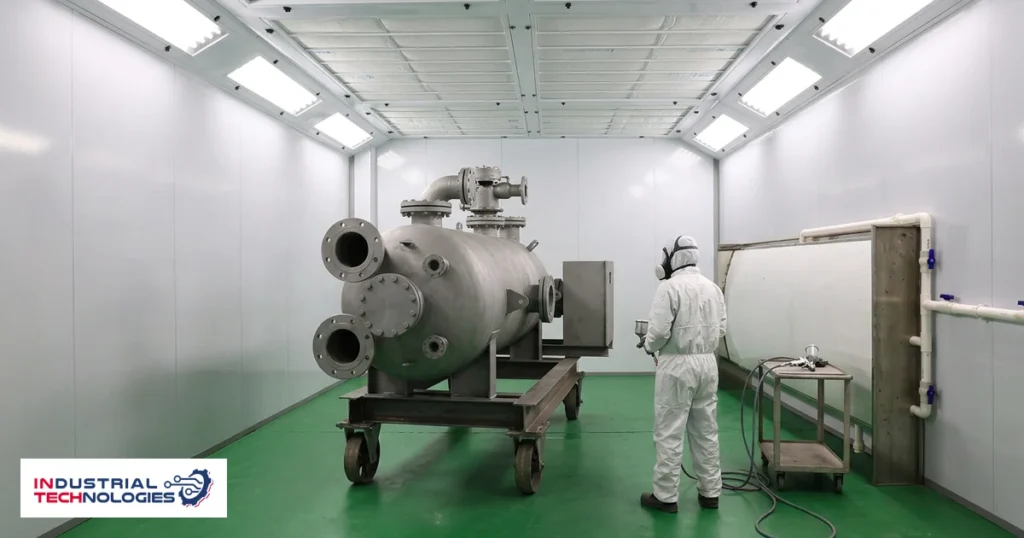
Suppliers into the Saudi oil and gas sector share one complaint about finishing: no two parts are alike. A valve, a spool, a pressure vessel and a support frame pass down the same line at weights and shapes no single size covers.
So an oil and gas equipment coating booth is built around the heaviest and most awkward part to handle, not around the average of what passes through.
Weight before size
Part size, weight and handling method are the first inputs in industrial finishing. A chamber bought before they are fixed becomes a constraint on production rather than a step within it.
The delivered range in this family runs from 3000 to 24,000 mm long, 3000 to 20,000 mm wide and 2650 to 6000 mm high — it takes large industrial parts, and the final figure comes from your heaviest one.
| Input | What follows from it |
|---|---|
| Heaviest part weight | Hanging or conveying system and load points |
| Largest part dimensions | Internal size plus the technician’s working space |
| Coating material | Heat curve and filter class |
| Parts per batch | Internal size, more than the single-part dimension |
| Shifts per day | Durability criterion, maintenance schedule and critical spares |
Irregular geometry and the air path
A cylindrical or recessed part behaves differently from a flat panel in air: the curved surface needs reach from more than one direction, and shadowed areas do not receive the same flow if extraction runs one way only.
Extraction direction — downdraft or side — is therefore set by the nature of the work and the part, rather than by what is conventional in an automotive booth.
Continuous shifts change the criterion
Facilities in this sector run the chamber across connected shifts rather than intermittent cycles. In that pattern, durability, ease of maintenance and spare parts availability outrank the catalogue maximum.
The reason is operational: a finishing chamber that stops in an industrial facility halts a line, not a station. So filtration, maintenance schedules and critical spares are discussed alongside the specification rather than after handover.
Heat curve on the material
The heat curve is set to the industrial coating you use. Published heat output in this family runs from 200,000 to 600,000 kcal/h, with electrical power from 11 to 50 kW on 380 V three-phase supply.
Frequently asked questions
What is the largest part you can take?
The published range extends to 24,000 mm long, 20,000 mm wide and 6000 mm high. Final size is built on the largest part on your line plus the technician’s working space around it.
What information do you need to design the chamber?
Four inputs: the size and weight of the largest part, how it is hung or moved, the coating material in use, and target line throughput. The chamber, air capacity and heat curve are derived from those four.
Will it take two-shift daily operation?
Continuous running shifts the selection criterion from peak specification to durability and ease of maintenance. Send shift count and running hours so the specification is built on your actual pattern rather than an average.
Which regulatory requirements apply?
Ventilation and fire requirements for finishing areas inside plants, disposal of finishing material and solvent waste under the applicable environmental rules, and SASO conformity for imported equipment.
Related reading
- Valve and Pipe Coating Booth
- Heavy Steel Structure Paint Booth
- Powder Coating Curing Oven
- Paint Booth Internal Width to 20 Metres
- Four inputs for industrial booth design
- Mining Equipment Paint Booth
What to do next
Send the heaviest part size and weight, how it moves, the coating material and line throughput, and we will return a chamber specification built on your line. Request a quote. Sector detail is on the industrial and manufacturing page.