
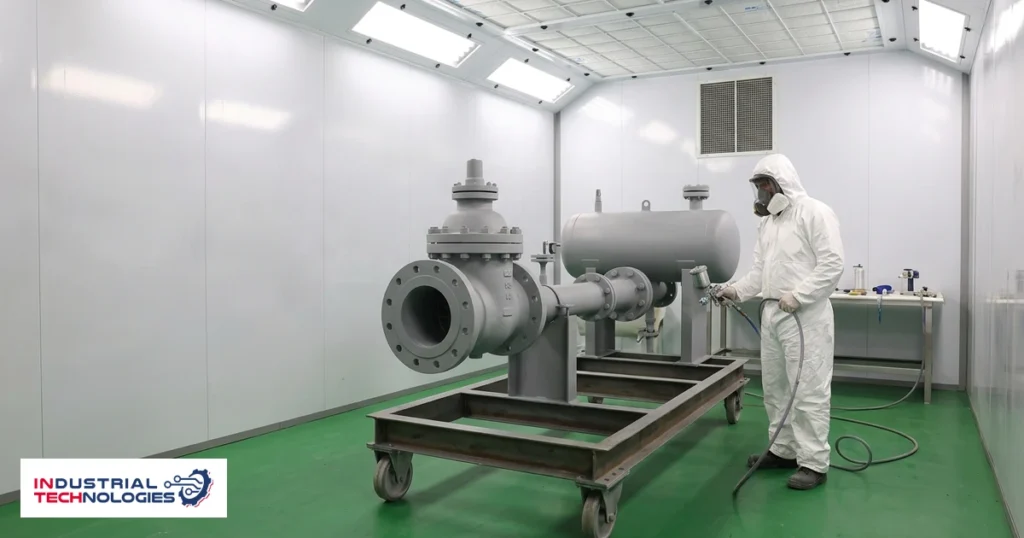
A plant treating a hundred valves a day asks about chamber size and quotes the size of a valve. The two numbers are almost unrelated: what sets the chamber here is how many valves go in together, not how long one is.
A valve and pipe coating booth is designed on the batch, and that inverts the usual order of questions.
Small parts, large counts
Pipes and valves are relatively small parts processed in quantity. A chamber two metres deep takes hung rows of them, where the same chamber takes exactly one vehicle.
Design therefore starts from the number of parts to be processed per cycle, and internal size is derived from it within a published range extending to 24,000 mm long and 20,000 mm wide.
| Question | Effect on the design |
|---|---|
| How many parts per cycle? | Internal size and usable volume |
| Largest part size and weight? | Minimum size and racking system |
| How is a part hung? | Racking arrangement and row spacing |
| Which coating material? | Heat curve and filter class |
| How many cycles per day? | Extraction capacity and durability criterion |
Row spacing is not a detail
Provision for hanging or moving parts inside the cabin goes into the design from the start, and it is what converts floor area into throughput.
Spacing is not arbitrary: it has to let air reach between two parts, or the inner one leaves with a different result from the outer one in the same batch. That is the commonest cause of variation within a single batch.
Internal surfaces and recesses
A valve is a part with internal passages and recesses; a pipe is a continuous cylindrical surface. Both need air reaching from more than one direction, so extraction direction is set by the part rather than by automotive convention.
Metal mass and cycle time
A valve is a comparatively solid metal mass, which means it absorbs heat slowly and releases it slowly. Time to cure temperature is longer than for a sheet part of the same weight, and that belongs in the cycle time calculation before the oven is bought.
The matching rule stays the same: finishing cycle time must equal line takt or fall below it, or the oven becomes the bottleneck.
Frequently asked questions
How do I calculate the chamber’s throughput?
Parts per batch divided by cycle time. Those two figures together are what must match your line rhythm, and the specification is built on them rather than on size alone.
Does the chamber differ between pipes and valves?
The principle is the same and the difference is in racking. A pipe hangs lengthwise and a valve needs load points that carry its mass, and both sit inside the same published range.
Which filter class is required?
It depends on your coating material and acceptance requirements. Published filtration starts with stop, pre and ceiling stages at EU3, EU4 and EU5 and extends to three-stage bag and high-efficiency filtration at ≥98%.
Can one chamber handle several part sizes?
Yes, if racking is built on the range of sizes rather than one size. That is a design-stage decision, because changing the racking system after installation is harder than changing a schedule.
Related reading
- Oil and Gas Equipment Coating Booth
- Industrial Baking Oven
- Heavy Steel Structure Paint Booth
- Technician Working Space Allowance in Booth Sizing
What to do next
Send parts per cycle, the size and weight of the largest part and the coating material, and we will return a specification built on your throughput. Request a quote. The published range is on the paint booth family page.