
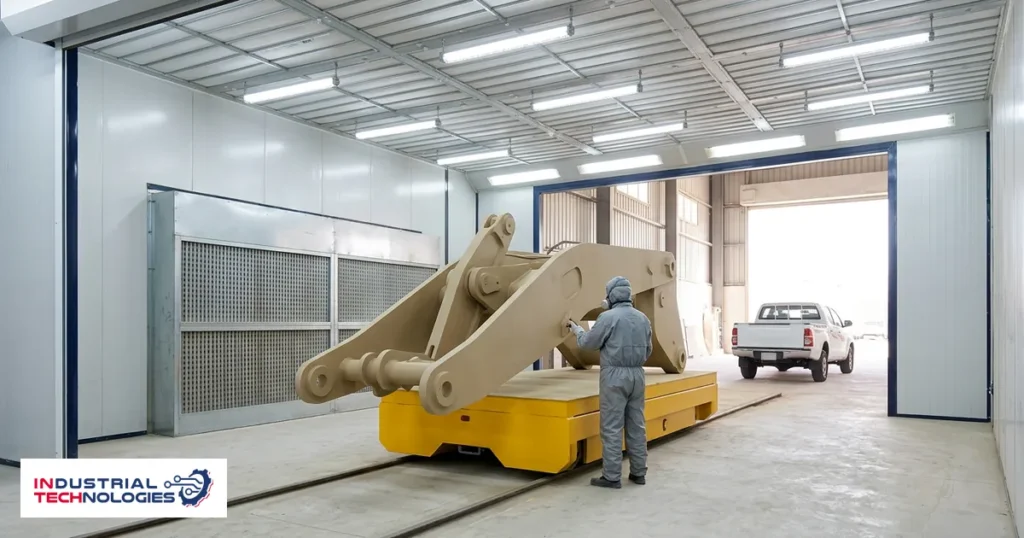
A mining machine does not enter a coating chamber once in its life. It enters at every scheduled overhaul, alongside its siblings from the same fleet, inside a window fixed in advance. That moves the question from whether the piece fits to whether the chamber keeps up with the programme.
The industrial sector page states that continuous operation changes the criterion for selecting equipment, so endurance, ease of maintenance and spare parts availability matter more than the peak specification. A mining equipment paint booth is selected on that criterion rather than on the largest piece alone, because it runs consecutive shifts inside an overhaul window.
The overhaul programme, not the single piece
A chamber calculated on the largest piece alone can be the correct size and still stall the programme: its cycle runs longer than overhaul takt, machines queue in front of it and the window slips. The sector page says this plainly — a chamber slower than the line stops it, and one faster than the line is idle capital. The criterion is matching the two times, not maximising either.
What the configuration changes
| Item | What changes |
|---|---|
| Selection criterion | Endurance, ease of maintenance and spare parts availability ahead of peak specification |
| Cycle time | Equal to or shorter than overhaul takt, otherwise the window slips |
| Internal size | Built on the largest piece in the programme plus handling clearance, inside 3,000–24,000 mm in length |
| Air capacity | Built on chamber volume and coating material, inside 18,000–190,000 m³/h |
| Filtration and maintenance schedules | Discussed with the specification itself, not after it, because a stopped chamber stops the whole programme |
Why the calculation is not carried over from a single industrial part
A single industrial part is measured, the chamber is built around it, and that is the end of it. An overhaul programme introduces a second dimension: repetition. A chamber that handles one piece excellently may not hold the same quality across thirty consecutive pieces, and the difference appears in filtration, maintenance schedules and spare parts availability rather than in dimensions.
Frequently asked
Why are the largest piece dimensions not enough to select the chamber?
Because they answer the question of entry, not of rhythm. The machine enters, but if cycle time runs longer than overhaul takt then machines queue in front of a chamber that is working. So the number of pieces inside the window is asked before the chamber is specified.
How is the required cycle time determined?
From the number of machines in the overhaul programme and the length of the available window, which together yield the time allowed per piece. The configuration is then built to achieve it, not the other way round. These are figures measured in your facility before a configuration is adopted.
What is fixed before manufacture?
Internal size, loading method, air capacity, heat curve and filtration stages, together with maintenance schedules and critical spare parts. The reason is that a finishing chamber stopping inside an overhaul programme stops the programme rather than one station in it.
What indicates the chamber has become the constraint?
The overhaul window slipping while the chamber keeps running. If the chamber runs without stopping and the window still slips, the constraint sits in cycle time or in handling around the chamber rather than in the chamber itself.
Related reading
- Heavy steel structure paint booth
- Four inputs for industrial booth design
- The industrial coating heat curve
Practical next step
Send the number of machines in your overhaul programme, the length of the available window and the largest piece dimensions in it, and we return a configuration built on your programme. Contact an expert. The published range sits on the paint booths family page, and the sector configuration on the industrial and manufacturing sector page.