
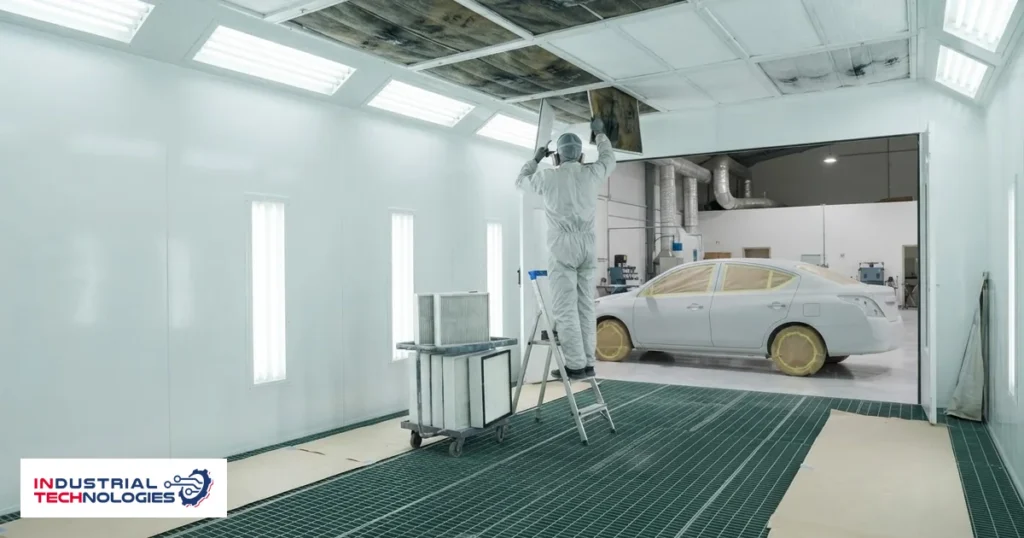
Filters are the cheapest item in a finishing shop and the one most reliably left until it announces itself. By the time it announces itself, it has usually done so on a customer’s panel.
A booth filter replacement schedule is worth writing down for the same reason any preventive task is: it converts an unpredictable cost into a planned one.
The published interval
The position stated on this site is specific: filtration is a consumable replaced periodically rather than on failure, according to running hours and workload — and the usual practice is replacement twice a year within preventive maintenance.
It also states that the interval differs between the pre-filter, the ceiling filter and the floor filter. Three positions, three duties, three rates of loading. Treating them as one line item is where schedules go wrong.
Running hours are the qualifier that does the work. Two shops on the same nominal schedule with very different daily cycle counts are not on the same schedule at all.
Each position fails differently
The pre-filter protects what is behind it. In the enclosed preparation room the published arrangement is a pre-filter, then a ceiling plenum with a high-efficiency filter, then exhaust through a fibreglass filter — and a neglected pre-filter consumes an expensive high-efficiency element at the rate of a cheap one.
The ceiling stage decides what lands on the workpiece. The published plenum covers the chamber area so air descends clean onto the part rather than entering from a side opening carrying bay dust with it.
The exhaust stage protects the plant. Dry fibreglass filtration captures overspray before the exhaust path, protecting the fan and the stack — and a loaded exhaust filter shows up as reduced extraction long before it shows up as a defect.
The gauge tells you what the calendar cannot
A schedule is a plan; a pressure gauge is a measurement. The highest-extraction model publishes a pressure gauge in its standard supply, and it is the instrument that reports actual filter condition.
Record the reading when the booth is commissioned with clean filters. A reading that has drifted steadily since then is filtration reaching the end of its service life, visible before any panel is affected.
The same model publishes a safety door that opens automatically above 10 Pa — the protective backstop for the condition a neglected gauge eventually produces.
Stock what cannot wait
Spare parts and filters for equipment we supply are held in our warehouse, and anything not in stock is supplied within days. That published position is what your own stocking plan should be built against.
Which narrows your internal stock to what cannot tolerate a wait of days — typically filtration during your peak season. Parts are matched by model from the supply record rather than by description, so keeping model numbers accessible shortens every order.
The published replacement position
Filtration is replaced periodically rather than on failure — and the positions differ:
| Item | Published | Note |
|---|---|---|
| Basis | Running hours and workload, not the calendar | A consumable, not a repair |
| Usual practice | Replacement twice a year within preventive maintenance | The interval differs between pre-filter, ceiling filter and floor filter |
| Enclosed preparation room | Pre-filter, then ceiling plenum with a high-efficiency filter, then exhaust through a fibreglass filter | A neglected pre-filter consumes an expensive high-efficiency element at the rate of a cheap one |
| The plenum | Covers the chamber area | Air descends clean onto the part rather than entering from a side opening |
| Safety backstop | Safety door opens automatically above 10 Pa | The condition a neglected gauge eventually produces |
Common questions
Are filters covered by warranty?
No. Consumable parts such as filters, belts and lamps are excluded from the manufacturer’s warranty under our published terms, which is precisely why they belong in a maintenance budget rather than a contingency.
Can this be handled under a contract?
Yes. Filter replacement, air duct cleaning and inspection of electrical and pneumatic safety circuits are published as the scope of the optional service, offered under a renewable annual maintenance contract or on request.
Does carbon filtration follow the same rule?
It follows a schedule even more strictly, because adsorption capacity is exhausted without any visible change or pressure signal. The open preparation platform publishes multi-layer fibreglass with activated carbon.
Related reading
What to send with your enquiry
Equipment models and supply dates, daily running hours, your peak season months, and your current filter stock. Then request a quotation for a schedule built on your equipment rather than a generic list.