
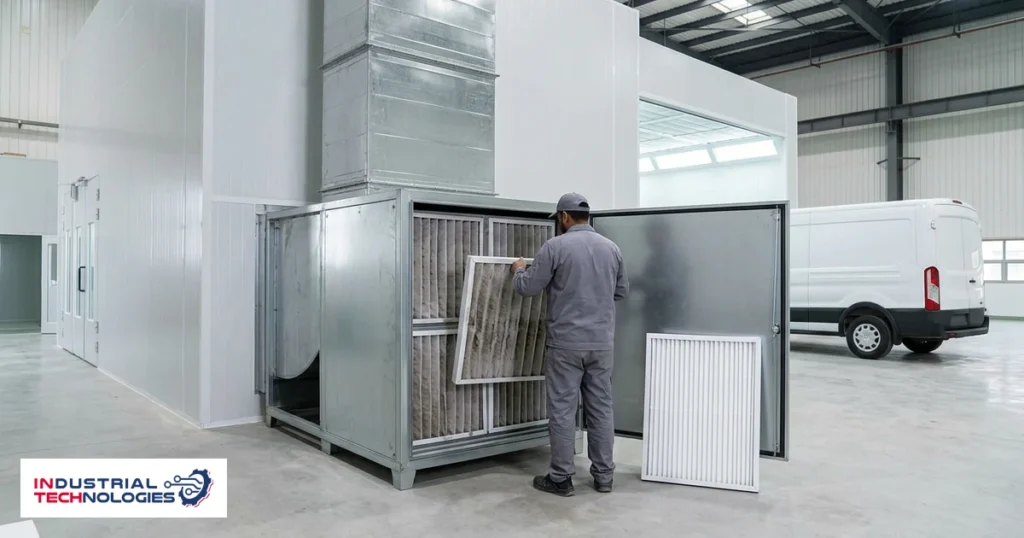
Long routes, heat and dust accelerate vehicle wear and raise service frequency. They also shorten the life of the workshop equipment’s own filters and seals — and that second half is the one forgotten at fit-out.
A courier fleet workshop is therefore studied on filtration as much as on capacity: vehicles arrive carrying a heavier dust load than usual, and filter life shortens accordingly against the imported specification sheet.
The published filtration stages
Filtration in this family is layered rather than single: stop filtration, pre-filtration, and ceiling filtration at EU3, EU4 and EU5. Where the part requires it, builds go up to three-stage bag and high-efficiency filtration at ≥98% efficiency.
| Layer | Published class | What governs its life |
|---|---|---|
| Stop filter | Holds overspray before it leaves | Spray density and cycle count |
| Pre-filter | Protects everything downstream | Dust load arriving with the vehicle |
| Ceiling filtration | EU3 · EU4 · EU5 | Running hours and incoming air quality |
| Three-stage bag and high-efficiency filtration | ≥98% efficiency | Built where the part requires it |
When they get changed — and why the calendar is not enough
Replacement is computed by running hours and differs between the primary, ceiling and floor filters. Filters are typically replaced twice a year as part of preventive maintenance — a starting figure that moves upward on dusty routes, not a fixed ceiling.
The practical indicator is not the date but pressure differential across the filter. A rising differential means the fan is working harder and energy consumption has already climbed, before anything shows on the finished panel.
What that puts into the fit-out
- Local filter availability — a filter ordered from abroad stops the cabin until it lands
- Easy access to filter positions — frequent replacement turns awkward access into an annual cost
- A written replacement schedule — because it belongs in the fleet’s preventive maintenance record, not in a technician’s memory
These are configuration items discussed with the proposal rather than after installation, because dust and heat are what will decide downtime in year three.
Common questions
How often do filters actually get changed?
Twice a year is typical within preventive maintenance, and the figure moves with running hours and the real dust load on your routes. A fleet working desert routes changes more often than that norm, not less.
Is a higher filtration class always better?
Not always. A higher class delivers cleaner air and resists flow more, so it is selected by what the part and the coating require rather than by its number alone.
What do filters have to do with finish quality?
A saturated filter passes particles that settle on wet coating and show as specks in the finish. The cost of a late filter appears in rework, not on the filter invoice.
Do the layers share one schedule?
No. Primary, ceiling and floor filters each carry their own schedule because each receives a different load.
Related reading
Next step
Send your vehicle count, the nature of your routes and expected workshop running hours, and we will come back with a filtration configuration and a replacement schedule built on them. Talk to a specialist. The sector challenges sit on the fleet sector page.