
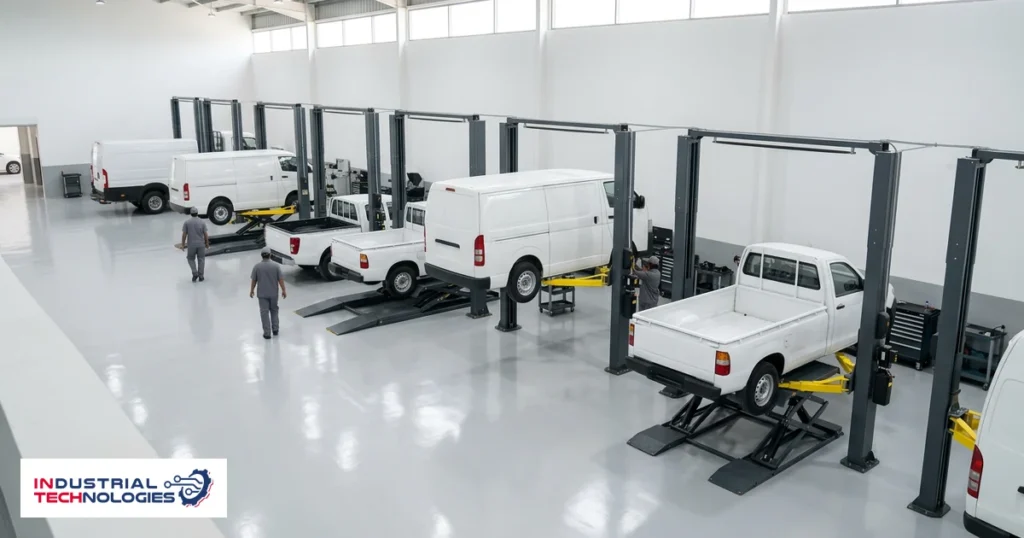
A distribution fleet is rarely one vehicle type. The same operation runs a saloon for a rep, a van carrying light loads, and a heavier commercial unit on the long routes. Each imposes a different number on the workshop.
So a distribution fleet workshop is specified from the fleet mix rather than from an equipment list: identify the heaviest unit, the longest one, and the type you run most, then build the capacity and height range around that distribution.
Why the average fails
The arithmetic average of a mixed parc describes no vehicle in it. A lift bought on the average covers half the fleet and sends the other half outside for repair — which reinstates the downtime the workshop was built to remove.
The published rule is explicit: capacity is built on the heaviest unit, not the average, and a mixed fleet usually needs more than one capacity spread across bays rather than a single capacity imposed on all of them.
| Item | Published range | What governs it |
|---|---|---|
| Lift capacity | 1,200–4,500 kg depending on the model | The heaviest unit in the parc |
| Lift height | 600–1,999 mm depending on the model | Daily repetition of underbody work |
| Electrical power | 2.2–3 kW | The published model |
| Lowest surface mount | From 125 mm on scissor models | Building height and slab thickness |
Four numbers decide whether the building works
Before any equipment is chosen, the building itself is measured. Four numbers decide it: clear height, slab thickness, available supply voltage and air pressure. These four determine which models can be installed at all, before anyone debates which one suits the work.
The lowest surface-mounted installation on the published scissor models starts at 125 mm, and that figure widens the options inside existing warehouses that were never built as workshops.
Where the booth sits in a distribution operation
If the fleet carries a livery, refinishing in house keeps the colours consistent and shortens the time a vehicle spends out of service. Size decides the form: the INTECH internal cabin of 6,900 × 4,000 × 2,650 mm takes passenger vehicles, and anything beyond it — vans and commercial units — is built to order starting at 8,000 mm of internal length.
Common questions
Our parc runs cars and vans. Do we need two capacities?
Usually yes. The published range runs 1,200 to 4,500 kg, and spreading capacities across bays serves a mixed parc better than forcing one capacity on every bay.
Can the workshop go into an existing warehouse?
Often yes, and the four numbers above decide it. Clear height is the most decisive because, unlike voltage and air pressure, it cannot be changed later.
Does a distribution operation need a paint booth?
It depends on whether the fleet carries a livery and takes repeated operational damage. A fleet repainting vehicles regularly benefits from having the booth in house; one doing it once a year does not justify it.
What do you need from us to start?
The fleet mix, the vehicle count and the floor area available. Those three produce the bay layout and the equipment list.
Related reading
Next step
Send your fleet mix, vehicle count and available floor area, and we will come back with a bay layout and an equipment list built on the heaviest unit you run. Talk to a specialist. The published detail sits on the fleet sector page.