
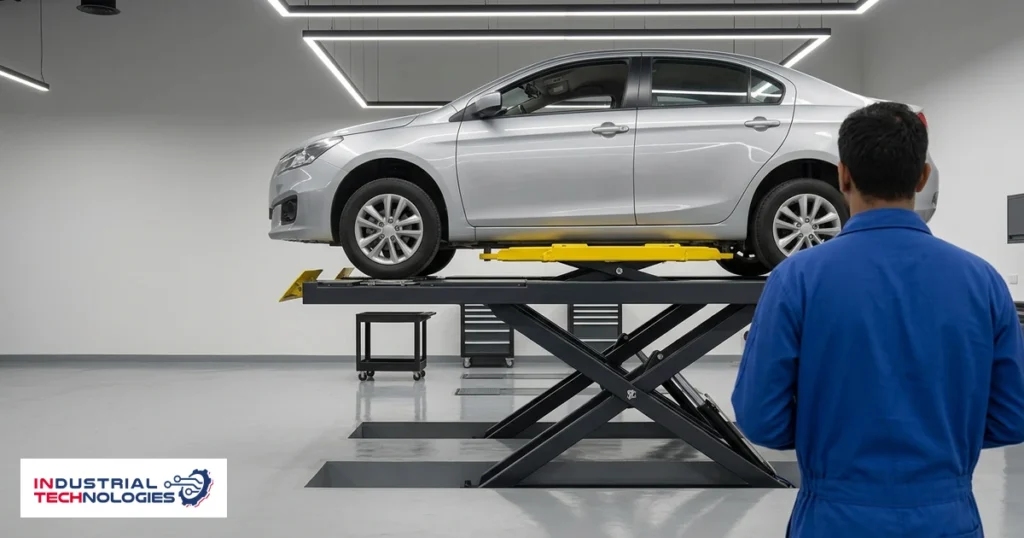
A scissor lift is bought on capacity and lived with on geometry. The number that decides whether a given vehicle sits properly on it is not how much it lifts but how long and how wide the platform is.
Getting scissor lift platform sizing right is what separates a bay that handles your whole vehicle mix from one that handles most of it and improvises for the rest.
Adjustable length solves a real problem
Wheelbases vary across the vehicles that enter a general workshop, and a fixed platform is a compromise struck once for all of them.
The small platform model publishes an adjustable platform length from 1560 to 1760 mm, described specifically as suiting different wheelbases. It also publishes the highest lift height in the family at 1999 mm with 4000 kg capacity.
Adjustment matters most where the vehicle mix is unpredictable. A single-marque service centre knows its wheelbases; an independent workshop does not, and pays for that uncertainty in every awkward setup.
Width follows vehicle class
The highest-capacity small-platform model publishes 4500 kg with a platform width of 720 mm and 1880 mm lift height.
Its published positioning explains the width: it is for the workshop that receives four-wheel-drive vehicles and pick-ups rather than passenger cars alone. Wider tires and wider sill spacing need platform to sit on.
This is the point where capacity and geometry have to be read together. A platform rated for the weight but too narrow for the track leaves the vehicle supported at the edges — a configuration nobody specifies on purpose and many arrive at by accident.
Height at rest and height at work
Two heights are published for each model and they answer different questions.
Starting height decides whether a low vehicle can drive on. The published figures span 110 mm, 125 mm and 135 mm, and the lowest is documented as allowing low vehicles to drive on without additional ramps.
Lift height decides what work is possible once up. The published range runs from 600 mm on the ultra-thin model — documented as intended for wheel, brake and suspension work that does not require standing beneath the vehicle — to 1999 mm on the small platform model.
Specialist platforms are a separate case
Not every platform in the family lifts vehicles. The EV battery platform publishes 1200 kg capacity, 1800 mm lift height and a platform of 1350×790 mm.
Here platform dimensions are a compatibility specification against a component rather than a vehicle, and the published tilt function — forwards and backwards, electro-hydraulically, to align mounting bolts — exists because a flat platform alone does not complete the job.
Platform figures across the family
The published figures, grouped by the work each platform is documented for:
| Model | Published figures | Documented work |
|---|---|---|
| Small platform — adjustable | Length 1560–1760 mm · lift 1999 mm · 4000 kg | Different wheelbases; highest lift in the family |
| Small platform — highest capacity | 4500 kg · width 720 mm · lift 1880 mm | Capacity over reach |
| Ultra-thin | Starting heights 110 · 125 · 135 mm · lift 600 mm | Wheel, brake and suspension work without standing beneath |
| EV battery platform | 1200 kg · lift 1800 mm · platform 1350×790 mm | Battery pack handling |
Common questions
Is a larger platform always safer?
Not automatically. What matters is that the vehicle’s designated lift points land on supported area. An oversized platform in a narrow bay also costs floor space and access, both of which have operational value.
Can one lift cover a mixed fleet?
Often yes, with adjustable length. Where the mix spans passenger cars and heavier four-wheel-drive vehicles, capacity and width usually decide it before length does — see the family page for the published range.
Does adjustable length need tools?
That is a per-model operational detail worth confirming at quotation stage, because an adjustment that needs tools will be made once and left, which removes the benefit you paid for.
What to send with your enquiry
Your wheelbase range, the widest and heaviest vehicles you handle, the lowest vehicle that must drive on, and the work performed at height. Then request a quotation.