
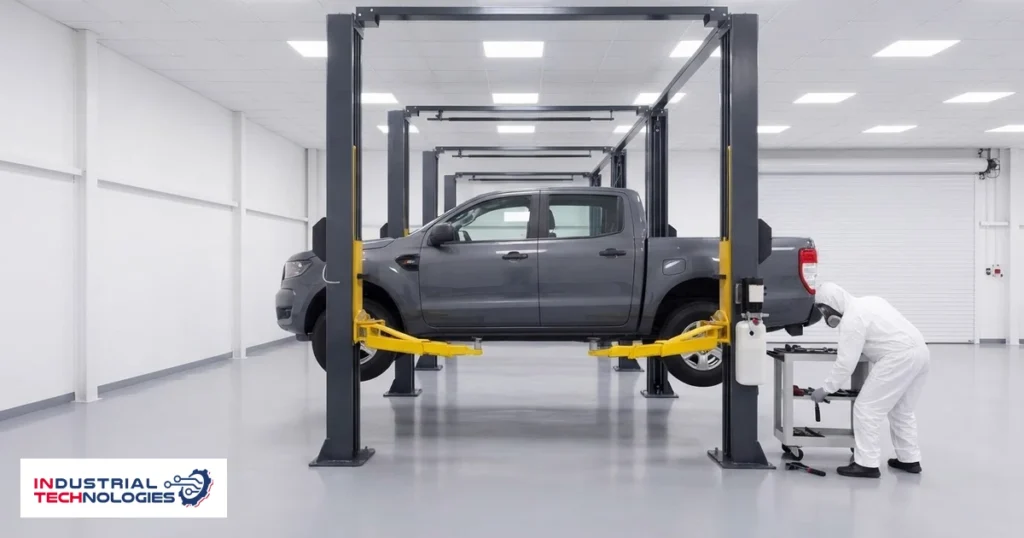
Every clear floor lift bay layout drawing looks fine until a technician tries to walk from the front of the vehicle to the back while carrying something in both hands. What stops them is usually a base frame.
The clear floor two post lift removes that obstacle by design, and the consequences run further into daily operation than the phrase suggests.
What “clear floor” actually removes
The published description across the two-post models in the family is a floor completely free of cross members, with the technician passing beneath the vehicle without a floor obstruction.
The overhead arrangement relocates the synchronisation path from the floor to the top of the posts. That is the whole trade: you gain an unobstructed floor and you accept a structure overhead, which is why clear height becomes a specification question the moment you choose this type.
The published models sit at 3700 mm and 3900 mm, which is exactly the dimension a building has to accommodate.
Drive and synchronisation are not one method
The published models differ in how the carriage is driven and how the posts stay level with each other, and the difference is documented rather than implied.
The compact model is published with a direct cylinder drive and no chain: the hydraulic cylinder pushes the carriage itself, so there is no chain in the lift path to inspect or re-tension.
The taller model uses a twin cylinder chain drive with steel wire synchronisation between the posts, and is published as intended for a bay lifting more than ten vehicles a day. The wire links post movement mechanically so both sides stay at one height even with an off-centre load.
The lock question
The published models lock their arms automatically on a built-in toothed ratchet, and one handle on one side releases the locks on both posts at once. Those two lines are what to read carefully in any lock specification.
Arm locks matter because the arms are set under every vehicle, by a technician working at pace. A lock that engages by itself on a toothed ratchet removes the step that is easiest to skip, and it is the same across the published models.
The polymer slider on the post track is a related design choice: it runs without periodic greasing and does not score the track, so post maintenance drops and movement stays quiet across thousands of cycles.
Where this type does not fit
An honest limit is more useful than a general recommendation. This type needs overhead clearance, and a building with low clear height or overhead services in the wrong place cannot take it.
For those sites the family page documents scissor models installed on the floor surface with a minimum of 125 mm and ultra-thin models with starting heights of 110 to 135 mm — no pit, no overhead structure, and a different kind of access underneath.
What differs and what is shared
The building constraint is the figure that differs; the performance figures do not:
| Item | Published | Note |
|---|---|---|
| Overhead clearance | 3700 mm and 3900 mm on the published models | Exactly the dimension the building must accommodate |
| Capacity | 4500 kg | Shared across the published models |
| Lift height | 1990 mm | Shared across the published models |
| Cycle time | 50 s up · 30 s down | Shared across the published models |
| No-pit alternatives | Scissor at 125 mm minimum · ultra-thin starting heights 110–135 mm | No pit, no overhead structure |
Common questions
Does the overhead beam limit vehicle height?
It sets the ceiling for the vehicle plus its lift height, which is why the model heights are published as distinct figures. Compare your tallest vehicle against the model height and your building’s clear height against both.
Which model suits a high-throughput bay?
The published positioning is explicit: the model with chain drive and wire synchronisation is described as intended for bays lifting more than ten vehicles a day. Cycle counts, not capacity, separate them.
What are the shared figures?
The published models share 4500 kg capacity and 1990 mm lift height, with 50 seconds up and 30 seconds down. The differences are in height, drive and synchronisation, not in what they lift.
What to send with your enquiry
Clear building height including any overhead services, floor slab thickness, daily lift count, and the heaviest and widest vehicles you handle. Then request a quotation.