
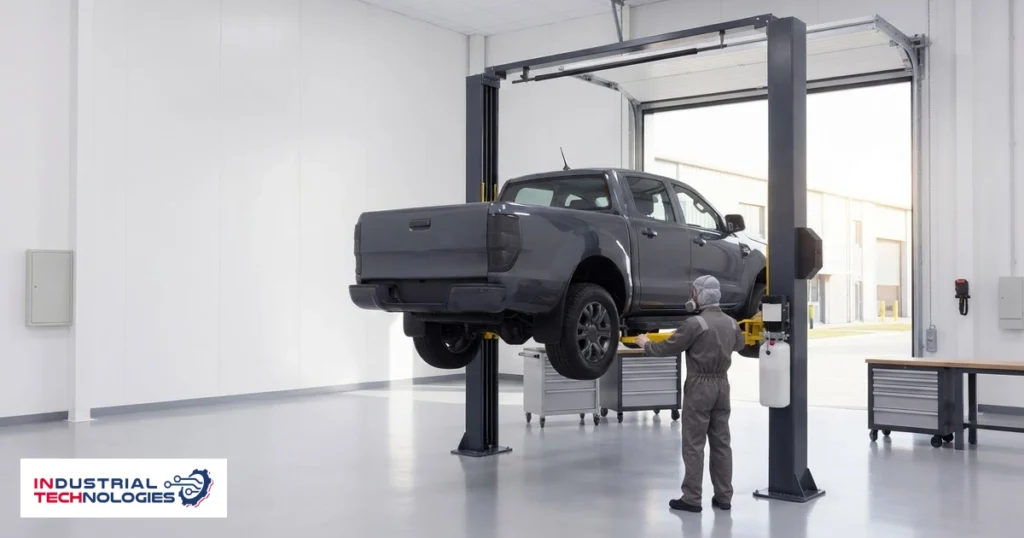
Capacity gets compared. Arms rarely do. And yet the arm assembly is what decides whether a given vehicle can actually be lifted safely on the lift you bought.
A two post lift arm configuration behaves like a compatibility list: it determines the range of wheelbases and body shapes a bay can accept without improvisation.
Stage count is reach
The arm is the line a specification sheet most often compresses into a single word, so ask for it by name at quotation: how many telescoping stages each arm has, and whether arm extensions come as standard supply.
Stages are telescoping sections, and their count sets how far the pad can travel from the post. A short-reach arm on one side and a long-reach arm on the other is not a manufacturing quirk — it is how a lift reaches asymmetric pickup points on a vehicle that is not centred in the bay.
Extensions matter for the opposite case: a vehicle whose lift points sit further out than the arm’s normal travel. Having them listed as standard supply rather than as an accessory is worth checking in any comparison, because they are the item most often discovered missing on the first awkward vehicle.
Pads are the contact patch
The pad is the second line worth asking for by name: what it is made of, and how many stages of height adjustment it has.
Height adjustment exists because vehicles do not present their lift points at a common height. Body cladding, side steps and underbody protection all change where the pad must sit, and a pad that cannot be raised to clear them is a pad placed somewhere else — which is how sills get crushed.
Rubber rather than bare steel is the second half of the same point: it protects the contact area on a painted or plastic-clad underbody and provides friction that a metal-to-metal contact does not.
Inner width sets vehicle access
On the published SHL-2-245L the inner width — the clear distance between the posts — is 2860 mm.
That distance limits the width of vehicle that can enter the bay and the door opening angle after lifting. Measure your widest vehicle with its doors open against it, and leave the technician working room on both sides instead of colliding with the post.
Door opening angle is the detail that reveals itself on day one of live work, and never appears in a capacity comparison.
What the arms sit within
Arm configuration is read alongside the rest of the model’s published specification. Across the two-post models in the family the figures are 4500 kg capacity, 1990 mm lift height, and 50 seconds up and 30 seconds down.
Lock release is the last line to confirm: manual or automatic. Manual release keeps unlocking a deliberate operator action rather than an automatic event, which some workshop safety procedures require where more than one technician works around a single vehicle.
Published two-post lift figures
What differs between models, and what is shared across the family:
| Item | Published | What it decides |
|---|---|---|
| Inner width between posts | 2860 mm — SHL-2-245L | Vehicle width and door opening once raised |
| Overall height | 3700 mm and 3900 mm | The figure that differs between the two-post models |
| Capacity | 4500 kg | Shared across the two-post models |
| Lift height | 1990 mm | Shared |
| Cycle time | 50 s up · 30 s down | Shared |
| Scissor alternative | Platform length adjustable 1560–1760 mm | A different solution to wheelbase variation |
Common questions
Do arm extensions reduce capacity?
Load behaviour changes with reach on any lifting arm, and the governing figures are those the manufacturer publishes for that configuration. Ask for them explicitly at quotation stage rather than inferring from the headline capacity.
Is a scissor lift an alternative?
For different work, yes. The family page covers scissor models with platform lengths adjustable from 1560 to 1760 mm — a different way of solving the same wheelbase-variation problem.
What does this change about site preparation?
Bay width, not just floor slab. The inner width between the posts only helps if the bay around the columns is clear, and that is a layout decision made before the lift is ordered.
What to send with your enquiry
The widest vehicle you handle, your typical wheelbase range, clear bay width, and whether the bay is shared by more than one technician. Then request a quotation.