
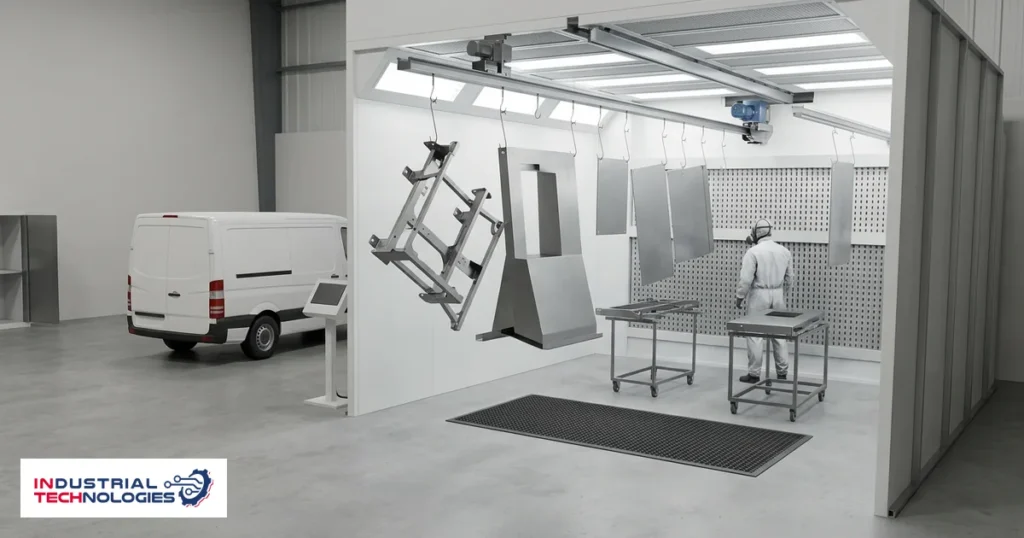
A vehicle enters the booth on its own wheels and parks. An industrial part does none of that: some parts hang, some ride a conveyor, some sit on a stand. That single difference changes chamber height before it changes anything else.
This is why part hanging inside the chamber belongs in the first set of inputs rather than in the installation phase. What this family delivers for industrial work includes provision for hanging or moving parts inside the cabin, and internal height runs from 2650 to 6000 mm.
Why hanging comes before the height calculation
Chamber height is not part height. It is part height, plus whatever sits above it — a frame, a chain, a conveyor rail — plus the distance descending air needs before it meets the surface. A one-metre part hung from the roof therefore asks for more internal height than the same part sitting on a floor stand.
Three loading methods, three different consequences
| Loading method | What it settles | What to send |
|---|---|---|
| Hung from above | Internal height and the layout of hanging points | Part height plus the height of the frame above it |
| Conveyor through the chamber | Opening positions and chamber length | Conveyor path, speed and direction of travel |
| Floor stand or trolley | Chamber width and movement space around the part | Stand dimensions and the technician’s standing space |
The delivered size range for this sector
Delivered industrial configurations start at a 3000×3000×3000 mm cabin for powder coating curing and extend to 5700×3700×3000 mm for industrial baking ovens and above, with anything beyond built to order within a range reaching 24,000 mm long.
Frequently asked questions
Is the hanging arrangement fixed before manufacture or after?
Before. Hanging points and conveyor openings are part of the chamber structure itself, and adding them afterwards means cutting into a finished wall. They are fixed alongside the internal size at the configuration stage.
What needs to be sent to settle this item?
The largest part’s dimensions and weight, and how it is loaded: hung, conveyed or on a stand. Internal height, opening positions and hanging-point layout are derived from those three.
Does airflow direction change with the loading method?
The loading method sets where the part stands inside the chamber and how much space air has around it. Extraction direction is settled with the internal size during configuration rather than by a general rule applied to every booth.
Does a heavy part need a different arrangement?
Yes. Weight decides whether the part is hung at all or moved at floor level, which is why weight is quoted alongside size in the first set of inputs rather than after them.
Related reading
- The industrial coating heat curve
- Booth cycle time and line takt
- Continuous shift booth operation
- Fire requirements for wood dust
Next step
Send the dimensions and weight of the largest part or platform to be coated, together with your site area, and the internal size and configuration come back against them. Talk to a specialist. The published range sits on the paint booths family page, and the sector configuration on the Industrial & Manufacturing sector page.