
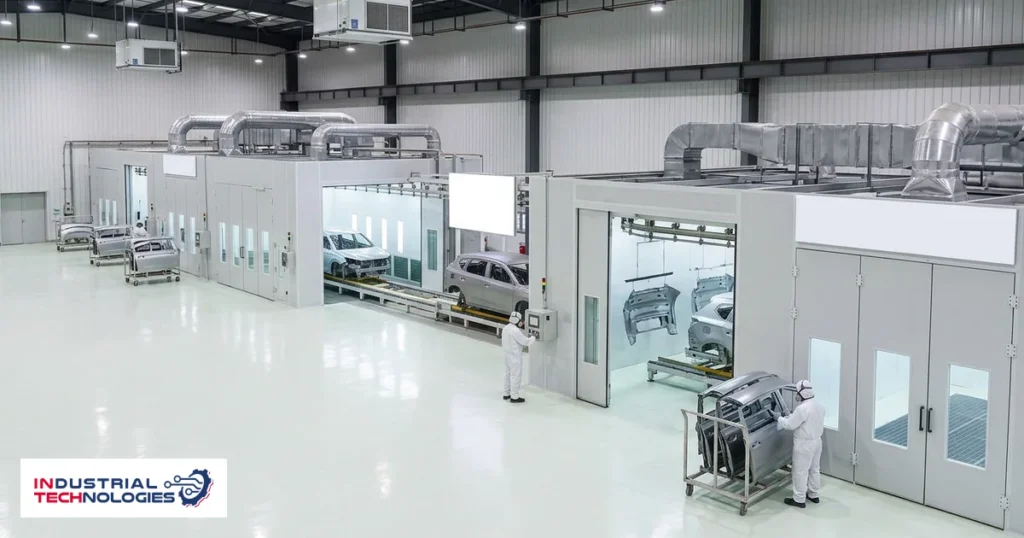
The difference between a repair workshop and an assembly plant is not size but rhythm. A workshop paints a vehicle when it arrives; a plant paints one every fixed number of minutes and cannot absorb a late one.
Vehicle assembly plant finishing starts from that rhythm: finishing cycle time must equal line takt or fall below it, or finishing becomes the bottleneck.
Throughput before specification
We ask for target throughput before specifying the chamber, because finishing that cannot keep up cancels the benefit of every improvement upstream. A chamber far faster than the line is idle capital the plant pays for monthly.
The arithmetic is simple: vehicles per hour gives you the permitted time per cycle, and that figure is the input on which extraction capacity and the heat curve are built.
| Input | What follows from it |
|---|---|
| Target throughput | Permitted cycle time |
| Longest vehicle on the line | Internal length and height |
| Shifts per day | Durability criterion, maintenance and spares |
| Coating material | Heat curve and filter class |
| Line stages | Number of chambers and prep/spray separation |
Continuous operation changes the criterion
A plant runs the chamber across connected shifts, and in that pattern durability, ease of maintenance and spare parts availability outrank the catalogue maximum.
The reason is operational: a finishing chamber that stops in a plant halts a line, not a station. So filtration, maintenance schedules and critical spares are discussed alongside the specification rather than after handover.
Separating preparation from spraying
A preparation and mixing room with its own extraction precedes the spray chamber and protects the surface from plant-floor contaminants. The separation is physical rather than procedural, because procedure alone does not stop dust generated in the hall.
Controlled environment where the material calls for it
Some assembly-line coatings are applied inside an operating window their supplier defines. Temperature and humidity control together is delivered on custom builds whose coating requires a controlled environment, set per project.
Frequently asked questions
How do I calculate the cycle time I need?
From target throughput: divide vehicles per hour by batch capacity inside the chamber, and the permitted time per cycle appears. That figure is the input and the chamber is built to meet it.
How many chambers does the line need?
It depends on your stages and the time each takes. We fix the number after reviewing rhythm and stages together, because one slow chamber equals a stopped line.
Will it take continuous shifts?
Continuous running shifts the criterion from peak specification to durability, maintainability and spares availability. Send shift count and running hours so the specification is built on your actual pattern.
What size range is available?
The published range runs from 3000 to 24,000 mm long and 2650 to 6000 mm high, taking vehicles and assembly lines. Final size is built on the longest vehicle on your line.
Related reading
What to do next
Send target throughput, the longest vehicle and shift count, and we will return a specification built on your line rhythm. Request a quote. Sector detail is on the auto dealers industry page.