
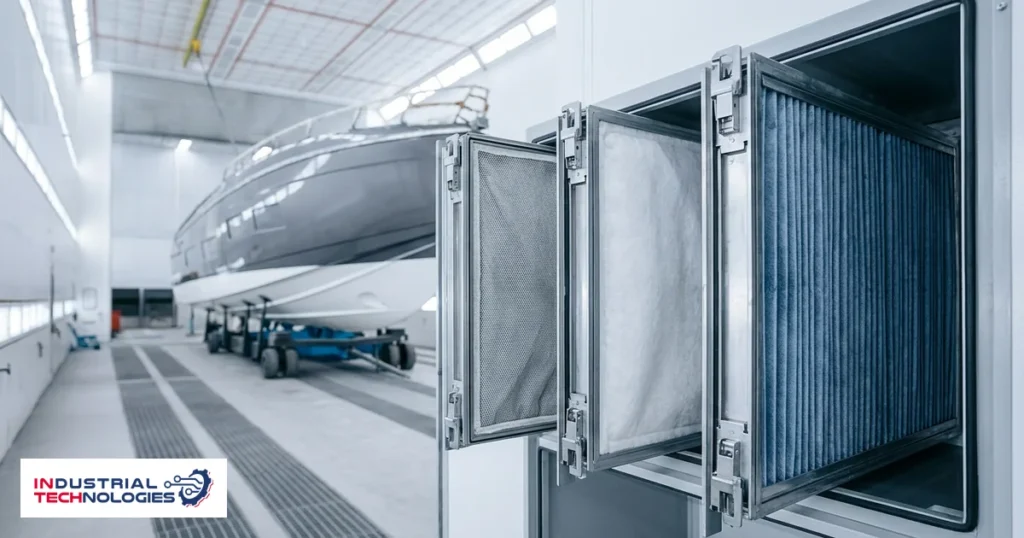
Filtration in a paint booth is usually described by a single class. In large chambers it is described by a number of stages instead — and that is a difference in structure, not in grade.
What is published for large-structure chambers is three stage bag high-efficiency filtration at 98% efficiency or better, while smaller classes are served by arrestor, pre- and ceiling filtration at EU3, EU4 and EU5.
Why three stages rather than one harder stage
A single high-efficiency stage placed directly in the incoming air blinds quickly. A graded sequence lets each stage protect the next: the first stops the coarse particles, the second cleans what got past it, and the third carries the final load. The result is that the most expensive stage lasts longest, because less reaches it.
What is published in this family
| Chamber class | Published filtration |
|---|---|
| The family generally | arrestor, pre and ceiling at EU3, EU4 and EU5 |
| Top of the family range | up to three-stage bag and high-efficiency filtration at ≥98% |
| Large-structure chambers | three-stage bag and high-efficiency filtration at ≥98%, plus gas monitoring and static discharge |
| Accompanying air capacity | up to 190,000 + 190,000 m³/h |
Filtration and airflow are linked figures
Raising the filter class raises resistance to airflow, so the system needs more power to hold the same throughput. Filtration, air capacity and electrical power are therefore read together at configuration: the published power range runs from 11 to 50 kW, with large chambers at its upper end. Filter class is set with the configuration rather than after installation, because changing it later changes the whole flow calculation.
Consumption is an operating item planned early
Three stages mean three consumable lines on three different change intervals. The first stage is changed more often than the last by virtue of where it sits, and that is planned with a change schedule and a parts holding rather than handled as a reaction to blinding. The filter box also needs access space around it at change-out, which is part of the published service space required around the booth.
Frequently asked questions
Are three stages required on every large chamber?
They are published as a configuration for large-structure chambers, and the written limit is “up to three-stage” rather than “three stages always”. The class is set by coating type, finish level and project requirements, not by the sector alone.
What does 98% or better mean?
It is the published efficiency for the high-efficiency stage in this configuration, written as a floor because the grade actually supplied may be higher depending on what is approved in the final configuration.
Are replacement filters available locally?
Filter availability is reviewed with the configuration because it governs operation rather than installation. Send your expected duty cycle and we will settle the consumable lines and lead times with you before the class is approved.
Does this class carry an additional safety item?
Yes. The published large-structure configuration includes gas monitoring and static discharge alongside the filtration, and neither appears in the description of the smaller classes.
Related reading
- Large Enclosure Ventilation
- High-Efficiency Filtration in Paint Booths
- Hull Coating Enclosure
- Special finishes for defense equipment
What to do next
Send the coating you use, the finish level required and the chamber volume, and we will come back with a stage sequence and classes built on your work, together with the consumable lines that follow. Talk to a specialist. The published configuration sits on the paint booth family page.