
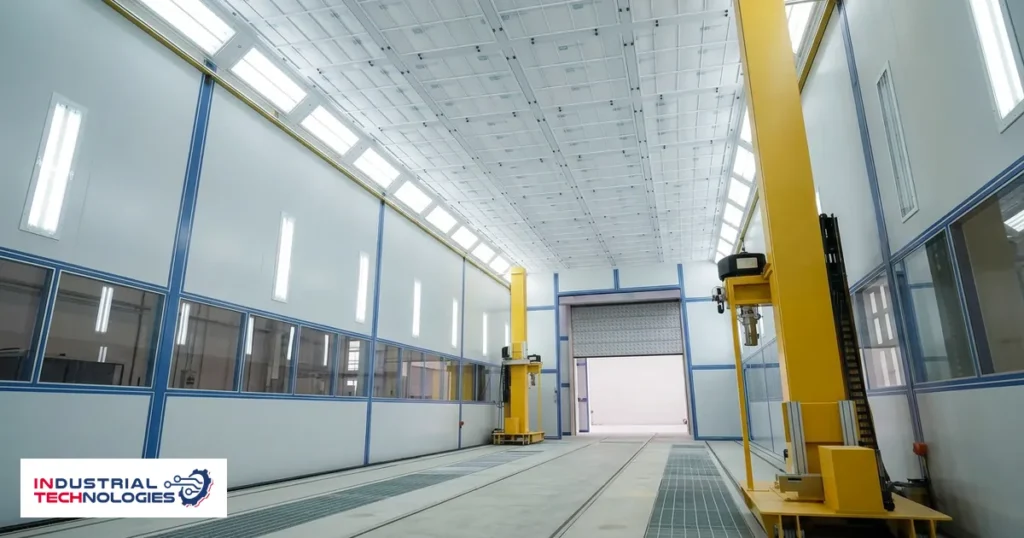
As a chamber grows, the ventilation question changes from “how much airflow does the part need” to “how often is the air in this volume replaced”. The second question is the one the design is actually built on.
So large enclosure ventilation is read from chamber volume rather than from the surface area of the structure inside it. That is the fundamental difference from an automotive booth: the volume is many times larger, and the part occupies a smaller share of it than people expect.
The figure is written as a pair for a reason
The published range in this family runs from 18,000 to 190,000 m³/h, and the full wording matters: per supply or extraction set. Large-structure chambers are delivered with two sets, which is why the figure for that class is written 190,000 + 190,000 m³/h rather than as a single number.
| Item | Delivered range |
|---|---|
| Air capacity per set | 18,000 – 190,000 m³/h |
| Large-structure chambers | up to 190,000 + 190,000 m³/h |
| Heat output | 200,000 – 600,000 kcal/h |
| Electrical power | 11 – 50 kW |
| Filtration in this class | up to three-stage bag and high-efficiency filtration at ≥98% |
Ventilation and fire are read together, not apart
The published regulatory considerations for this sector put ventilation and fire requirements for large-volume coating chambers in a single line. The reason is practical: the airflow that keeps the spray environment usable is the same airflow that holds vapour concentration below the limit, so losing one loses the other. A third item accompanies them in this class specifically — gas monitoring and static discharge, both published within the large-structure configuration and absent from the description of smaller classes.
The stack is a site item, not a chamber item
Stack height and position follow the size and the site together. A hull-scale chamber needs duct runs for exhaust ventilation and the burner flue, and those are fixed during the site survey rather than after installation — changing them once the chamber is built means rerouting the ducting entirely.
Frequently asked questions
Is one set enough for a hull-scale chamber?
The range is published per set, and the number of sets follows chamber volume and the approved configuration. That decision is taken with the other configuration items before manufacture, not after.
Which regulatory requirements apply at this size?
Three are published for this sector: ventilation and fire requirements for large-volume chambers, disposal of coating, solvent and stripping waste under the applicable environmental requirements, and SASO conformity for imported equipment. The detail varies by city and by where the facility sits.
Does higher airflow raise filter consumption?
Yes, because the mass of air passing through is greater. Filter class and air capacity are therefore read together at configuration, and the class is set with the configuration rather than after installation.
Which heating system suits a volume of this size?
Five systems are delivered in this family: diesel, gas, electric heating, heat pump, and short-wave infrared. The choice follows the coating type and the cost of energy on site.
Related reading
- Three Stage Bag High-Efficiency Filtration
- Hull Coating Enclosure
- Spray Booth Fire Safety Requirements
What to do next
Send the internal size your part imposes and where the chamber sits in the facility, and we will come back with an air capacity and heat output calculated from the volume rather than estimated. Talk to a specialist. The regulatory considerations for this sector sit on the sector page.