
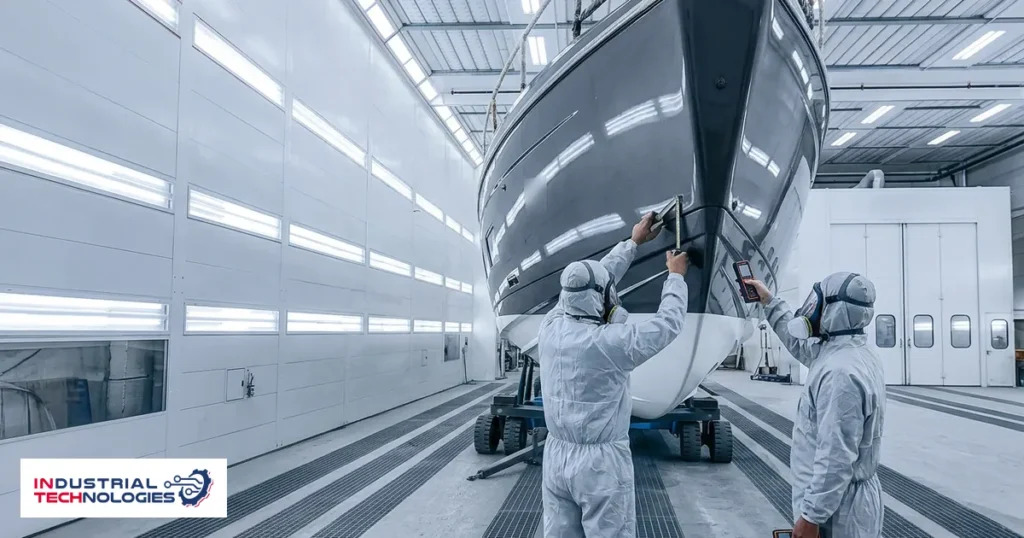
The sector page states the limit plainly: a yacht hull exceeds the length, width and height of any stock model. That is a design sentence, not a marketing one — it means the enclosure is drawn after the hull is measured, never before.
So a hull coating enclosure begins with three figures sent ahead of any concept: overall length, beam at the widest point, and height from the keel to the highest surface being coated.
A hull is measured on the cradle, not in the water
Afloat, half the hull is hidden. On a cradle the whole of it is exposed, and the cradle’s own height is added underneath. The internal height needed is therefore the sum of three things: cradle height, hull height from keel to deck, and spraying clearance above. That order explains why a hull of moderate length lands at the upper end of the height range rather than in the middle of it.
The range that takes a hull
Chambers delivered for this class start at 16,000 mm and extend to 24,000×20,000×6,000 mm. The distance between those two ends is not only a difference of volume — every configuration item that follows changes with it.
| Item | Published automotive envelope | Large-structure chambers |
|---|---|---|
| Internal chamber | 6900×4000×2650 mm | 16,000 mm up to 24,000×20,000×6,000 mm |
| Air capacity | within 18,000 – 190,000 m³/h per set | up to 190,000 + 190,000 m³/h |
| Filtration | arrestor, pre and ceiling EU3–EU5 | up to three-stage bag and high-efficiency filtration at ≥98% |
| Main door | from 3000×2600 mm | up to 14,200×5,000 mm powered |
| Wall | 50 mm insulated panel | 1.5 mm galvanised sheet on large cabins |
Width is the figure people forget
Length always arrives; width often does not. A hull is a wide object at its middle, and the operator has to walk around all of it at a constant spraying distance. The internal width required is therefore the beam plus twice the working clearance, not the beam alone. The published width range extends to 20,000 mm, which is what carries that arithmetic.
Frequently asked questions
Do you supply other marine workshop equipment with the enclosure?
No. What we actually supply to this sector is made-to-order paint booths for ship and yacht products. Other marine workshop equipment is not listed because it is not confirmed.
Why are large cabins built in galvanised sheet rather than panel?
Two wall builds are published in this family: 50 mm insulated panel with EPS, rockwool or glass wool, or 1.5 mm galvanised sheet for large cabins. The choice follows the size.
What heat output accompanies a chamber this size?
The delivered range in this family runs from 200,000 to 600,000 kcal/h, and large chambers sit at its upper end. The final figure follows chamber volume rather than hull surface area.
Does the whole vessel have to go in at once?
That is a process question rather than a sizing one. Some work is done on the complete hull and some on sections coated separately and then fitted. Send your process stages with the dimensions, because the answer changes both the chamber count and its size.
Related reading
What to do next
Send the overall length, the beam at its widest point and the hull height on its cradle, and we will come back with an internal size and air capacity derived from your hull rather than from a model. Talk to a specialist. The confirmed scope for this sector sits on the aerospace, marine and rail sector page.