
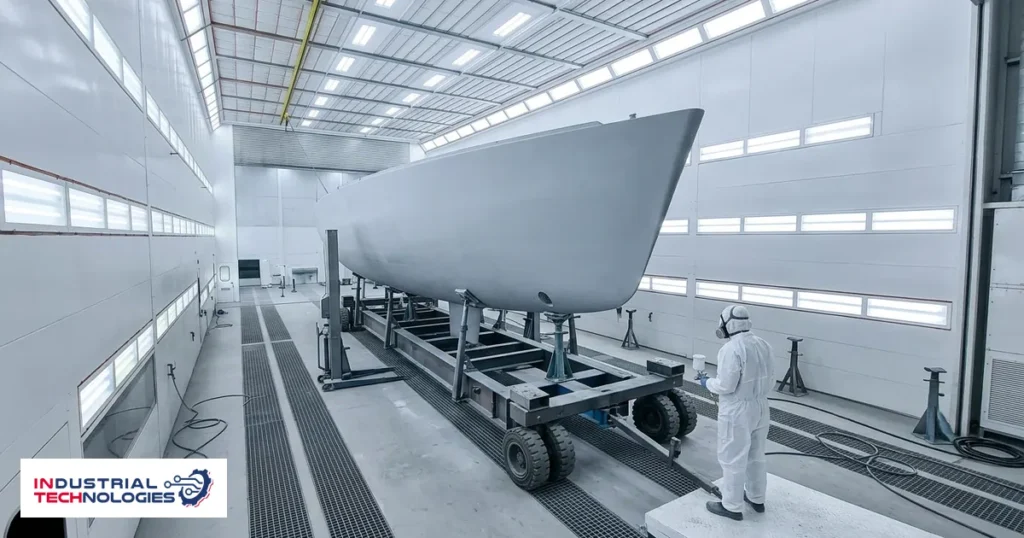
The figure that arrives first in a boat enquiry is hull length. It is the one number that does not, on its own, set the chamber.
A boat does not stand on its own keel. It comes in on a trailer or a cradle, so a boat finishing booth is measured on the base the hull sits on rather than on the hull itself — in length, in width and above all in height.
Three dimensions shift before the hull goes in
Length grows by the trailer drawbar and by the door swing behind it. Width grows by working room on both sides, and by more than it looks, because a hull curves away from the operator as it falls towards the keel. Height grows by the cradle itself, which lifts the highest point of the hull half a metre or more off the floor before any spraying clearance is counted.
The published range starts smaller than assumed
Marine work is usually discussed at the top of the range, where large structures sit. The delivered range in this family also has a bottom end, and that bottom end is what actually serves small craft.
| Item | Bottom of the delivered range | Top of the delivered range |
|---|---|---|
| Internal length | 3000 mm | 24,000 mm |
| Internal width | 3000 mm | 20,000 mm |
| Internal height | 2650 mm | 6000 mm |
| Main door | 3000×2600 mm | 14,200×5,000 mm powered |
| Air capacity | 18,000 m³/h | 190,000 m³/h per set |
A craft that arrives on an ordinary road trailer usually lands between those ends rather than at either of them — closer to the automotive envelope than to large-structure work. The INTECH internal chamber is 6900×4000×2650 mm, which makes a useful yardstick: if your craft on its trailer fits inside that with working room around it, you are in the small end of the range.
The door is the second constraint
A craft on a trailer is towed in rather than driven in, and the door is measured on the widest section that passes through it — usually the trailer at its rear guard, not the hull at its beam. The published door range starts at 3000×2600 mm, which serves small craft without reaching for the large powered door.
Frequently asked questions
Is this size available as a stock model?
No. Our confirmed marine scope is made-to-order paint booths for ship and yacht products, and that applies at the small end as much as the large. Stock models are built on the automotive envelope; anything outside it is designed around the part.
What filtration class suits a small craft?
Published in this family are arrestor, pre- and ceiling filtration at EU3, EU4 and EU5, and up to three-stage bag and high-efficiency filtration at 98% or better. The class is set with the configuration by coating type and finish level, not by hull size alone.
What electrical supply is required?
380 V three-phase at 50 or 60 Hz, the same value across all documented models, with power from 11 to 50 kW depending on size and configuration.
Does prep need to be separated from spraying at this size?
It depends on your process stages. Preparation, sanding and inspection have different extraction requirements from spraying, and combining the two in one chamber compromises one of them. The chamber count is set after reviewing your stages, not before.
Related reading
What to do next
Send the craft’s length, its beam at the widest point, the height of the trailer or cradle it sits on, and your process stages, and we will come back with an internal size and door built on the base rather than the hull. Talk to a specialist. The full published range sits on the paint booth family page.