
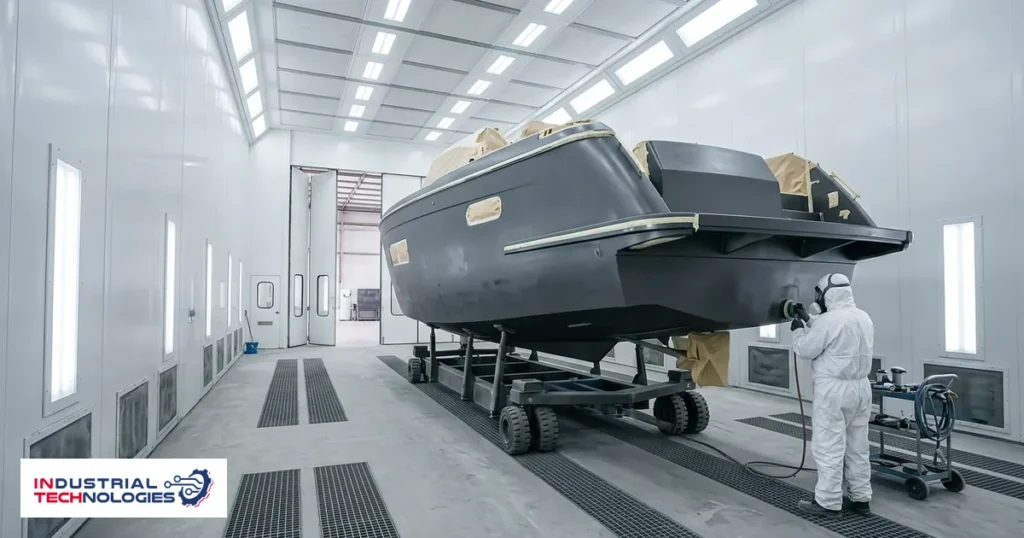
A booth is a box with a specification. A bay is a sequence: the craft arrives, is prepared, is coated, is cured, and leaves. Most of what goes wrong in small-craft work happens between those steps rather than inside any one of them.
Laying out a small craft refinishing bay therefore starts from the movement, not from the chamber. Where the craft is unloaded, where it waits, where sanding dust is contained, and where it goes while it cures all decide how many chambers the work actually needs.
Preparation and spraying are two operations
Preparation, stripping and inspection have different extraction requirements from spraying. Combining them in a single space means one of the two is done incompletely — dust from sanding lands on wet coating, or extraction sized for spraying fails to clear an abrasive load. That is why a separate preparation chamber with its own extraction ahead of the coating chamber is the published approach in this sector.
How the two chambers differ
| Item | Preparation | Coating |
|---|---|---|
| Load handled | Dust and abrasive residue | Overspray and solvent vapour |
| Extraction | Its own requirement, sized separately | Within 18,000 – 190,000 m³/h per set |
| Filtration | Set with the configuration | Up to three-stage bag and high-efficiency filtration at ≥98% |
| Heat | Not the governing item | 200,000 – 600,000 kcal/h |
| Family | Prep stations and mixing rooms | Paint booths and finishing systems |
Access decides the door before size does
A small craft is towed rather than driven, which means it needs an approach line, room to swing the trailer, and a straight run through the opening. The published door range starts at 3000×2600 mm and rises to 14,200×5,000 mm powered, but at this end of the work the constraint is rarely the door leaf — it is the space in front of it. A workshop with enough floor area on paper can still be unable to line the trailer up with the opening.
Curing occupies the chamber unless it is planned out
If curing happens where spraying happens, the chamber is unavailable for the whole cure. On short repeated cycles that is the item that caps throughput, not the spraying time. Deciding early whether the craft cures in the chamber or moves out to a holding area changes how many chambers the bay needs, and it is a cheaper decision before manufacture than after.
Frequently asked questions
Does a small workshop really need two chambers?
Not necessarily. It depends on how your stages are split and how often each runs. The chamber count is defined after reviewing the process stages, which is why we ask for those before quoting a size.
What internal size does this end of the work need?
The delivered internal range in this family starts at 3000 mm long and wide and 2650 mm high. For comparison, the INTECH internal chamber is 6900×4000×2650 mm — the automotive envelope.
Is the preparation chamber part of the same supply?
It sits in the prep stations and mixing rooms family inside the products hub, and it is configured with its own extraction requirement rather than as a smaller copy of the coating chamber.
What has to be ready on site?
A suitable concrete floor, an electrical supply matching the voltage, compressed-air runs feeding the booth, and duct runs for exhaust ventilation and the burner flue. Service space around the booth is also required, to swing the doors and reach the air handling unit and filter box at change-out.
Related reading
What to do next
Send your process stages, how craft arrive and leave, and the available floor area with its approach, and we will come back with a chamber count and layout built on the movement rather than on a catalogue size. Talk to a specialist. The published range sits on the paint booth family page.