
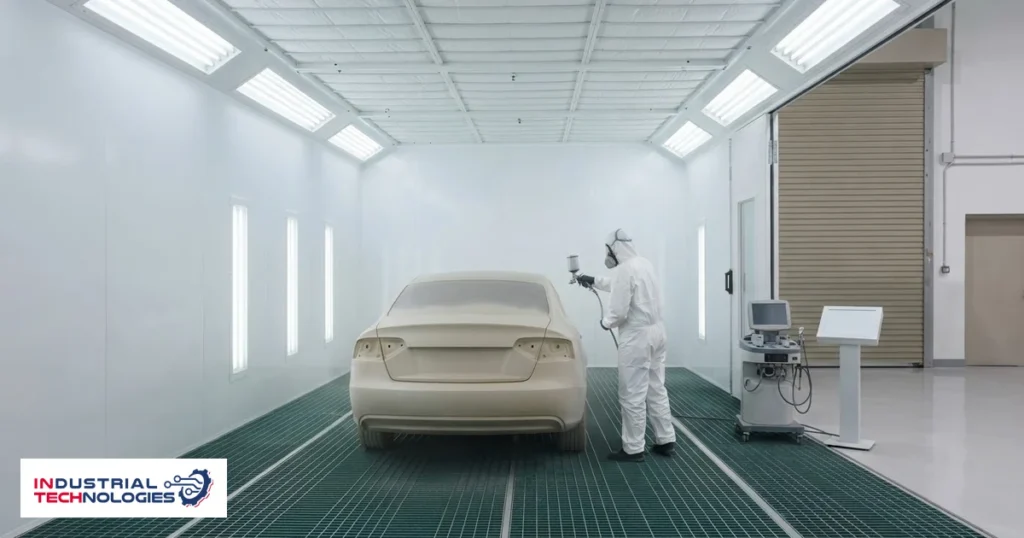
The phrase “controlled environment” is used generously in booth offers, and most of the time it means temperature alone. The gap shows at the first sensitive coating that will not accept that much.
A controlled spray environment means holding three variables together — temperature, humidity and air cleanliness — rather than one of them.
The three variables
- Temperature — governs reaction rate and time to cure, with published heat output from 200,000 to 600,000 kcal/h
- Humidity — governs solvent evaporation rate and film behaviour, and is held on custom builds whose coating requires it
- Air cleanliness — stop, pre and ceiling filtration at EU3, EU4 and EU5, up to three-stage bag and high-efficiency filtration at ≥98%
Holding two and leaving the third produces an unstable result that appears seasonally or in one batch and not another — the hardest defect class to diagnose, because the loose variable is not on the panel.
Where the operating window comes from
We do not publish one window that fits every coating, because it is not a property of the booth but a condition of your material. The window is read from the datasheet the material supplier defines, and the configuration is built on it.
So the technical conversation starts from the material sheet rather than the booth catalogue, and the window is written into the specification so it can be compared and verified.
| Input | What is derived from it |
|---|---|
| Finishing material datasheet | Required temperature and humidity window |
| Largest part size and weight | Internal size and racking system |
| Your acceptance requirements | Filtration level and documentation |
| Facility location | Expected load on the system |
| Line throughput | Permitted cycle time |
When you do not need it
Most repair workshops and collision centres do not need humidity control: temperature, ceiling filtration at the highest class offered and even flow cover them. Adding a controlled environment there is running cost with no effect on the finish.
The dividing line is not workshop size but coating material and acceptance requirements — which is why it is decided after reading the material sheet rather than before.
Where it is delivered
The controlled environment is one of the configuration items in a custom booth, like internal size, extraction direction, heating system and filtration stages — all set by the part and the nature of the industry rather than by an off-the-shelf model.
Frequently asked questions
How does this differ from a temperature-controlled booth?
The latter holds one variable. A controlled environment holds temperature, humidity and air cleanliness together, and is delivered on custom builds whose coating requires it.
Is it available on the stock models?
The stock models are built on the standard automotive size and hold temperature. An environment holding all three variables is delivered on custom builds.
What should I send first?
The finishing material datasheet. The required window is read from it, and the rest of the configuration is built on that — every other figure comes after it in order.
Does it raise running cost?
It adds load to the system, yes. That is why we recommend it only where the material, the acceptance requirements or the site conditions call for it.
Related reading
- Temperature and Humidity Controlled Paint Booth
- Humidity Effect on Paint Drying
- High-Efficiency Filtration Paint Booth
- Joinery Product Finishing Booth
What to do next
Send your material datasheet, the largest part size and your acceptance requirements, and we will return a configuration built on your material. talk to a specialist. The published range is on the paint booth family page.